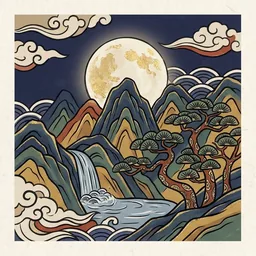
Dream of the Moon
Good on the whole: the moon is light that comes back and steadies you. A red, cloudy or falling one means something unclear or a strong feeling.
- Fortune
- Wealth
- Category
- Nature
Good or Bad Omen?
A good omen
It leans good because the moon is a light that comes back every month, so even a hidden night belongs to a pattern that returns. What can turn it is the clarity of the scene, and even then the dream moves towards a question to sit with and not towards a bad sign.
Interpretation
Dreaming of the moon is a good dream on the whole: the light that returns and steadies, with a bright full moon as its clearest form. Even a thin or waning moon belongs to that picture, since it is a stage in a cycle and not a loss. What turns the reading is how clear the scene was. A moon behind cloud, dim, red, eclipsed or falling reads as something not yet clear, or a feeling worth listening to, and not as a warning of events.
Korean dream interpretation, haemong, links the moon to the taemong, a conception dream. Tradition holds that a taemong comes around the time a child is conceived, and families have read it for the child's temperament. A bright moon appears in that lore as one of the sun, moon and star images, and the lore ties it to a daughter's or a person's brightness.
The moon is the night light that changes shape and still comes back, so it fits the parts of life that run on cycles: moods, waiting, a wish that takes a month rather than a day. Seen that way a bright moon is steadiness, a light you can find your way by, and a veiled one simply asks you to hold off a judgement until the sky clears.
In Korean Dream Lore
Korean life keeps the moon close through the lunar calendar. Jeongwol Daeboreum, the first full moon of the lunar year, is the night for dalmaji, greeting the moon as it rises: people climb a hill or step outside and say their wishes to it, and in some villages a daljip, a tall moon house of pine branches and straw, is set alight to carry ill luck away and to wish for a good harvest and peace. Chuseok, the harvest festival on the fifteenth of the eighth lunar month, brings the other great night, when families look up together and make wishes to the full moon, and the songpyeon rice cakes of the season are folded into a half-moon shape. The rabbit pounding in the moon is a figure children meet early. The children's song Bandal, the half-moon, sets that half-moon sailing across the Milky Way as a white boat carrying a cassia tree and a rabbit.
Within dream tradition itself, the moon enters through taemong lore. Apart from this lore, no consistent inherited rule for moon dreams was found, so the wider reading of a moon dream is a symbolic one and not a rule handed down.
In Japanese Dream Reading
Japan gives the moon a night of its own. Tsukimi, moon-viewing, falls on jūgoya, the fifteenth night of the old eighth month, when dango dumplings and susuki, pampas grass, are set out by a window or on the veranda in thanks for the harvest. Tsukuyomi, the moon deity, is the brother of the sun goddess Amaterasu in the old myths, and the name is often explained as moon-reading or moon-counting, which suits the lunar calendar that farmers worked by. Japan has a moon rabbit too, and it pounds mochi. Together with snow and flowers the moon makes up setsugekka, the trio of seasonal beauty, and it is the autumn member.
Japanese yume-uranai, dream fortune-telling, generally treats the moon as feeling, intuition and the feminine, a full moon as fulfilment and a crescent as a beginning, and these work as soft pointers more than rules. A lucky dream is called a kichimu and an ominous one a kyōmu, and a bright full moon is read on the kichimu side.
Readings by Situation
A bright, clear full moon
This is the clearest version of the good reading: warmth, steadiness and a wish coming into view. A full moon you could look at without effort can turn up when something awaited is nearly in sight, such as an answer, a reunion or the end of a long stretch of work. Notice whether its light felt cool or warm, because it shows how settled you feel.
A moon held in your arms, received or swallowed
This is the taemong picture in the lore: a bright moon coming into someone's arms, lap or mouth, read by families as a sign of a child with light about them. As lore it belongs to the family that tells it and is no signal about your own life. Without a child in the picture, the same scene reads as a wish felt close, something carried at a distance that now seems within reach of your hands.
A moon behind cloud, or in eclipse
This is not a bad dream, and there is no hurry to judge. Cloud and eclipse put the moon in the not-yet-clear branch: a fact not yet in view, a decision with one piece missing, or a feeling that has not found its words. Let it sit for a few days. The picture can ease once the missing piece shows up.
A crescent or waning moon
A new, waxing crescent means a beginning, and a waning moon a stage of letting go, with no loss implied in either. A thin crescent is the first stroke of a new cycle and suits something small that is just starting. A waning moon belongs to the point where things are set down gently. Ask which you felt on waking: curious about what is starting, or ready to put something down.
A red or blood-coloured moon
The name blood moon is sometimes used as an ominous sign, but the quieter reading is a heightened feeling: something in you is running warm, perhaps anger, longing or excitement. Intensity of this kind settles, and the image fades with it.
A very large moon, two moons or a falling moon
These scenes share intensity, or the sense that something is out of its place. A moon filling the sky can mirror a feeling grown larger than the rest of your day. Two moons suggest a choice between two things. A moon that drops out of the sky and away from you can mirror an expectation that seems to slip, or simply being overwhelmed. Each is better held as a question about feeling.
What It Reflects in Waking Life
Moon dreams can gather around tides in the waking day: a mood that rises and falls, a stretch of waiting, weeks of night work or short sleep when the real moon is what you see from the window, a wish that has been drawing closer, or the end of a cycle such as a term, a contract or a season of looking after someone. The dream mirrors mood. A bright, steady moon can belong to calmer weeks, while a hazy, red or falling one belongs to weeks when something felt unfinished or too loud. Noticing which kind of week you have just had can be enough to place the dream.
Love and Relationships
In love the moon is longing made gentle: moonlight on someone far away, or the wish to be seen as you are. A full moon can mirror openness, a readiness to let someone closer, and cloud can mirror something unsaid between two people, a sentence kept back. For singles the dream can reflect the wish to be noticed more than the arrival of someone. What it holds is your own feeling; a partner's heart and what comes next are not in it.
Money and Work
The moon is a picture of rhythm and timing, which suits work better than it suits luck. As a modern, symbolic image, the waxing side belongs to launching, asking and starting, and the waning side to finishing, tidying what is done and setting down what has run its course. The attitude it suggests is to match effort to the phase you are in instead of pushing everything at once. It is a note about pacing and says nothing about what to do with money.
Advice
Before the details fade, note the phase and how clear the moon was: full, thin, hidden or red. Then write the wish the moon brought up in one sentence, even if it feels too small or too large. This week, leave one thing alone, a task or a worry you have been feeding out of habit. On the next clear night, step outside and look at the real moon for a minute, then say which it felt like: something starting or something to put down.
What to Watch
Do not use the taemong lore to try to tell whether someone is pregnant or what sex a baby will be: a moon dream, your own or anyone else's, shows neither. A red moon is not a prediction either. The practical point is timing: a moon dream that stirred a big feeling is not the moment to act on it or to settle a big decision. Wait until the feeling has settled and the moon in your head has gone back to its usual size.
Frequently Asked Questions
Is dreaming of the moon good or bad?
Good on the whole. A quick way to place your own dream is the feeling you woke with: calm, warm or hopeful points to the steady reading, while unease points to something that has not become clear yet. Even a dim or strange moon is a question about a feeling.
Is holding the full moon in my arms a taemong?
Yes, in the lore, though it does not mean anyone is pregnant. The dreamer need not be the mother: a grandmother, a father or another relative may be the one who sees the moon, and the family tells it as the family's own dream. What makes it a taemong is the family that keeps the telling, more than who happened to dream it.
What does a red or blood moon dream mean?
A heightened feeling, not a forecast. A total lunar eclipse really does turn the moon coppery red as sunlight bends through the Earth's atmosphere, which is where the name blood moon comes from, and a moon low on the horizon often looks amber, so a dream may borrow a sight you have already seen. The red adds intensity to the picture and nothing more.
Does a moon behind clouds mean something bad?
No, it points to something not yet clear and is no warning. Cloud is an ordinary part of any night sky, and what the cloud did is worth recalling. Drifting cloud with the light coming back leans towards waiting, while cloud that never lifted leans towards a feeling that cannot find its words yet.
What does it mean to dream of two or three moons?
Two moons mirror a choice between two things, and three or more mirror a crowd of possibilities in which one stands out. Ask which moon you looked at first and which felt nearer; that can be the option you are already leaning towards.
What is the spiritual meaning of a moon dream?
Cycles and feeling, with no religious claim. Korea and Japan both kept lunar calendars, so the moon was how a month was counted, and Daeboreum, Chuseok and tsukimi are set on full-moon nights. A moon in a dream borrows that sense of time and asks where you are in your own cycle. It is a way of paying attention to feeling, not a message from anywhere.