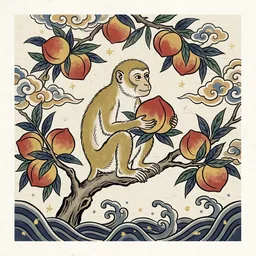
Mu-sin (戊申) Day Pillar: Personality, Love and Career
Mu-sin (戊申) is a mountain rich in ore with a clever monkey scrambling over it: quick, witty and giving, but apt to hand out much more than it gets back in return.
- Quick-witted
- Generous
- Resourceful
- Sociable
- Restless
- Perceptive
At a glance
- Day stem (the "self")
- Mu (戊) · yang Earth
- Day branch
- Sin (申) · Monkey · yang Metal
- Growth stage of the day stem
- Illness (病)
- Nayin ("sound") element
- Earth of the Great Post Road (大驛土) · Earth
- Void branches (kongwang)
- In (寅) · Myo (卯)
- Stem that combines with yours
- Gye (癸) → Fire
- Six-harmony partner
- Sa (巳)
- Clashing branch
- In (寅)
- Triad branches
- Ja (子) · Jin (辰)
Hidden stems
- Mu (戊)Companion (比肩)
- Im (壬)Indirect Wealth (偏財)
- Gyeong (庚)Eating God (食神) · main qi
Stems stored inside the branch, each shown with its ten god relative to your day stem. The last one is the main qi.
Stem and branch. The stem feeds the branch. Energy flows outward into the world, which makes for expressiveness and generosity, and a risk of being drained.
Growth stage of the day stem. Sensitive and thoughtful with a strong inner life. The body may tire easily; imagination and care run deep.
Nature and personality
The Mu-sin (戊申) day pillar is a mountain full of ore with a monkey scrambling over it: a quick, resourceful and sociable personality with a hand for making things and a knack for being useful to nearly everyone it meets. People born on a Mu-sin day tend to be witty, adaptable and generous with their time, as good at solving a problem as at making the room laugh while they do it, and a little allergic to being tied to one spot. Korean saju, the Four Pillars system, writes a birth date as four pairs of characters, and the pair for the day is the day pillar, the one that speaks about you rather than your family or your career stage. Its upper character, the day master, is the self; its lower character, the branch, is the private side and the inner circle. In this pillar the day master is 戊, yang earth, which pictures a mountain. The branch is 申, the monkey, which is metal: cut stone, tools, ore in the rock. Among the five elements, earth gives birth to metal, so the stem feeds the branch. Energy flows outward from the mountain into things made and things said, which makes for an expressive, giving person who can run low when nothing flows back. Inside the monkey sit three hidden stems, each tagged with a ten god, saju's name for how another energy relates to the day master. The main one is 庚, a yang metal tool such as an axe or a chisel, and it is the Eating God: the gift for expression, craft, appetite and enjoyment, the person who cooks, draws, jokes or explains well. Under it lies 壬, a great river, Indirect Wealth: the nose for openings, trade and income from side channels. The last is 戊 again, Companion, a plain, loyal self-reliance that keeps the monkey from floating away. The growth stage of the day master here is Illness (病). It sounds alarming but is only a stage name: the point where raw strength begins to ease and sensitivity rises. Tradition reads it as someone perceptive, who picks up the mood of a room and thinks things through, sometimes too much. The nayin, the poetic nickname of the pillar, is Earth of the Great Post Road (大驛土): the packed soil of a relay station on a main road, where travellers change horses and swap news. It fits a hub person, always coming and going, good at joining people who would never otherwise meet.
Strengths
- Picks up a skill by trying it, fast
- Easy humour that relaxes a tense table
- Generous with help, time and food
- Spots chances and useful people early
- Practical hands: fixes, builds, cooks, arranges
Challenges
- Spreads energy over too many projects and people
- Gives first and counts the cost afterwards
- Restless once a routine stops teaching anything
- Overthinks in private, then hides the worry behind a joke
Love and relationships
A Mu-sin partner is the one who makes a first date feel easy: good questions, a good memory for the answers, and something small and well chosen in the bag. The day branch, called the spouse palace because it marks the seat of the closest partner in a chart, holds a monkey here, which points to someone agile and curious who wants a partner just as quick, funny and independent. Stagnation, more than conflict, is what wears this pillar down in a relationship. Affection is shown by feeding, hosting and planning: the surprise picnic, the friend group assembled around a birthday, a dozen small gifts through the year. The Indirect Wealth inside the branch is traditionally read as a taste for variety and a wide social circle: someone who enjoys many kinds of company. The weak point is the outward flow: Mu-sin gives and gives and rarely asks, then feels depleted without saying why. Partners who ask what they need and say plainly what they want in return get the very best of this pillar.
Work and career
Variety is the working condition that matters most here. A job with a counter, a stage, a customer or a workbench lets the Eating God do what it does best, which is to make something visible and get a response to it. Fields that match include sales and trade, import and export, media and content making, teaching and training, food and hospitality, travel and events, craft and engineering, technology and tool-making, consulting and freelance work. The Post Road nayin adds a connecting talent: recruiting, introductions, community management, anything where people and information pass through your hands. The Indirect Wealth in the branch suits a portfolio of income: a main role plus a craft, a course or a small business on the side. The pitfall is the unfinished middle. A shared tracker, a work partner who likes closing things out, or public deadlines keep a good start from becoming a pile of good starts.
Money
Money moves through a Mu-sin like traffic through a relay station: plenty arrives and plenty continues on its way. The hidden Indirect Wealth gives a feeling for where small margins and several modest income streams can be found, and the Eating God spends happily on meals out, tools, gadgets, experiences and treating friends. The habit that works is to separate the flow. Let a set share of each payment move into a savings account the day it arrives, keep a monthly treat amount that is yours to enjoy without guilt, and give shared costs a number before the evening begins. Since the stem feeds the branch, giving is natural; a plan makes sure the first person fed is you.
Energy and wellbeing
Because the stem feeds the branch, this pillar spends more than it takes in, and the usual theme is depletion through busyness: a late night of conversation, a calendar with no gaps, nerves that never fully switch off. The Illness stage adds sensitivity, so the mood of the room and the worries of friends get absorbed more than they show. Metal is traditionally linked with breath, so open-air walks, slow breathing and proper meals sit well with it, and the Post Road image suggests building in rest stops rather than hoping for one. Take all of this as everyday lifestyle symbolism, never as medical guidance.
Who you get on with
The traditional six harmony partner of the monkey is the snake (巳), and a snake-branch day such as Jeong-sa (丁巳) is a classic place to look for easy company. The monkey also sits in a water triad with the rat (子) and the dragon (辰), three branches that run toward the same flow; these tend to feel like friends who help the river keep moving. The traditional clash is the tiger (寅), the opposite in tempo and style. The tiger is also one of this pillar's void branches (寅卯), which tradition reads as a link that feels thinner or comes later, so the clash may feel milder than the label implies. Separately, the day stem 戊 is said to combine with 癸, rain, toward fire, and a 癸 day master often brings calm to a restless mountain. By element, earth kin such as the neighbouring Gi-yu (己酉) feel like family, water people carry the river already inside you, and fire people bring warmth that can be lovely or can melt the metal, depending on dose.
How life tends to unfold
Saju reads a life as a relay of ten-year luck cycles called daewoon. Every cycle is a stem and a branch of its own, and it tints one decade much as a season tints a year; the age at which the first one begins and the order it runs in come from the birth date. With the Illness stage and the Post Road image, this pillar often feels more than it shows early in life and learns by trying many things; a few changes of direction, city or job through the twenties and thirties would be quite in character. As a loose guide, metal cycles bring the Eating God to the front: more making, speaking and performing, and more chances to be drained as well. Water cycles bring openings and money to handle, often with heavier workload. Wood cycles ask for structure and responsibility, which can feel like being asked to settle down. Fire cycles bring teachers and protection, and earth cycles bring peers and steadiness. Which decade actually feels like which depends on the other pillars of the chart, so these are leanings, not predictions.
Advice
Decide in advance what you will keep for yourself each week, a couple of unbooked hours, an early night, a meal alone, and defend it the way you would defend a favour to a friend. Pick one project to finish before you start the next. Ask once a week, out loud, for something you actually want, because the people around you will not guess. And let the joke wait a moment when something matters: the monkey's best material is often the truth.
Frequently asked questions
What does the Illness growth stage mean for Mu-sin?
Illness (病) is simply the name of one of twelve growth stages that describe how strong the day master is, and it has nothing to do with sickness. It marks the point where raw strength eases and sensitivity rises. In practice tradition reads it as perceptiveness, thoughtfulness and a tendency to absorb the moods around you.
Who gets on best with the Mu-sin day pillar?
Tradition points to the snake as the six harmony partner, then the rat and the dragon in the water triad, and to a 癸 day master for a gentle, balancing combination. The tiger is the traditional clash. These are leanings only: an honest, curious partner who gives back as much as they take matters far more than any chart match.
Is a Mu-sin person restless, or can they commit?
Both are true. The monkey likes variety and the Post Road nayin suggests movement, but the Companion hidden inside gives a loyal core that does stay. Mu-sin tends to commit when the relationship or work keeps teaching them something new. Routine alone is what makes them wander; trust is not the difficulty.
Learn the terms on this page
Is this your day pillar?
Your day pillar comes from your exact birth date, not your birth year. Enter it in our Four Pillars calculator and it shows all four of your pillars.
New to saju? Saju (四柱, "four pillars") describes a person by the year, month, day and hour of birth. The day pillar is the centre of it: its stem is you, and its branch is your closest circle and your home life.