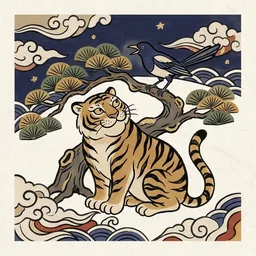
Mu-in (戊寅) Day Pillar: Personality, Love and Career
Mu-in (戊寅) is a hill with a tiger in its trees: sturdy, brave and a guard by nature, with an inner drive that is hard to turn off, even at rest.
- Driven
- Protective
- Disciplined
- Frank
- Restless inside
- Quick starter
At a glance
- Day stem (the "self")
- Mu (戊) · yang Earth
- Day branch
- In (寅) · Tiger · yang Wood
- Growth stage of the day stem
- Birth (長生)
- Nayin ("sound") element
- Earth of the City Wall (城頭土) · Earth
- Void branches (kongwang)
- Sin (申) · Yu (酉)
- Stem that combines with yours
- Gye (癸) → Fire
- Six-harmony partner
- Hae (亥)
- Clashing branch
- Sin (申)
- Triad branches
- O (午) · Sul (戌)
Hidden stems
- Mu (戊)Companion (比肩)
- Byeong (丙)Indirect Resource (偏印)
- Gap (甲)Seven Killings (七殺) · main qi
Stems stored inside the branch, each shown with its ten god relative to your day stem. The last one is the main qi.
Stem and branch. The branch controls the stem. There is a constant pull of pressure and duty that builds discipline and inner tension together.
Growth stage of the day stem. A newborn's stage: hopeful, quick to learn and well supported by others, with a fresh start in the air.
Nature and personality
The Mu-in (戊寅) day pillar is a mountain with a tiger in its trees: a sturdy, protective, driven personality that looks calm on the outside while something inside keeps pushing it to do more. People born on a Mu-in day tend to be frank, brave about starting hard things and hard on themselves, and they often seem older and more settled than they feel. In Korean saju, the Four Pillars system, the day pillar is the two-character mark of the day you were born. The upper character, the day master, is you; the lower one, the day branch, is your home ground and closest circle. The day master here is 戊, yang earth: a big mountain or city rampart, solid and slow to move. The branch is 寅, the tiger, which is wood, and the first branch of spring, the season when shoots break the surface. Wood presses on earth, so in saju the branch controls the stem. Think of roots working into a hillside: there is a constant pull of pressure and duty, and it builds discipline and inner tension at the same time. It is the person who feels watched by an inner supervisor, whether or not anyone is watching. The tiger carries three hidden stems, each named by a ten god, saju's ten ways of describing how another energy relates to you. The main one is 甲, Seven Killings: the great tree, the energy of challenge, authority and a worthy rival. It is intense, but it is also the courage to take on what others avoid. Next comes 丙, Indirect Resource, the sun that warms the mountain: unconventional learning, protection and help from unexpected places. Last is 戊, Companion, a self-reliant core. Tradition likes this arrangement because the tree feeds the sun and the sun feeds the earth, so pressure can be turned into support when it is handled well. The day master's growth stage is Birth (長生), a fresh start with natural vigour, and the nayin, the poetic name attached to each pillar, is Earth of the City Wall (城頭土): earth that has been rammed down and built up, there to protect, shaped by effort rather than by chance.
Strengths
- Courage to take on the hard task first
- Protective of family, team and anyone depending on them
- Self-disciplined, with high standards held quietly
- Quick energy at the start of a new chapter
- Frank, loyal and unfussy
Challenges
- Inner pressure that never quite switches off
- Treats rest as laziness
- Friction with bosses or rivals who push back
- Reluctant to ask for help or admit tiredness
Love and relationships
In love, Mu-in is usually the one who walks on the road side of the pavement and picks up the call at 2 a.m. when something goes wrong. Protectiveness is the first language here. The Seven Killings stem in the tiger tends to draw this pillar toward partners with spark, spine and opinions of their own, people who will not simply agree, and the relationship can carry some friction as a result: sharp debates, testing, rivalry over small things. Many Mu-in people find it is exactly that friction that keeps them interested. The Indirect Resource beside it asks for something softer: to be understood and looked after without having to explain, which Mu-in rarely says aloud. In saju the day branch is called the spouse palace, the seat of the partner, so a tiger there reads as someone who wants a partner worth defending and a home that feels like a base. The risk is running the home like a fortress: criticising, taking charge of everything and then feeling alone. A partner who can hold their own and also say 'sit down, I have this' is a gift. Tradition also notes that 戊 combines with 癸, so soft, rain-like 癸 people can feel unusually calming; read that as a lean, not a promise.
Work and career
Mu-in does its best work when there is a real problem, a deadline or a team that needs someone to hold the line. The Seven Killings energy turns pressure into fuel, which is why this pillar is often the calm one in the emergency and the one asked to take over a project that is behind schedule. Fields that match include operations and project leadership, engineering and construction, emergency and rescue work, security, sports and coaching, outdoor leadership, start-up operations and teaching in demanding settings. The Indirect Resource adds a second path: self-taught expertise, qualifications taken on one's own initiative, or a mentor who spots the potential. The soft spot is burnout and boss friction. Seven Killings does not enjoy being managed from above by someone it does not respect, and it may overload itself to prove a point. Choose workplaces with clear standards and fair authority, keep one day a month that is not an emergency, and teach someone else the job so you are not the only wall.
Money
The tiger holds no money star of its own: there is no Wealth among its hidden stems, so Mu-in tends to earn through effort, position and reputation more than through trade or deals. Pay rises when the role grows, not when the market moves. Money is spent protectively: on the home, on good tools, on insurance and on the people who depend on you, with the Companion in the branch also inclined to treat close friends' needs as your own. The risk is lumpiness, such as one hard push followed by a big purchase to reward yourself, or helping others past what your own account allows. A simple rule works: divide the salary the day it arrives, with a reserve first, bills second and a named amount for rewards. Keep to ordinary saving habits and plain accounts rather than clever products.
Energy and wellbeing
Wood pressing on earth tends to show up as held-in tension: tight shoulders, a clenched jaw, a mind that is still working at 3 a.m. Both the tree and the mountain like physical outlets, so hard exercise, hiking, climbing or a long stretching routine suit this pillar, as do fixed times for stopping. Mu-in tends to treat rest as something to be earned; try treating it as maintenance of the wall. The Resource sun inside also suggests time in daylight and warm food in the evening. This is traditional lifestyle symbolism, not medical advice, and persistent pain or sleeplessness deserves a doctor.
Who you get on with
Traditionally the tiger's six-harmony partner is the pig (亥): water that feeds wood and settles the tiger's restlessness. Gye-hae (癸亥) is the pillar that adds the 戊 and 癸 combination, so some readers single it out as an easy fit. The tiger also forms a fire triad with the horse (午) and the dog (戌), three branches moving in the same direction, which often feels like quick shared enthusiasm and plenty of energy. The monkey (申) is the traditional clash, metal against wood, a cutting-and-pushing pairing, but the monkey is also one of this pillar's void branches (申酉), which tradition reads as a link that feels thinner, so the clash is said to land less sharply. Among elements, fire people give the mountain warmth and soften the pressure; water people feed the tree and can make the inner pressure stronger, which may be restful or tiring; metal people trim the tree and are often a relief to a Mu-in under strain; and earth people share the weight. The next pillar in the cycle, Gi-myo (己卯), has the same wood-over-earth pressure in a gentler, more yin form. Beyond the day pillar, everything rests on the rest of each chart.
How life tends to unfold
Daewoon are the ten-year luck cycles of saju, each a stem-and-branch pair that colours a decade; the start age is worked out from the birth date. With the day master at the Birth stage, Mu-in often has a fast, energetic opening: early independence, a first big task taken on young, and a feeling that life starts in earnest the moment you leave the family home or first school. The middle chapters are about converting that drive into something that can be kept up. Fire cycles tend to feel like support, with teachers, protectors and ease. Wood cycles raise the pressure and the stakes, with authority, promotion and also rivals. Metal cycles trim and give an outlet, such as craft, speech and results, while water cycles bring practical income and busy social calendars. Another earth cycle brings peers and partners, sometimes also competition. The monkey and the rooster are void for this pillar, so years with those branches are traditionally less solidly anchored; put important agreements in writing. What a decade actually holds depends on the whole chart.
Advice
Pick one day a week where nothing is urgent and nobody needs a decision, and guard it as you would a deadline. When pressure arrives, ask who set the standard: if it was you, you are allowed to change it. Ask for help in the third hour, not the third day. Give the warmer, curious side of you, the sun in the branch, a hobby that has no goal, since the wall does not need to be defending something every day. And thank the people who stand behind it, aloud, sometimes.
Frequently asked questions
What does the tiger do to the Mu-in day master?
Wood controls earth, so the tiger presses on the mountain: a steady sense of duty and pressure that shapes habits and drive. This is not a flaw. It is why Mu-in people are often disciplined and brave under load. The cost is inner tension, which is worth releasing through exercise and real time off.
Is Mu-in a hard or stressful day pillar?
No. Saju does not rank the sixty pillars. Mu-in does have a pressure built in, but pressure is also drive and courage, and the hidden sun inside the tiger tends to turn it into support. People with this pillar often do well in demanding roles. How life feels depends on the whole chart and the luck cycles.
What does Earth of the City Wall mean for Mu-in?
Earth of the City Wall (城頭土) is the nayin, the traditional poetic name for this pair. It pictures earth that was packed and built into a rampart, which fits a person who protects others and is shaped by effort and responsibility. It is a symbol for temperament, not a prediction of events.
Learn the terms on this page
Is this your day pillar?
Your day pillar comes from your exact birth date, not your birth year. Enter it in our Four Pillars calculator and it shows all four of your pillars.
New to saju? Saju (四柱, "four pillars") describes a person by the year, month, day and hour of birth. The day pillar is the centre of it: its stem is you, and its branch is your closest circle and your home life.