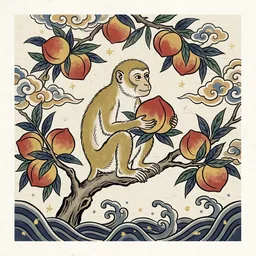
Gyeong-sin (庚申) Day Pillar: Personality, Love and Career
Gyeong-sin (庚申) is steel in quick hands: a pure metal pillar that is exact, free and inventive, and it does its best work on one goal at a time, not ten.
- Self-reliant
- Exact
- Inventive
- Single-minded
- Nimble
- Independent
At a glance
- Day stem (the "self")
- Gyeong (庚) · yang Metal
- Day branch
- Sin (申) · Monkey · yang Metal
- Growth stage of the day stem
- Prime post (建祿)
- Nayin ("sound") element
- Pomegranate Wood (石榴木) · Wood
- Void branches (kongwang)
- Ja (子) · Chuk (丑)
- Stem that combines with yours
- Eul (乙) → Metal
- Six-harmony partner
- Sa (巳)
- Clashing branch
- In (寅)
- Triad branches
- Ja (子) · Jin (辰)
Hidden stems
- Mu (戊)Indirect Resource (偏印)
- Im (壬)Eating God (食神)
- Gyeong (庚)Companion (比肩) · main qi
Stems stored inside the branch, each shown with its ten god relative to your day stem. The last one is the main qi.
Stem and branch. Stem and branch share one element. The energy is concentrated and single-minded, strong in focus and short on variety.
Growth stage of the day stem. The stage of a person at a post of their own: steady strength, independence and the ability to stand on your own feet.
Nature and personality
The Gyeong-sin (庚申) day pillar is the Metal Monkey: tempered steel in a pair of very quick hands. People born on a Gyeong-sin day tend to be exact, independent and resourceful, happiest when they can work out how a thing functions and then do it better themselves, and they carry a self-sufficiency that others sometimes read as coolness. In saju, the Korean Four Pillars system, a birth date becomes four pairs of characters, and the pair for the birth day is the day pillar, or ilju. Its upper character is the day stem, called the day master, which stands for the self; its lower character is a branch, one of the twelve zodiac animals, which stands for private temperament and the closest circle. The day master is 庚, yang metal: raw iron, an axe, a girder. The branch is 申, the monkey, also metal, the animal of early autumn, when summer turns and the first cool air arrives. Because stem and branch share one element, the energy is concentrated and single-minded: very strong in focus and short on variety. With no wood or fire inside the pillar to redirect it, this person tends to pick a direction and go straight down it, and to be quietly baffled when others drift. Three hidden stems sit in the monkey, each tagged with a ten god, a saju term for how another element relates to the day master. The main one is 庚 itself, the Companion (比肩): a second self, the voice that says 'I will do it myself'. Below it is 壬, a great river, the Eating God (食神): the playful, inventive side, with its appetite for good food and an easy sense of humour. The faintest is 戊, mountain earth, the Indirect Resource (偏印): a self-taught streak and a curiosity about unusual subjects. The growth stage is Prime post (建祿), the point in the twelve stages where a person stands at their own post and earns their own keep, which fits an early independence. The nayin, the poetic nickname for the pillar, is Pomegranate Wood (石榴木): a tough rind outside and a great many bright seeds within, and fruit that ripens late in autumn.
Strengths
- Precise hands and a mind that wants to know how things work
- Self-reliance that does not wait for permission
- Focus that can stay with one problem for hours
- Inventive workarounds when the standard way fails
- Straight dealing, with promises that mean something
Challenges
- A narrow focus that shuts out advice and other options
- Going it alone when asking would be faster
- Little patience for sloppiness, in others and in themselves
- Feelings filed away, so a partner may feel left outside
Love and relationships
Respect is the way in. A Gyeong-sin partner shows interest by wanting to do things with you: spend a Sunday rebuilding a bookshelf, work out a route, cook a recipe properly and argue pleasantly about the method. In saju the day branch is called the spouse palace, the traditional seat of the closest partner, and here it holds a Companion with the Eating God beside it. Read as tradition, that is a partner treated as a peer and teammate, with a good deal of teasing and good appetite, and a firm need for a life of one's own. Where it gets thin is in emotional talk, which Gyeong-sin tends to file away until it is solved. A partner may sense that they are being handled like an interesting problem. What helps is someone who is independent in return, who says what they feel in plain sentences and does not ask for long scenes, and who can bring a feeling to the table without needing it fixed in an hour. Gyeong-sin does best when it says, 'I do not need to solve this; I just want you to know,' and means it.
Work and career
The pillar wants to master a craft, and to be left to get on with it. Engineering, mechanics and precision manufacturing, software and hardware, instrument and tool making, laboratory work, accounting and quality control, translation, research, martial arts and sport coaching all reward a nimble mind joined to exact hands. Self-employment or a role with its own corner of responsibility suits the Companion energy better than a crowded team. The risk is a narrow channel: deep skill but little interest in office politics, delegation or explaining why. One generalist colleague who handles the people side lets a Gyeong-sin's depth be seen. Making one's reasoning visible, in a short note or a diagram, helps others trust a result that seems to come out of nowhere.
Money
The Companion at the centre of the branch is the picture of money that is earned by one's own hands and kept on one's own terms. Gyeong-sin tends to know exactly what is in the account, dislikes debt and prefers to pay its way. Spending is lumpy and focused: the better tool, the hobby gear, the course that sharpens a skill, and good food, courtesy of the Eating God. The leak is gear for a single passion and a reluctance to split costs with others. A yearly review of subscriptions and gear, and a fixed transfer into savings before the hobby budget, keeps the focus from running away with the funds.
Energy and wellbeing
With metal on both levels of the pillar and no fire or wood within, tradition reads a dry, taut, one-note energy: the mind in one groove and the body holding the same posture for hours. Variety is the remedy. Alternate sitting with walking, swap one workout for something unrelated to the job, add something soft and slow, such as a warm bath or a damp-air walk, and set breaks as hard stops, since this pillar will otherwise work until it forgets to eat. A hobby that has nothing to do with work, particularly a social one, relieves the single track. None of this is medical advice; it is a traditional picture to borrow habits from.
Who you get on with
The monkey's traditional six harmony partner is the snake (巳), and snake-branch days such as Gi-sa (己巳) are the classic place to look, a pairing in which two sharp minds understand each other quickly. The monkey also sits in a water triad with the rat (子) and the dragon (辰); the dragon is the easier partner there, while the rat is one of this pillar's void branches (子丑), which tradition reads as a link that feels lighter or comes later. The traditional clash is the tiger (寅), wood against metal and impulse against precision: a friction of styles more than a curse, often easing once each says how they like to work. The day stem 庚 is also said to combine with 乙, yin wood, the vine, which softens a hard edge by bending around it. By element, earth people support you, fire people forge and test you, water people give your ideas somewhere to flow, and wood people give you material to shape. How well any of this lands depends on the rest of the chart.
How life tends to unfold
Saju divides life into ten-year stretches called daewoon, the luck cycles. Each is a stem-and-branch pair that colours a decade as a season colours a year, and the start age and direction are worked out from the birth date. With a day master at the Prime post stage, this pillar often feels capable early, leaves a home or a first job sooner than most and builds a skill in the first decades; the lesson of the middle years is more often how to let others in than how to get things done. In general fire cycles are the forge, applying heat and discipline that can feel hard and leave a sharper, better-formed tool, earth cycles support and bring learning, water cycles bring invention and travel, wood cycles bring materials, projects and practical affairs, and metal cycles amplify the focus, which is a gift for mastery and a risk of isolation. The pomegranate nayin hints at a late sweetness. What a given decade brings depends on the rest of the chart, so these are tendencies, not a timetable.
Advice
Pick a second field that has nothing to do with the first and give it a place in the weekly calendar, so that the single track has a branch line. Show your working along with the result. Ask one person for a view before you start, not after you finish. Say aloud one feeling a week that you do not intend to fix. And let a task be good enough once in a while: nobody else is measuring it with your ruler.
Frequently asked questions
What does the Gyeong-sin day pillar mean in saju?
It pairs 庚, yang metal, with 申, the metal monkey, at the day position of a Korean Four Pillars chart. People with it are usually exact, self-reliant and inventive, with a strong ability to concentrate. The day pillar comes from your birth date, and a Four Pillars calculator will tell you whether yours is Gyeong-sin.
Is a double-metal pillar like Gyeong-sin cold or stubborn?
It can look that way, but it is better read as concentrated. Stem and branch share one element, so the energy goes into focus and independence, not into variety. Warmth tends to show as practical help and straight dealing, not speeches. Whether the whole chart feels hard or soft depends on the other three pillars and the luck cycles.
Is Gyeong-sin the same as being born in a Metal Monkey year?
The characters are the same, but the use differs. The sixty pairs repeat as years and as days, and 1980 was a Metal Monkey year. Your day pillar comes from your birth date and describes you personally, while the year pillar is only one other layer of the chart, so a person of any birth year can have a Gyeong-sin day.
Learn the terms on this page
Is this your day pillar?
Your day pillar comes from your exact birth date, not your birth year. Enter it in our Four Pillars calculator and it shows all four of your pillars.
New to saju? Saju (四柱, "four pillars") describes a person by the year, month, day and hour of birth. The day pillar is the centre of it: its stem is you, and its branch is your closest circle and your home life.