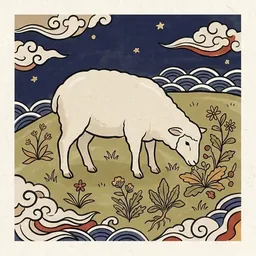
Jeong-mi (丁未) Day Pillar: Personality, Love and Career
Jeong-mi (丁未) is a lamp in a warm late-summer garden: generous, expressive and caring, with a firm taste of its own and a real need to refill what it pours out.
- Generous
- Expressive
- Nurturing
- Tasteful
- Curious
- Gives freely
At a glance
- Day stem (the "self")
- Jeong (丁) · yin Fire
- Day branch
- Mi (未) · Goat · yin Earth
- Growth stage of the day stem
- Capping (冠帶)
- Nayin ("sound") element
- Water of the Heavenly River (天河水) · Water
- Void branches (kongwang)
- In (寅) · Myo (卯)
- Stem that combines with yours
- Im (壬) → Wood
- Six-harmony partner
- O (午)
- Clashing branch
- Chuk (丑)
- Triad branches
- Hae (亥) · Myo (卯)
Hidden stems
- Jeong (丁)Companion (比肩)
- Eul (乙)Indirect Resource (偏印)
- Gi (己)Eating God (食神) · main qi
Stems stored inside the branch, each shown with its ten god relative to your day stem. The last one is the main qi.
Stem and branch. The stem feeds the branch. Energy flows outward into the world, which makes for expressiveness and generosity, and a risk of being drained.
Growth stage of the day stem. Coming of age: ambition, pride in appearance and a wish to be recognised for what you can do.
Nature and personality
The Jeong-mi (丁未) day pillar is a lamp lit in a warm late-summer garden. People born on a Jeong-mi day tend to be generous, expressive and nurturing, someone who hands out warmth, food, ideas and time almost by reflex, and who is a good deal more particular about their own taste than their softness suggests. In saju, the Korean Four Pillars system, the day pillar is the two-character pair for the day you were born. The upper character is the day stem, called the day master, and it stands for you yourself; the lower is the day branch, one of twelve animals, and it describes your private nature and your closest circle. Here the day master is 丁, yin fire: a lamp, a candle, a hearth, a small personal flame that gives light by warming whoever sits near it. The branch is 未, the goat, an earth sign that tradition links with the hot, dry end of summer, when the soil is warm all the way through. Fire produces earth, so here the stem feeds the branch. Energy flows outward into the world, which makes for expressiveness and generosity and for a risk of being drained. In daily life that is the host who keeps refilling glasses, the teacher who stays after class, the friend who remembers the birthday of someone else's mother. Three hidden stems sit in the goat, each given a ten god, a label for how another stem relates to the day master. The main one is 己, soft earth, the Eating God: the talent for expression, making things and giving comfort, and a real appetite for good company. The middle one is 乙, a vine or flower, the Indirect Resource: learning of the unconventional sort, strong hunches and odd, particular interests. The residual one is 丁, your own element again, the Companion: a self-reliant core that quietly keeps its own counsel. The day master sits at the Capping stage (冠帶), named for the old coming-of-age rite in which a young person was given a cap and sash, which adds pride in presentation, an eye for style and a wish to be seen as capable. The nayin, a poetic nickname for the pillar, is Water of the Heavenly River (天河水), the Milky Way: a lamp whose light reaches a long way, with something cool and flowing written into its name.
Strengths
- Warm generosity with time, attention and hospitality
- A natural gift for putting things into words, music or craft
- Curiosity about unusual subjects and skills
- Puts people at ease within minutes
- A personal taste that is recognisably its own
Challenges
- Giving until there is nothing left for yourself
- Needing to be thanked and not saying so
- Spreading energy across too many people and projects
- Holding firmly to your own way while sounding easygoing
Love and relationships
Jeong-mi shows love by going out toward the other person. This is the one who stays on the line until you have finished the long story, who sends a playlist that fits your mood this week, who makes you laugh at the exact moment you were about to be low. Affection is spoken, shared and a little playful, and it is rarely cold or calculated. The day branch is traditionally called the spouse palace, the seat of the closest partner in a chart, and here it holds a goat whose main hidden star is the Eating God. Tradition reads that as tenderness, humour and a wish to nurture, with a strong need to see that the gift lands. The weak spot is that the energy runs one way: fire feeds earth, and a Jeong-mi person can pour and pour, then go quiet and hurt instead of saying that they would like something back. What they need is a partner who receives warmly, gives in return without being asked, and respects the Companion in the branch, the part that needs an evening of its own. Saying aloud that a thank-you would mean a lot costs one sentence and spares months of silent tally.
Work and career
Work goes best when giving something out is the job itself and the result can be seen on someone's face. The Eating God in the goat favours fields built on expression and care: teaching and tutoring, early-years education, counselling, writing, illustration, music, a craft studio, ceramics, a tea room or bakery, and event or wedding planning. The Indirect Resource beside it adds a taste for niche subjects, so self-taught skills and unconventional routes often serve this pillar better than a straight corporate ladder. What tends to go wrong is boundaries, not talent: saying yes to the extra class, the free draft, the favour that quietly became a second job. Naming a fair price for your time and showing your work in public, even when it feels immodest, makes a career from a gift. Pairing with someone brisk about schedules and invoices frees the lamp to do what it does best.
Money
None of the three hidden stems is a wealth star, so money here does not come from chasing it. It tends to follow expression: a skill taught, a thing made, a service people return for. It also leaves the same way it arrives, as treats, hospitality and gifts, because the fire feeds outward. One image that works well is the envelope a guest brings to a Korean wedding, with the amount decided in advance and no second thoughts at the door. Decide a monthly giving amount the same way, and set a standing transfer to savings on payday so that generosity spends from what is left, not from what is needed.
Energy and wellbeing
With fire feeding earth, the usual theme is depletion rather than overheating: a week of giving that ends with a flat, tired evening and a feeling that nobody asked how you were. Earth is also the element of routine, so regular meals, enough sleep and a fixed time when nobody needs anything are worth more here than any new regime. The Water of the Heavenly River nayin is a gentle reminder to schedule something cool and flowing: a slow tea, a walk by water, an unhurried bath. Take it as a traditional lens on habits and not as medical advice.
Who you get on with
Traditionally the goat has a six-harmony partner in the horse (午), warm earth under a summer sun, which is why the neighbouring pillar Byeong-o (丙午), the day just before yours in the cycle, is the classic image of a fitting match. The goat also forms a wood triad with the pig (亥) and the rabbit (卯); the rabbit is one of this pillar's void branches (寅卯), which tradition reads as a link that feels thinner or arrives on its own schedule. The goat's clash is the ox (丑). Both are earth, but the goat is hot, dry summer soil and the ox is cold, wet winter soil, so the friction is one of temperature: you offer warmth, they want patience, and it improves once each says what they need. By element, wood people feed the lamp, earth people take what you give without strain, and water people cool the heat. A 壬 day master, yang water, is said to combine with 丁 toward wood, which tradition reads as a pairing that brings out something gentler. All of this depends on the rest of each chart.
How life tends to unfold
Daewoon are the ten-year luck cycles, each a stem-and-branch pair that colours a decade the way a season colours a year; the start age comes from the birth date. A day master at the Capping stage often spends its early decades finding a voice and learning how to present it, so the first half of life can be a matter of working out who you are when you are not looking after anyone. In general, wood cycles fuel the lamp and tend to bring study and being looked after, a good moment to refill; fire cycles brighten the self, with more drive and visibility; earth cycles increase output and the demand for it, which can be fruitful and tiring; metal cycles bring wealth stars into view, with structure, income and honest feedback; and water cycles bring pressure and responsibility that can steady the flame. Both void branches here, 寅 and 卯, are wood, the element that nourishes fire, so tradition reads help and study as arriving in their own time rather than on demand. Which decade feels like which comes down to the other three pillars as well.
Advice
Settle the amount before the evening begins, whether it is money, hours or energy, and treat what is left as yours. Say once, out loud, that a thank-you matters to you. Pick one project a season and let the other nine interests wait their turn. Practise a kind no, such as not this week, so that your yes keeps its warmth. Keep one habit that is private, a notebook or a late tea, which no one else can order from you.
Frequently asked questions
2027 is a Fire Goat year; does that matter if my day pillar is Jeong-mi?
The year 2027 carries the same pair of characters, 丁未, as your day pillar, which tradition reads as a year that echoes your own temperament, so generosity, taste and the habit of giving may feel louder than usual. It is a mirror, not a verdict. How it plays out depends on the rest of your chart and on the luck cycle you are in, and your day pillar still describes you, not the year.
Is Jeong-mi a weak pillar because its fire feeds the earth?
Not in the sense of being worse. Here the stem feeds the branch, which means energy flows outward: the person gives, creates and expresses a great deal, and can run low if nothing returns. The remedy is habit rather than luck, with real rest, people who give back and clear boundaries. Whether a chart is balanced depends on all four pillars, not on one pair.
What does Water of the Heavenly River mean for a fire pillar?
Every day pillar has a nayin, a poetic nickname from an old classification of the sixty pairs. The Heavenly River is the Milky Way, an odd label for a fire day master and best read as imagery: a small lamp whose light travels far, and a hint that something cool and flowing belongs in your life. It does not change the pillar's fire and earth nature.
Learn the terms on this page
Is this your day pillar?
Your day pillar comes from your exact birth date, not your birth year. Enter it in our Four Pillars calculator and it shows all four of your pillars.
New to saju? Saju (四柱, "four pillars") describes a person by the year, month, day and hour of birth. The day pillar is the centre of it: its stem is you, and its branch is your closest circle and your home life.