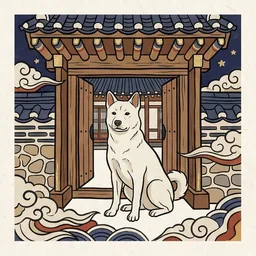
Mu-sul (戊戌) Day Pillar: Personality, Love and Career
Mu-sul (戊戌) is a mountain with a watchdog at its gate: loyal, slow to trust and hard to move, with a dry wit and a strong sense of duty to all it guards.
- Steadfast
- Loyal guardian
- Slow to trust
- Dry-witted
- Immovable once decided
- Dutiful
At a glance
- Day stem (the "self")
- Mu (戊) · yang Earth
- Day branch
- Sul (戌) · Dog · yang Earth
- Growth stage of the day stem
- Storehouse (墓)
- Nayin ("sound") element
- Wood of the Plain (平地木) · Wood
- Void branches (kongwang)
- Jin (辰) · Sa (巳)
- Stem that combines with yours
- Gye (癸) → Fire
- Six-harmony partner
- Myo (卯)
- Clashing branch
- Jin (辰)
- Triad branches
- In (寅) · O (午)
- Traditional label
- Goegang (魁罡)
Hidden stems
- Sin (辛)Hurting Officer (傷官)
- Jeong (丁)Direct Resource (正印)
- Mu (戊)Companion (比肩) · main qi
Stems stored inside the branch, each shown with its ten god relative to your day stem. The last one is the main qi.
Stem and branch. Stem and branch share one element. The energy is concentrated and single-minded, strong in focus and short on variety.
Growth stage of the day stem. The storehouse: thrifty, patient and good at keeping things inside, like treasure locked in a vault.
Traditional label. One of four pillars the tradition calls Goegang, "the chief star": unusually forceful, decisive and proud, with a strong sense of authority and all-or-nothing swings.
Nature and personality
The Mu-sul (戊戌) day pillar is a mountain with a guard dog posted at the gate: a steady, loyal personality that looks calm from outside and holds firm opinions within. People born on a Mu-sul day tend to be dependable keepers of whatever they have taken on, slow to warm up, quick to notice what is wrong, and very hard to talk out of a decision once it is made. In Korean saju, the Four Pillars system, a birth date is written as pairs of characters, and the pair for the day itself is called the day pillar (ilju in Korean). Its upper character, the day master, stands for you; its lower character, the branch, is your private side and your closest circle. Here the day master is 戊, yang earth: not garden soil but a whole mountain, the kind of ground that other things get built on. The branch is 戌, the dog, which is earth too, the dry ground of late autumn after the harvest is in. Because both halves are earth, nothing inside the pillar pulls against anything else. It is a pillar of great steadiness and great sameness, fond of routine and unwilling to be hurried. Every branch also stores hidden stems, smaller energies tucked inside it, and saju names each one with a ten god, one of ten labels for how another stem relates to the day master. The main hidden stem in the dog is 戊 again, Companion: self-reliance, the habit of trusting your own hands first. Beneath it sits 丁, Direct Resource, a candle flame: the wish to learn properly, to be taught by someone worth respecting, and to look after those in your care. The faintest is 辛, Hurting Officer, polished yin metal: a sharp eye for flaws, a dry sense of humour, and little patience for rules that exist only because they always have. The growth stage of the day master is Storehouse (墓), the stage of things being put away and kept. That suits this pillar, which stores goods, feelings, grudges and knowledge, and opens the vault slowly. Its nayin, the poetic nickname of the pillar, is Wood of the Plain (平地木): one tree standing alone on open ground, giving shade to whoever comes near. Finally, Mu-sul carries the traditional label Goegang (魁罡), given to a small group of day pillars said to be commanding, decisive and all-or-nothing. It speaks of intensity and strong will, not of fate.
Strengths
- Loyalty that does not expire when things become inconvenient
- Steady nerves while everyone else is panicking
- A sharp eye for the flaw in a plan before it costs anything
- Decisiveness once the facts are in
- Keeps promises, large and small, and remembers who kept theirs
Challenges
- Slow to trust, so real closeness takes years rather than weeks
- Stores opinions and grudges instead of airing them
- Criticism that lands like a verdict even when meant as help
- Resists change until it has been proved necessary
Love and relationships
Mu-sul does not fall in love quickly, and the people who wait are often surprised by how complete it is when it comes. In saju the day branch is called the spouse palace, the seat of the closest partner in a chart, and here it holds a dog: a guard and a companion, someone who inspects the gate carefully before opening it. Affection shows up as logistics. The lift home after a late shift, the shelf quietly repaired, the allergy that was mentioned once and never forgotten; the words 'I love you' often arrive later, and sometimes in writing. The Hurting Officer hidden in the branch is the weak point: the eye that finds the error in a report also finds it in a partner's habits, and a remark meant as help can sting for days. Saying what you appreciate as often as what could improve is the habit that pays back most. What suits this pillar is a partner who is consistent, says what they mean, does not test loyalty with games, and can sit in a long silence without reading it as coldness. Slow does not mean uninterested; it usually means this person is deciding whether the whole of their life can be put in your hands.
Work and career
Put a Mu-sul person in charge of the thing that must not fail and it will quietly be done: the operations lead who knows where every key, contract and spare part is kept, the inspector who finds the crack before the bridge opens. Fields that match the mountain image include operations and facilities, quality control and auditing, public service, engineering and construction, security and rescue work, archives and records, logistics, farming and land, and trades with a visible, lasting result. The Hurting Officer adds a talent for review, editing and compliance, and the Goegang label is traditionally tied to decisive posts where someone must make the call. The friction point is constant reorganisation: this pillar needs reasons and time before it adopts a new method, and then it adopts it thoroughly. Leave it independent room to do the job its own way and it repays that with years of reliability.
Money
Storehouse is the right word for the money habits too: saving comes naturally, and so does a firm opinion about what is worth paying for. No wealth stem is hidden inside this pillar, which tradition reads as income that arrives through skill and steady work rather than deals or windfalls, and that tendency suits patient, long-service careers well. The common leaks are quiet ones: spending too little on your own comfort, covering costs for family without mentioning it, and lending to a friend because a Companion does not like to say no. A fixed monthly transfer into savings keeps the storehouse filling, and a small, named yearly amount that exists only to be spent on yourself keeps the habit from turning into hardship.
Energy and wellbeing
Earth on earth, with no water and almost no wood inside, is the dry and heavy end of the five-element picture. Tradition reads it as a pillar that holds things in: tension gathering in the neck and shoulders, worries kept private, a body that likes routine and goes stiff without movement. Water and wood are the missing notes, so walking by a river, regular swimming, stretching, and talking a problem through before it hardens all suit this pillar. The nayin even offers the image, one green tree on dry ground. This is a lifestyle reading in the traditional vocabulary, not medical advice.
Who you get on with
The traditional six harmony partner of the dog is the rabbit (卯), wood growing on earth, which tends to feel like an easy, restful pairing; a rabbit-branch day such as Gi-myo (己卯) is one example. The dog also sits in a fire triad with the tiger (寅) and the horse (午), three branches that run in the same direction, and the horse in particular brings warmth to a very dry pillar. Mu-sul's traditional clash is the dragon (辰), another earth branch: two mountains meeting, a clash of two firm wills more than anything fated. The dragon is also one of this pillar's void branches (辰巳), which tradition reads as a link that feels thinner or comes later, so the friction is often milder than the label suggests. Separately, the day stem 戊 is said to combine with 癸, rain and dew, toward fire: a gentle, adaptable 癸 day master often draws out the softer side of the mountain. By element, fire gives the earth warmth and a reason to learn, wood gives it structure and a push, and water brings movement. Whoever stays calm when the mountain goes quiet is usually the person who stays.
How life tends to unfold
Saju maps a life as a chain of ten-year luck cycles called daewoon. Each is a stem-and-branch pair that colours a decade the way a season colours a year, and the starting age and the direction are worked out from the birth date. With the Storehouse stage at its centre, the pillar's tendency is to accumulate: skill, standing and trust build slowly, and recognition often comes after others have already been relying on you for years. As a loose guide, fire cycles warm the mountain and tend to bring teachers, study and a sense of being backed; wood cycles bring structure and duty, which can feel like pressure at first and then like a proper post; metal cycles sharpen the Hurting Officer, so speech and craft come to the front; water cycles open the ground and bring movement, travel or money to handle; and earth cycles repeat the pillar, which brings steadiness along with a risk of getting set. What any actual decade holds depends on the rest of the chart, so take these as tendencies, not a timetable.
Advice
Treat your first reaction as a draft, not a ruling: give it one night before you say it, particularly criticism. Say one specific thank-you a day, aloud, to the people you rely on. Choose one thing a year to change on purpose, a route, a tool, a habit, so that change is a choice you made rather than something you resisted. Make time every week for something that has no use: a walk, a hobby, a meal with no agenda. And remember that being slow to trust is a strength only when someone eventually passes the test.
Frequently asked questions
What does the Goegang label mean for the Mu-sul day pillar?
Goegang is a traditional label attached to a few day pillars, Mu-sul among them, and it is said to indicate strong will, authority and an all-or-nothing temperament. Older texts treated it with some alarm, but modern readers mostly see determination and leadership. It is one label among many in a chart and does not decide anyone's relationships, work or luck.
Is the Mu-sul day pillar the same as being born in a dog year?
No. The dog in your year pillar is the zodiac animal most people mean, such as the Earth Dog year of 2018. A Mu-sul day pillar refers to the day you were born in the sixty-day cycle, so a person of any birth year can have it. Your chart reads the year, month, day and hour together.
How do I find out whether my day pillar is Mu-sul?
You need only your birth date, and ideally your birth time, entered into a Four Pillars calculator. Day pillars cycle through sixty pairs, so Mu-sul falls on one day in every sixty. Births close to midnight can differ between calculators depending on which day-change rule they follow, so check the time if it is near the edge.
Learn the terms on this page
Is this your day pillar?
Your day pillar comes from your exact birth date, not your birth year. Enter it in our Four Pillars calculator and it shows all four of your pillars.
New to saju? Saju (四柱, "four pillars") describes a person by the year, month, day and hour of birth. The day pillar is the centre of it: its stem is you, and its branch is your closest circle and your home life.