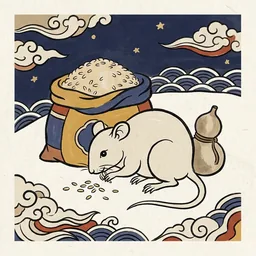
Mu-ja (戊子) Day Pillar: Personality, Love and Career
Mu-ja (戊子) is a hill by a lake: calm, thrifty and sharp with cash. Its quiet ideas ripen unseen, and then they all come at once, like a bolt of light.
- Practical
- Resourceful
- Money-aware
- Quietly inventive
- Slow reveal
- Sudden spark
At a glance
- Day stem (the "self")
- Mu (戊) · yang Earth
- Day branch
- Ja (子) · Rat · yang Water
- Growth stage of the day stem
- Conception (胎)
- Nayin ("sound") element
- Thunderbolt Fire (霹靂火) · Fire
- Void branches (kongwang)
- O (午) · Mi (未)
- Stem that combines with yours
- Gye (癸) → Fire
- Six-harmony partner
- Chuk (丑)
- Clashing branch
- O (午)
- Triad branches
- Jin (辰) · Sin (申)
Hidden stems
- Im (壬)Indirect Wealth (偏財)
- Gye (癸)Direct Wealth (正財) · main qi
Stems stored inside the branch, each shown with its ten god relative to your day stem. The last one is the main qi.
Stem and branch. The stem controls the branch. You press on your surroundings and act on them; practical drive is high and so is the effort.
Growth stage of the day stem. A seed of potential: ideas are forming, plans come before action, and nurture matters a great deal.
Nature and personality
The Mu-ja (戊子) day pillar is earth above water: a mountain bank holding back a deep reservoir, which makes for a practical, resourceful personality that notices what things cost, what they are worth and how to make them work. People born on a Mu-ja day tend to look calm and unhurried while doing a good deal of quiet calculation underneath, with ideas that take their time to surface and then arrive fully formed. In saju, the Four Pillars system, the day pillar is the two-character mark of the day you were born. The top character, the day master, stands for you; the bottom one, the day branch, stands for your private temperament and closest circle. The day master is 戊, yang earth, the large, solid ground that bears weight. The branch is 子, the rat, which is water, the water of the deepest, quietest hour of midnight in midwinter. Earth controls water, as a bank holds a river in, so the stem controls the branch: you press on your surroundings and shape them, and practical drive is high and so is the effort. Hidden inside the rat are two stems, and both are Wealth in the ten gods, saju's ten ways of describing how another energy relates to the day master. The main one is 癸, Direct Wealth: income that is earned, counted and kept, such as salary, savings and household order. Underneath is 壬, Indirect Wealth: money and opportunity that flow, such as trade, side projects, a wide network and the instinct for a good deal. An inner circle made entirely of Wealth is why money and practical affairs are never far from a Mu-ja mind. The growth stage is Conception (胎): the seed has formed but is not yet born, so ideas and plans gestate longer than anyone sees. The nayin, a poetic name for each pillar, is Thunderbolt Fire (霹靂火), a flash of lightning: the quiet surface can break into a sudden decision or a burst of work.
Strengths
- Practical sense of value, cost and timing
- Resourceful, finds a way with what is on hand
- Patient planner who lets ideas ripen
- Hard worker who does not need an audience
- Sharp, sudden insight when it counts
Challenges
- Keeps worry and calculation running in the background
- Slow to share plans, so others cannot help
- Can try to manage people like accounts
- Overworks, because effort is the way to feel safe
Love and relationships
Love, for Mu-ja, is mostly logistics done with feeling: the lift to the airport booked early, the gift chosen months ahead because it was exactly right and happened to be on sale. Because the inner circle is made of Wealth, the partner is read as someone to care for and build a life with, and the care is practical and long-range. This is the person who asks 'Have you eaten yet?' and then cooks. Mu-Ja is not quick to show the romantic side. Conception keeps feelings forming for a long time before they are said, and the earth stem holds water back, so you may seem more reserved than you are. The weak point is managing: arranging the schedule, the budget and sometimes the partner's decisions, then feeling unappreciated. A partner who is light-hearted, says plainly what they need and is not bothered by a bit of planning is a good fit. Tradition adds that 戊 combines with 癸, the quiet rain water that sits in the rat as its main hidden stem; some readers take this as a pull toward gentle, thoughtful people and strong attachment once committed. It is a lean, not a promise.
Work and career
Mu-ja does well wherever work is about getting resources to the right place at the right price. With Wealth on both levels, the usual picture is a person who is good with numbers, suppliers and negotiation: accounting and bookkeeping, procurement and purchasing, logistics and supply chains, retail and wholesale, import and export, banking operations, property administration and food distribution. The Indirect Wealth side suits independent trade, a small business or any role with many contacts, and the Direct Wealth side suits steady salaried work with a clear scope. Many Mu-ja people run both, a job and a small business in parallel. The rat adds quickness with information: the colleague who has last quarter's answer within a minute and who has already quietly compared three quotes. The weak spots are working alone for too long and treating every project as a cost to be controlled. Say what you are building before you start counting, so that people can pitch in.
Money
Money is a visible theme in this pillar, since the inner circle holds only Wealth: Direct Wealth as the main stem and Indirect Wealth beneath it. Mu-ja tends to know roughly what is in each account, what a subscription costs and when a bill falls due. The earth stem acts as a bank for the water, so saving feels natural, and the Indirect side likes a second stream such as freelance work, a small sale or a skill that pays. Two things to watch. The first is worry: a pillar this alert to money can feel short of it at any level, so naming 'enough' as a number helps. The second is the flow in the other direction, with money going to relatives, group dinners and projects started on enthusiasm. A plain system works: pay bills and savings automatically on payday, keep a visible fun allowance, and review the whole thing once a quarter, not every day. This is about everyday saving and spending habits, not investment advice.
Energy and wellbeing
Water under a heavy bank tends to mean held-in worry: calculations, to-do lists and money thoughts that circle at the hour the rat rules, around midnight. In five-element terms the nayin brings fire, which is the missing warmth: sunlight, warm meals, a hot bath or sauna, and anything that gets laughter into the evening. Regular sleep matters more than average for this pillar, and so does leaving the banking app alone after dinner. Walking or other movement helps water flow instead of pooling. Read all of this as traditional lifestyle symbolism for Mu-ja, not as medical advice.
Who you get on with
Traditionally the rat's six-harmony partner is the ox (丑), an earth branch that stores a little water of its own, patient, practical and slow to warm. Gye-chuk (癸丑) adds the 戊 and 癸 combination as well, and the next pillar in the cycle, Gi-chuk (己丑), carries the same ox branch. The rat also forms a water triad with the dragon (辰) and the monkey (申), branches that move in the same direction, so those signs tend to feel familiar quickly, with shared plans and shared humour. The clash is the horse (午), fire against water: opposite tempos, impulsive against calculating. The horse is also one of this pillar's void branches (午未), which tradition reads as a link that feels thinner or comes later, so the clash is said to land less sharply. By element, fire people warm the earth and tend to draw out the playful side, wood people bring structure and sometimes pressure, metal people give ease of expression, and another water-heavy friend can mean two worriers comparing notes. What a pairing is really like depends on the whole of both charts.
How life tends to unfold
Daewoon are the ten-year luck cycles of saju: each decade carries its own stem and branch, and the age at which the first one starts is worked out from your birth date. With the day master at Conception, Mu-ja's early chapters often feel like a long gestation: a lot of gathering, learning the ropes and building a base before results are visible, followed by a point in the middle where several things come due at once. Fire cycles tend to feel like support, with mentors, qualifications and a warmer atmosphere. Wood cycles bring roles, titles and duties, and also pressure. Metal cycles open expression and give the quiet planner a voice. Water cycles bring more income and more business, and also more calculation and worry. Earth cycles bring peers and partners in a venture. The horse and the goat are void for this pillar, so those years are traditionally read as less anchored, and a reason to put plans on paper. Which decades feel like which depends on the whole chart.
Advice
Name 'enough' as a figure and a date, then stop re-checking it. Tell one person your plan while it is still half-made; ideas that gestate in the dark are lighter once someone else has seen them. Treat the people around you as partners rather than accounts to be balanced. Keep one expense that is only for joy, decided in advance so it needs no defence. And when the sudden idea strikes, as thunderbolts do, give it a night before you act: if it is still there in the morning, it is probably yours.
Frequently asked questions
Is Mu-ja a good day pillar for money?
It is a money-aware pillar rather than a lucky one. The rat holds only Wealth stems, so earning, saving and practical affairs are a constant theme, and people with it are often careful and resourceful. Whether money actually grows depends on the rest of the chart, the luck cycles and your habits. No pillar is richer than another.
What does the Conception stage mean for a Mu-ja day pillar?
Conception is the stage where a new life has been formed but is not yet visible. For Mu-ja it suggests ideas and plans that need time before they show, and a person whose early years are spent preparing. It is not a delay or a handicap. It describes a slow, careful start that often pays off in the middle years.
Which day pillars suit Mu-ja best?
Tradition points to the ox branch as the six-harmony partner, with the dragon and the monkey in the water triad, and to a 癸 stem for the 戊 and 癸 combination. The horse is the classic clash, which tends to feel like opposite tempos. These are leanings only; honest communication matters far more than any chart.
Learn the terms on this page
Is this your day pillar?
Your day pillar comes from your exact birth date, not your birth year. Enter it in our Four Pillars calculator and it shows all four of your pillars.
New to saju? Saju (四柱, "four pillars") describes a person by the year, month, day and hour of birth. The day pillar is the centre of it: its stem is you, and its branch is your closest circle and your home life.