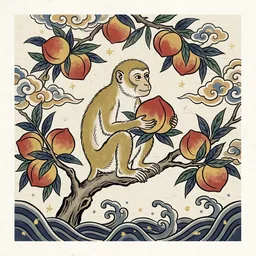
Byeong-sin (丙申) Day Pillar: Personality, Love and Career
Byeong-sin (丙申) is late sun on bright metal: a quick, warm and handy pillar, apt to turn an idea into a tool, to fix a snag and to spot the gap most miss.
- Quick-witted
- Resourceful
- Sociable
- Hands-on
- Restless for novelty
- Sensitive underneath
At a glance
- Day stem (the "self")
- Byeong (丙) · yang Fire
- Day branch
- Sin (申) · Monkey · yang Metal
- Growth stage of the day stem
- Illness (病)
- Nayin ("sound") element
- Fire at the Mountain Foot (山下火) · Fire
- Void branches (kongwang)
- Jin (辰) · Sa (巳)
- Stem that combines with yours
- Sin (辛) → Water
- Six-harmony partner
- Sa (巳)
- Clashing branch
- In (寅)
- Triad branches
- Ja (子) · Jin (辰)
Hidden stems
- Mu (戊)Eating God (食神)
- Im (壬)Seven Killings (七殺)
- Gyeong (庚)Indirect Wealth (偏財) · main qi
Stems stored inside the branch, each shown with its ten god relative to your day stem. The last one is the main qi.
Stem and branch. The stem controls the branch. You press on your surroundings and act on them; practical drive is high and so is the effort.
Growth stage of the day stem. Sensitive and thoughtful with a strong inner life. The body may tire easily; imagination and care run deep.
Nature and personality
Byeong-sin (丙申) is the sun in the late afternoon shining on bright metal, and people born on this day tend to be quick, sociable and practical: charming problem-solvers who like to turn an idea into something that actually works. They are warm without being heavy and clever without needing to prove it, and what others notice first is how fast they read a room and find the useful angle. Korean saju, the Four Pillars system, describes a birth through four pillars, and the day pillar (ilju) is the one that speaks about you personally. Its upper character, the day master, is the self; its lower character is a branch, one of twelve animals, standing for your private temperament and closest circle. Here the day master is 丙, yang fire: the sun itself, which gives light to everyone without asking who deserves it. The branch is 申, the monkey, a metal sign whose hours are the middle of the afternoon and whose season is the first weeks of autumn: tools, coins and blades, things made by hands that know how. Fire melts and shapes metal, so in saju language the stem controls the branch. The sun works on its material. This is a person who presses on their surroundings, tinkers, improves and rearranges instead of simply admiring how things are, and practical drive is high, and so is the effort. Inside the monkey sit three hidden stems, each tagged with a ten god, a saju term for how another energy relates to the day master. The main one is 庚, Indirect Wealth: raw metal and opportunity, a nose for deals, trades and useful side channels. Beneath it is 壬, Seven Killings: flowing water that tests fire. Despite the dramatic name it means pressure and challenge, and it gives this pillar nerve under stress and a taste for hard problems. The faintest is 戊, Eating God: broad earth, the gift for expression, craft and putting people at ease. The day master's growth stage is Illness (病), one of twelve phases in a life-cycle metaphor, and it describes sensitivity and awareness, not ill health. The nayin, the traditional poetic name for the pillar, is Fire at the Mountain Foot (山下火): not a bonfire but a steady, sheltered glow, like a lantern at the base of a hill after the sun has slipped behind it.
Strengths
- Fast, flexible problem-solving
- Reads people and rooms quickly
- Turns ideas into working things
- Cool head when the pressure rises
- Easy humour that keeps groups relaxed
Challenges
- Loses interest once the puzzle is solved
- Fixes things when someone only wanted to be heard
- Pushes past tiredness until it shouts back
- Buys the tool before deciding on the project
Love and relationships
Playfulness is the first sign. A Byeong-sin person flirts through jokes, teasing nicknames and clever little gifts that prove they were really listening, and they have a talent for finding plan B when the dinner reservation falls through. The day branch is called the spouse palace, the seat of the closest partner in a chart, and here it holds the monkey: quick, curious, bored by routine and delighted by novelty. Expect the partner who suggests the odd little restaurant and then fixes your phone on the way home. The Seven Killings hidden in that palace is traditionally read as an attraction to capable, spirited people, those who can keep up and push back a little. And because the stem controls the branch, there is a habit of improving the relationship itself: planning, optimising, solving. That can slip into fixing when the partner only wanted company in a bad mood. What helps is someone who laughs easily, says honestly whether they want advice or just ears, and leaves room for new interests. Tradition adds a pull toward 辛, yin metal, the polished jewel, a pairing of sun and gem; treat it as a lean and nothing more. The pillar's lesson in love is staying for the slow, ordinary parts as well as the bright openings.
Work and career
Give this pillar a messy problem and a real deadline and it wakes up. Byeong-sin is often the colleague who finds the workaround, knows which supplier answers on a Friday and can explain a new system in ten minutes at the whiteboard. The monkey's metal suits work with tools, technology and mechanisms: engineering and product development, software and gadgets, technical sales, repair and installation, design and prototyping, logistics and purchasing, trade and import-export, or media production where gear and timing matter. The Indirect Wealth hidden in the branch also fits roles built on deals, negotiation and several channels at once, so a freelance mix or a commission-based post can feel natural. Seven Killings adds ease under pressure, which suits live events, operations desks and fast-moving start-ups. The weak point is the finish: once the puzzle is solved, interest drains and the paperwork piles up. A checklist or a detail-minded partner for the dull last ten percent, and work where the problems keep changing, make the difference.
Money
Money here has a sharp eye and a soft spot. The Indirect Wealth in the monkey is the traditional picture of someone who sees where value is hiding: a second-hand bargain, a small supplier with a better price, a skill that can be sold twice. Income often comes through more than one stream, and cash is earned by cleverness more than by patience alone. The soft spot is gear: the better lens, the new gadget, the tool for a hobby that might last a month. A simple rule keeps it affordable, such as waiting a full day before any non-essential purchase above a set amount, plus an automatic transfer into a savings account on payday so the clever part of you spends from what is left. This is everyday money habit, not a financial recommendation.
Energy and wellbeing
Fire working on metal is heat applied steadily to something hard, and the lifestyle theme is tension that builds quietly: a head full of next steps, shoulders creeping toward the ears, a body that skips lunch because the problem is more interesting. The Illness stage adds a fine sensitivity to atmosphere and fatigue, so this pillar often feels the early signal before others do, and the habit worth keeping is to answer it. Tradition pairs metal with dry air and the breath, so unhurried evening walks, a proper midday break away from the screen and regular sleep suit this pillar well. Water-side habits such as swimming or a warm bath cool the fire gently. Read this as traditional lifestyle imagery and not as a health opinion.
Who you get on with
The monkey's traditional six harmony partner, a pairing said to fit together easily, is the snake (巳), so snake-branch days such as Jeong-sa are where tradition looks for comfortable company. The snake is also one of this pillar's void branches (辰巳), which tradition reads as a link that feels lighter or arrives later, not as a fault. In the water triad the monkey travels with the rat (子) and the dragon (辰), three branches that move in the same direction and often feel like instant allies; Byeong-jin (丙辰), the sun over the dragon, shares that triad. The clash is the tiger (寅): two quick personalities each wanting the lead, so friction is about pace and who decides. It is not a curse, and plain talk about who drives usually settles it. By element, wood feeds your fire and is a generous companion, water steadies and challenges it, earth takes the edge off the heat and offers somewhere to rest, and other metal people are the ones you shape, polish or compete with. The day stem 丙 is said to combine with 辛 toward water; a 辛 day master often brings out your softer side. All of it depends on the rest of each chart.
How life tends to unfold
Saju counts life in ten-year stretches called daewoon, the great luck cycles. Each is a stem-and-branch pair that colours a decade the way a season colours a year, and the start age and direction come from the birth date. For Byeong-sin, the Illness stage and the sheltered glow of its nayin suggest a pattern in which the early years are spent noticing, sampling and trying on skills, and the strongest stretches come once the practical craft has settled into a recognisable speciality. In general, wood cycles add fuel and ideas; water cycles bring pressure, stricter standards or bigger responsibility, which can feel like growing up fast; earth cycles calm the heat and often show up as steadier output and a settled routine; metal cycles feed the material side, with deals, equipment and income streams; fire cycles add visibility and rivalry. Traditionally the dragon and snake (辰巳) are void for this pillar, so decisions tied to those years are worth writing down in detail. What a given decade is like depends on the rest of the chart, so read all this as tendency, not timetable.
Advice
Before you improve someone else's plan, ask whether they want it improved. Pick one project a month to carry to its dull end, and let a checklist hold the details you find boring. Treat the first signal of tiredness as information and not as an interruption, and schedule a real break in the mid-afternoon, the monkey's own hour. Spend on tools slowly and on people generously, and say a plain thank-you to the ones who tolerate your fifteen ideas an hour.
Frequently asked questions
Does the Illness stage mean a Byeong-sin person will be unwell?
No. Illness (病) is the seventh of twelve growth stages, a metaphor borrowed from a life cycle and not a forecast of health. In saju it pictures the moment just after a peak, when sensitivity and awareness are sharpest, so it is read as perceptiveness and an eye for what is off in a room. Questions about real health belong with a doctor.
Seven Killings sounds frightening. Is it a bad sign in Byeong-sin?
No. Seven Killings is the name of one of the ten gods, the one for energy that controls the day master, and in daily life it stands for pressure, competition and tests. The name comes from old texts and sounds dramatic, but it also describes nerve, drive and a talent for high-stakes tasks. In the monkey it is a hidden, middle-strength stem, not the main one.
Is the Byeong-sin day pillar the same as the Fire Monkey year?
The pair of characters is the same, but the use is different. 丙申 returns as a year every sixty years (2016 was a Fire Monkey year) and as a day every sixty days. Your day pillar comes from your birth date and describes you personally, while the year pillar is just one other layer of the chart. A Four Pillars calculator will find your day pillar.
Learn the terms on this page
Is this your day pillar?
Your day pillar comes from your exact birth date, not your birth year. Enter it in our Four Pillars calculator and it shows all four of your pillars.
New to saju? Saju (四柱, "four pillars") describes a person by the year, month, day and hour of birth. The day pillar is the centre of it: its stem is you, and its branch is your closest circle and your home life.