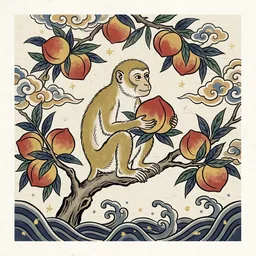
Im-sin (壬申) Day Pillar: Personality, Love and Career
Im-sin is a river fed by a spring in rock: quick, clever and easy to adapt. It takes help in stride, learns from odd sources and keeps plans to itself.
- Quick-witted
- Adaptable
- Self-reliant
- Restless
- Sharp-edged
- Resourceful
At a glance
- Day stem (the "self")
- Im (壬) · yang Water
- Day branch
- Sin (申) · Monkey · yang Metal
- Growth stage of the day stem
- Birth (長生)
- Nayin ("sound") element
- Sword-Edge Metal (劍鋒金) · Metal
- Void branches (kongwang)
- Sul (戌) · Hae (亥)
- Stem that combines with yours
- Jeong (丁) → Wood
- Six-harmony partner
- Sa (巳)
- Clashing branch
- In (寅)
- Triad branches
- Ja (子) · Jin (辰)
Hidden stems
- Mu (戊)Seven Killings (七殺)
- Im (壬)Companion (比肩)
- Gyeong (庚)Indirect Resource (偏印) · main qi
Stems stored inside the branch, each shown with its ten god relative to your day stem. The last one is the main qi.
Stem and branch. The branch feeds the stem. The day master is supported from below, so help and nourishment tend to arrive without much asking.
Growth stage of the day stem. A newborn's stage: hopeful, quick to learn and well supported by others, with a fresh start in the air.
Nature and personality
The Im-sin (壬申) day pillar is a wide river fed by a spring in the rocks: quick, clever and adaptable, with a mind that is already three steps down the road while the conversation is still on its first. People born on an Im-sin day tend to be resourceful, self-reliant and a little hard to pin down, good at finding the way round an obstacle and slow to explain how they did it. The day pillar (ilju in Korean) is the pair of characters, one stem over one branch, that names the day you were born in saju, the Korean Four Pillars system. The upper character is the day master, meaning the self; the lower one is the day branch, your private temperament and closest circle. Here the day master is 壬, yang water: not rain or a pond but the open river and the sea. The branch is 申, the Monkey, which belongs to metal. In the five elements, metal gives rise to water, the way a spring seeps out of stone, so the branch feeds the stem. Help tends to reach this person without much asking: a colleague passes along the right contact, an elder makes an introduction, a lead turns up in an unlikely place. Every branch also holds hidden stems, smaller energies tucked inside, and each is named by a ten gods role, one of ten labels for how another stem relates to the day master. The main one in the Monkey is 庚, Indirect Resource: the unconventional kind of learning and protection, such as self-teaching, odd side interests, strong hunches and the teacher who does not look like a teacher. The middle one is 壬 itself, Companion, a self-reliant core that prefers to work things out alone. The faintest is 戊, Seven Killings, the ten god of pressure and challenge; here it works like a riverbank, a readiness to take on a hard job and a certain edge. The day master sits at the Birth stage (長生) of the twelve growth stages, the moment a spring first starts to run: a fresh, welcome, curious beginning. The nayin, the poetic name attached to each pillar, is Sword-Edge Metal (劍鋒金), the keen edge of a blade, which suits a mind that cuts straight to the point.
Strengths
- Finds the way round an obstacle quickly
- Learns from unusual sources and keeps learning
- Adapts to new people and places without fuss
- Keeps a cool head when a situation turns tense
- Self-reliant, with a sharp eye for what matters
Challenges
- Keeps plans and feelings private until the last moment
- Slips away quietly when something starts to feel heavy
- Sharp tongue when impatient
- Many threads open at once, few tied off
Love and relationships
Im-sin flirts with ideas first, and affection comes out as wit. This is the person who sends you a photo of a badly translated menu with a one-line caption, who read the rules of the board game on the train, and who asks the odd, specific question that proves they were listening. The day branch is traditionally called the spouse palace, the seat of the closest partner in a chart, and here it holds the Monkey, so the pillar is drawn to someone nimble, curious and never dull, a partner who can still surprise them at a long dinner. The soft spot is retreat. Water goes underground when a feeling gets heavy: the Im-sin partner says "I'm fine", becomes busy and cool, and works the problem out in private, which can look like indifference from the outside. The Companion inside the branch adds a habit of self-sufficiency, so asking for comfort feels unnatural. What helps is a partner who gives room without leaving, does not mind being told things late, and says plainly when they would like more. In the other direction, one clear sentence offered before the quiet begins does a great deal. Tradition also says 壬 is drawn toward 丁, a candle flame, which hints at a taste for warm, gentle, fine-grained people; it is a lean, not a rule.
Work and career
Im-sin does well wherever there is a tangle to unpick and no manual to follow. Think of the colleague who joins a stalled project in its third week, finds the one broken link in the chain and moves on to the next fire. The Indirect Resource in the Monkey points toward work that runs on knowledge and cleverness: translation and interpreting, linguistics, research, journalism and editing, data and systems work, logistics and trade, consulting, and travel or cross-border business. The hidden Seven Killings gives an appetite for pressure, so crisis coordination, negotiation, auditing and troubleshooting roles also suit. What wears this pillar down is repetition without a puzzle, or a manager who wants every step reported. Autonomy matters more than the job title. Because Im-sin starts fast and may move on, a few chosen projects with a visible finish line, and someone to hand the final polish to, let the cleverness count.
Money
Water moves, and Im-sin money tends to move too. None of the hidden stems in the Monkey is a wealth star, so money is rarely the main goal; it arrives through skill, contacts and several small channels, such as a salary plus a freelance job or a translation done on the side. Spending leans toward gadgets, courses, travel and anything that makes the next trip or project smoother. The risk is slippage rather than extravagance: small subscriptions, spur-of-the-moment bookings and forgotten transfers that add up unnoticed. A simple habit helps, such as a separate account that takes a fixed amount on payday plus a named travel or learning pot, so that the freedom has a budget of its own.
Energy and wellbeing
Water over water with metal beneath it makes a cool, quick pillar with little fire or earth in its two characters to warm and ground it. Tradition reads the common pattern as a restless head and a body that runs cold: late-night scrolling, shallow sleep, cold hands, skipped meals when absorbed in something. Warm cooked food, regular mealtimes, morning daylight and a walk or run that carries the thoughts away tend to suit it. This is lifestyle symbolism, not medical advice; if sleep or mood trouble persists, a doctor is the right person to ask.
Who you get on with
Traditionally the Monkey's six harmony partner is the Snake (巳), a quiet, deep pairing in which the Snake's focus gives the Monkey's quick mind somewhere to settle. A Jeong-sa (丁巳) day is the classic example, because its stem 丁 is also the one 壬 is said to combine with. The Monkey forms a water triad with the Rat (子) and the Dragon (辰), three branches that run in the same direction, so those people often feel familiar fast: the same pace of joking, the same habit of drifting off to think. The Tiger (寅) is the Monkey's clash, two fast, strong-willed signs meeting head-on. That is friction of tempo, not a curse, and it softens when each lets the other finish the sentence. By element, fire people warm the cool river and are often welcome company, wood people give your cleverness something to grow, and another water person can flood a conversation with talk and no decisions. Gye-yu (癸酉), the next day in the cycle, is the same water in yin form, dew and rain instead of a river. The void branches (空亡) for this pillar are the Dog (戌) and the Pig (亥); tradition reads ties through those animals as lighter and less anchored. How well any two people get on is settled by the full charts, not by one pillar.
How life tends to unfold
Daewoon are the ten-year luck cycles of saju, each a stem-and-branch pair that colours one decade, with the starting age and direction worked out from the birth date. A day master at the Birth stage often meets early life with ease and curiosity: plenty of starts, a sense that doors open, and a long period of trying things before a line is chosen. Metal and water cycles usually add more of what you already are, with good timing for study, travel and independence. Wood cycles invite you to put the cleverness into something visible. Fire cycles pull warmth, money and relationships into focus, often with more responsibility attached, and earth cycles press down, which feels heavy but is also where a river learns to be a channel. When the Dog or the Pig turns up in a cycle or year, tradition says matters tied to them feel loosely anchored; treat that as a reason to put agreements in writing. Which decades feel like which is a question for the whole chart.
Advice
Tell one person your plan before it is finished; the support is real, but it cannot reach what it cannot see. Pick one project a season and carry it to the end, polish included. When a feeling gets heavy, say it in one line before going quiet. Keep your money visible in one account you glance at weekly, and let warm food and daylight do the quiet work of keeping the river from running cold.
Frequently asked questions
Why is Im-sin called the water monkey?
Im (壬) is yang water, the large open river, and Sin (申) is the Monkey, an animal that belongs to the metal element. People shorten the pair to water monkey. The animal in your day pillar describes your inner temperament and closest circle; it is not the zodiac animal of your birth year, which belongs to a different pillar.
What does the Birth stage mean for an Im-sin day pillar?
Birth (長生) is the first of the twelve growth stages in saju. Picture a spring beginning to run, or a baby arriving in the world. For Im-sin it adds freshness, early support and curiosity, a feeling that life keeps handing over new beginnings. The other side is starting more than gets finished, which a few firm finish lines can balance.
What does Sword-Edge Metal mean as a nayin?
Nayin are poetic names the old texts attach to the sixty pillars, two neighbouring pillars sharing one. Sword-Edge Metal (劍鋒金) is the cutting edge of a blade: sharp, quick and decisive, shared here with the next pillar, Gye-yu. For Im-sin it echoes a clear mind and direct speech. It is an image that adds colour, not a verdict.
Learn the terms on this page
Is this your day pillar?
Your day pillar comes from your exact birth date, not your birth year. Enter it in our Four Pillars calculator and it shows all four of your pillars.
New to saju? Saju (四柱, "four pillars") describes a person by the year, month, day and hour of birth. The day pillar is the centre of it: its stem is you, and its branch is your closest circle and your home life.