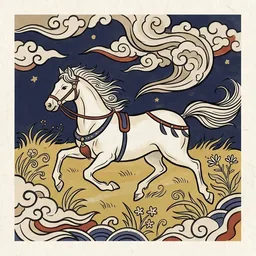
Byeong-o (丙午) Day Pillar: Personality, Love and Career
Byeong-o (丙午) is the noon sun on a fast horse: a day pillar of double fire that is warm, frank and open-hearted, and does best when it is on the move.
- Radiant
- Frank
- Wholehearted
- Generous
- Restless
- Quick to ignite
At a glance
- Day stem (the "self")
- Byeong (丙) · yang Fire
- Day branch
- O (午) · Horse · yang Fire
- Growth stage of the day stem
- Peak (帝旺)
- Nayin ("sound") element
- Water of the Heavenly River (天河水) · Water
- Void branches (kongwang)
- In (寅) · Myo (卯)
- Stem that combines with yours
- Sin (辛) → Water
- Six-harmony partner
- Mi (未)
- Clashing branch
- Ja (子)
- Triad branches
- Sul (戌) · In (寅)
Hidden stems
- Byeong (丙)Companion (比肩)
- Gi (己)Hurting Officer (傷官)
- Jeong (丁)Rob Wealth (劫財) · main qi
Stems stored inside the branch, each shown with its ten god relative to your day stem. The last one is the main qi.
Stem and branch. Stem and branch share one element. The energy is concentrated and single-minded, strong in focus and short on variety.
Growth stage of the day stem. The height of strength: confident and commanding, with a real risk of overreaching or going it alone.
Nature and personality
The Byeong-o (丙午) day pillar is the blazing midday sun standing on a galloping horse: a warm, direct, high-energy personality that lights up a room and finds it almost impossible to hide what it feels. Both halves of the pillar are fire, so people born on a Byeong-o day tend to be wholehearted, quick to ignite and honest to a fault, with little patience for half measures. In saju, the Korean four pillars system, every birth chart has four pillars (year, month, day and hour), and each pillar is a pair: a heavenly stem on top and an earthly branch, one of the twelve animals, below. The day pillar is the one that describes you personally. Its stem is called the day master, the core self, and its branch is the private side of you and your closest relationships. In Korean this pillar is called an ilju. Here the day master is 丙, yang fire, the sun itself rather than a campfire: it does not ask who deserves its light, it simply shines on everyone, which is why these people are so openly generous and so visible. The branch is 午, the horse, also fire, the hour of noon and the height of summer. Because stem and branch share one element, the energy is concentrated and single-minded: very strong in focus and drive, a little short on variety and on the habit of cooling down. Inside the horse sit three hidden stems, each read as a ten god, a label for how that energy relates to the day master. The main one is 丁, the candle flame, which counts as Rob Wealth: a sensitive, inner fire that shares what it has but also compares itself with the people around it. Next comes 己, soft earth, the Hurting Officer: the talent for expressing yourself and the dislike of rules that make no sense. Last is 丙 again, the Companion: a stubborn self-reliance. On top of that, the day stem sits at the stage called Peak (帝旺), the fullest strength in the twelve growth stages. This is a person who feels capable early, and whose main lesson is how to pace that power.
Strengths
- Warmth that people feel within minutes of meeting you
- Honesty with no hidden agenda behind it
- Courage to start things and to say what needs saying
- Natural flair for explaining, teaching and performing
- Generosity with time, attention and what you own
Challenges
- Impatience with slow processes, slow replies and slow people
- Running at full heat until sudden exhaustion arrives
- Bluntness that lands harder than you meant it to
- A quiet scorekeeping streak that can turn friends into rivals
Love and relationships
Affection arrives early and openly with this day pillar. The Byeong-o person is usually the one who texts first, plans the surprise and says the sentence others rehearse in their heads for weeks. There is no game-playing in it, and a partner who prefers slow, mysterious courtship may feel swept along at first. In saju the day branch is called the spouse palace, the seat of the closest partner, and here it holds a horse: someone who loves freely, needs to move and talk, and feels smothered by suspicion or by being kept on a short rope. The Hurting Officer hidden inside makes the teasing sharp and the honesty immediate, so a bad mood rarely stays secret; the upside is that arguments flare fast and fade just as fast. What they need back is simple: a partner with a life of their own who notices the effort, says thank you out loud, and can say slow down without making it feel like a verdict. Someone who keeps score in silence is a poor fit; someone who answers a loud feeling with a warm one is a very good one.
Work and career
Work goes best when there is an audience, a team to rally or a problem that needs someone to move first. This is the colleague who volunteers to present, who lifts the room when a deadline gets tense, and who is happiest when the project is a living thing rather than a filing system. Teaching, public speaking, broadcasting, performance, sales and marketing, event and hospitality work, coaching, and early-stage start-ups all give the fire somewhere useful to go; so do the literal fire trades, such as cooking, lighting and energy. The Hurting Officer in the branch makes rigid approval chains and close micromanagement hard to bear, so roles with real autonomy matter more than a grand title. The weak point is maintenance: the long, quiet middle of a project. Pairing with a detail-minded colleague, or building in public milestones, keeps interest alive through the dull stretch.
Money
Money tends to move the way heat does: it arrives with the energy of the moment and leaves the same way, on dinners for friends, gifts, a spontaneous trip or equipment for a new passion. The Rob Wealth hidden in the horse is the traditional picture of sharing resources with peers, so people with this pillar often pick up the bill and lend without asking for a receipt. A practical rhythm helps: set an automatic transfer to a savings account on payday so the generous part of you spends from what is left, and give spontaneity its own small monthly budget so it never needs guilt. Agreeing on group costs before the evening starts also saves some awkwardness.
Energy and wellbeing
With fire on both levels of the pillar and no water inside it, the usual theme is overheating: racing thoughts at night, short temper late in the day, a body that wants to go faster than a schedule allows. Habits that borrow some water's coolness suit this pillar well, such as swimming, a walk by a river, a screen-free hour before bed and regular meals and sleep. Poetically, the pillar's nayin (a classical image attached to each pair) is Water of the Heavenly River, the Milky Way, a reminder that a cooling stream is written into the name. Take this as lifestyle colour for a Fire Horse day, not as medical advice.
Who you get on with
Traditionally the horse has a six harmony partner in the goat (未): the sun over warm earth, a quiet pairing in which the goat's gentleness steadies the horse. Goat-branch days such as the neighbouring Jeong-mi are the easiest place to look for that comfort. The horse also sits in a fire triad with the tiger (寅) and the dog (戌), three branches that run in the same direction; the dog is the steadier of the two partners, and the tiger is one of this pillar's void branches (寅卯), which tradition reads as a link that feels thinner or arrives later. The opposite sign is the rat (子), water against fire, the one traditional clash for the horse. It is a pairing of opposite tempos rather than a curse: the rat plans quietly while the horse bolts, and each can see in the other exactly what they lack. Separately, the day stem 丙 is said to combine with 辛 (yin metal, the polished jewel) toward water, so a 辛 day master often brings out a gentler, more refined side. Among the five elements, wood feeds your fire, earth shapes it and gives it form, and water cools it; all three tend to be useful companions.
How life tends to unfold
Saju divides life into ten-year stretches called daewoon, the great luck cycles. Each is a stem-and-branch pair that colours a decade the way a season colours a year, and the start age and direction are worked out from the birth date. With a day master at Peak strength, this pillar often feels capable and self-assured early, and the first lesson of adult life is usually how to pace the fire rather than how to find it. In general, wood cycles add fuel and can make an already quick pace feel unstoppable; earth cycles give the fire a form, often in the shape of finished work and a clearer voice; metal cycles bring concrete things into focus, such as money, contracts and partnerships; and water cycles meet the fire head on, which can feel like pressure at first but often settles into responsibility and calm. What an actual decade brings depends on the rest of the chart, so read these as tendencies, not a timetable.
Advice
Say the first sentence, then wait one breath before the second; most of your warmth gets through anyway and far fewer sharp edges do. Put rest into the diary like a meeting, finish one thing before starting the next, and give credit loudly when others carry part of the load. Let someone with a patient temperament look over the details of anything long, and let a savings transfer run every month without asking you.
Frequently asked questions
What does the Byeong-o day pillar mean in saju?
It is the pairing of 丙, yang fire, the sun, with 午, the fire horse, sitting at the day position of a Korean four pillars chart. People with it are usually warm, frank and energetic, quick to start and quick to forgive. Your own day pillar comes from your birth date, and a four pillars calculator will work it out.
Is Byeong-o the same as the Fire Horse year?
It is the same pair of characters, but used differently. The sixty stem-and-branch pairs repeat as days every sixty days and as years every sixty years, and 2026 is a Fire Horse year. A Byeong-o day pillar belongs to your birth date and is about you personally, while the year pillar is only one other layer of the chart.
Is Byeong-o a lucky or an unlucky day pillar?
Neither. Saju does not rank the sixty pillars, and fire is simply one kind of temperament. This pillar shows up as brightness, courage and generosity, with a tendency to overheat and to speak too fast. How things go depends on the other three pillars and on the luck cycles, not on this pair alone.
Which day pillars suit Byeong-o best?
Tradition points to the goat (six harmony), then the dog and the tiger (fire triad), and to a 辛 day master for a refined, balancing combination. The rat is the traditional clash and tends to feel like opposite tempos. These are leanings only; two people who communicate honestly matter far more than any chart.
Learn the terms on this page
Is this your day pillar?
Your day pillar comes from your exact birth date, not your birth year. Enter it in our Four Pillars calculator and it shows all four of your pillars.
New to saju? Saju (四柱, "four pillars") describes a person by the year, month, day and hour of birth. The day pillar is the centre of it: its stem is you, and its branch is your closest circle and your home life.