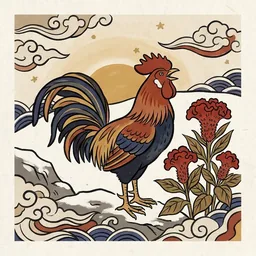
Jeong-yu (丁酉) Day Pillar: Personality, Love and Career
Jeong-yu (丁酉) is a lamp at a jeweller's bench: a fine, steady flame with a sharp eye for quality, a neat hand and a quiet pride in work that is done well.
- Refined
- Exacting
- Quietly proud
- Eye for quality
- Polished
- Fresh-starting
At a glance
- Day stem (the "self")
- Jeong (丁) · yin Fire
- Day branch
- Yu (酉) · Rooster · yin Metal
- Growth stage of the day stem
- Birth (長生)
- Nayin ("sound") element
- Fire at the Mountain Foot (山下火) · Fire
- Void branches (kongwang)
- Jin (辰) · Sa (巳)
- Stem that combines with yours
- Im (壬) → Wood
- Six-harmony partner
- Jin (辰)
- Clashing branch
- Myo (卯)
- Triad branches
- Chuk (丑) · Sa (巳)
Hidden stems
- Gyeong (庚)Direct Wealth (正財)
- Sin (辛)Indirect Wealth (偏財) · main qi
Stems stored inside the branch, each shown with its ten god relative to your day stem. The last one is the main qi.
Stem and branch. The stem controls the branch. You press on your surroundings and act on them; practical drive is high and so is the effort.
Growth stage of the day stem. A newborn's stage: hopeful, quick to learn and well supported by others, with a fresh start in the air.
Nature and personality
The Jeong-yu (丁酉) day pillar is a small, steady flame at a jeweller's bench. People born on a Jeong-yu day tend to be refined, exacting and quietly proud, with a fine eye for quality and a hand that likes to polish a thing until it is right. The flame is gentle but never idle: it is always working on something, whether a sentence, a room or a friendship. In saju, the Korean Four Pillars system, your birth date gives you a day pillar (ilju in Korean), two characters stacked one above the other. The top one, the day stem or day master, stands for you yourself; the bottom one, the day branch, is one of twelve animals and describes your private temperament and nearest circle. Here the stem is 丁, yin fire: not the sun but a lamp, a candle or a hearth ember, a small light that is sensitive to draughts and can be steered with care. The branch is 酉, the rooster, whose element is metal: the metal of cut gems, fine tools and coins, and an animal whose crow marks the start of the day. Fire melts and shapes metal, so in saju terms the stem controls the branch. You press on your surroundings and act on them instead of waiting: this is the person who straightens the crooked frame, rewrites the paragraph, re-sorts the shelf. Practical drive is high, and so is the effort. The pillar is rarely satisfied with good enough and is happiest when something has been refined. Inside the rooster sit two hidden stems, each tagged with a ten god, one of ten labels for how another stem relates to the day master. Both are metal and both are wealth. The residual one, 庚, is Direct Wealth: plain, earned, orderly worth. The main one, 辛, is Indirect Wealth: the finer, sparkling kind that shows up as craft, taste and a feel for what something should cost. So the inner circle is built around value, meaning what things are worth, how they should be made and who has earned what. The day master sits at the Birth stage (長生) of the twelve growth stages, a new life just beginning, which adds freshness and a habit of starting again. The nayin, a poetic nickname for the pillar, is Fire at the Mountain Foot (山下火): a modest fire at the bottom of a hillside, a light a village could steer by.
Strengths
- A refined eye for quality and detail
- Works steadily until the thing is actually right
- Reads what people and objects are truly worth
- Clear, polished way of speaking and writing
- Keeps a beginner's freshness when learning a new skill
Challenges
- Perfectionism that makes finishing, or even starting, hard
- A critical eye that turns on others and on yourself
- Pride that hides disappointment behind politeness
- Redoing a task alone because it is quicker than explaining
Love and relationships
A Jeong-yu person tends to love the way a jeweller works: slowly, with close attention and a clear sense of what is worth keeping. Early on you may notice how exactly they remember things, such as how you take your tea, a song you hummed once, the shoe size you mentioned in passing. Compliments are rare and specific, so when one arrives it is meant. The day branch is traditionally called the spouse palace, the place in a chart that stands for the closest partner, and here it holds a rooster with two wealth stars. Tradition reads that as someone who values a partner's character and standards and wants the relationship to be well made: tidy in its habits, honest, with some style. The weak spot is the same eye. Because the stem controls the branch, the flame can slip into improving a partner, correcting small things aloud, or going cool and silent instead of saying what is wrong. Someone with their own calm taste, who can take a precise question and answers disagreement with humour rather than defence, will feel at ease here. And the Jeong-yu person is happiest once they remember to say the warm sentence as exactly as they would say the critical one.
Work and career
This is the colleague whose document comes back from review with nothing to correct, and who quietly fixes the template for everyone else. Work goes best when quality is visible and someone cares about it. The two wealth stars hidden in the rooster point toward fields that deal in value and craft: jewellery and goldsmithing, tailoring, fashion and beauty, editing and proofreading, typography and design, accounting and auditing, quality control, curation, and careful technical or laboratory work. Fire acting on metal also suggests fabrication, so anything where raw material is turned into a fine object fits. It is a poor fit for workplaces that prize speed over accuracy, or where nobody ever checks anything. Delegating is the hard part, because handing over a task means accepting a version that is not yours. A simple rule for low-stakes work, such as ship at ninety percent, protects both your evenings and your team. Reputation here is built slowly and lasts: people come to you because your name on something means it has been looked at properly.
Money
Both hidden stems are wealth stars, so money is a subject Jeong-yu actually thinks about: prices, quality, what a thing will cost to keep. Tradition reads this as a good eye for value and a preference for earning through skill, in steady and well-defined amounts rather than windfalls. The leak is taste. A better pen, a nicer coat, a tool that is just a little finer, bought one at a time and each justified by quality. Two small habits help: for any non-essential purchase above a set amount, wait a week and see if it is still wanted, and give the habit its own modest monthly budget for fine things. A plain written record of spending suits this pillar, since it enjoys accuracy anyway.
Energy and wellbeing
Fire shaping metal is a picture of precision, and the usual theme here is tension from holding high standards: tight shoulders, a clenched jaw, a mind that is still editing at eleven at night. In the five-element view, metal gives rise to water and water settles fire, so cooling habits suit this pillar: an evening bath, a long glass of water, a walk where nothing is being improved. Fresh air and regular breaks matter more than heroic effort. This is a lifestyle reading of tradition, not medical advice.
Who you get on with
Traditionally the rooster has a six-harmony bond with the dragon (辰) and shares a metal triad with the snake (巳) and the ox (丑), three branches that tend to move together and feel familiar fast. Note that the dragon and the snake are this pillar's void branches (辰巳), which tradition reads as links that feel thinner or arrive later; the ox is the steadier partner here, and a Jeong-chuk (丁丑) day shares your stem as well as that triad. The Jeong-sa (丁巳) pillar is the other triad partner with the same flame above it. The rabbit (卯) is the rooster's clash: wood against metal, a quick, loose temperament against a precise one. That is a pairing of different tempos, not a curse, and it often resolves when one person says plainly what they need. By element, wood people feed your flame, fire people keep you company at the same temperature, and earth people soften the sharp edges. A 壬 day master, yang water, the great river, is said to combine with 丁 toward wood, which tradition reads as a pairing that brings out a gentler side. Past the day pillar itself, how any of this plays out belongs to the other characters in both charts.
How life tends to unfold
Daewoon are the ten-year luck cycles of saju, a sequence of stem-and-branch pairs that each colour one decade the way a season colours a year; the start age is worked out from the birth date. A Jeong-yu day master is at the Birth stage, so the early decades often feel like a slow warming: skills and standards take shape, and the pillar tends to grow sharper rather than louder. In general, wood cycles feed the lamp and can bring learning, ideas and energy; fire cycles raise the flame and bring more drive and visibility, and sometimes impatience; earth cycles turn effort into finished output, which can be productive and also tiring; metal cycles bring the wealth stars back in strong form, pointing to work, money and responsibility; and water cycles press on the flame, with supervision or pressure that asks for steadiness. Tradition also treats 辰 and 巳 as void for this pillar, so arrangements tied to them in a given year can feel less anchored: a reason to double-check agreements, not to worry. Which decade brings what depends on the rest of the chart.
Advice
Decide what finished looks like before you begin, and stop when you get there. Say the appreciative sentence as exactly as you would say the correction. Leave one small thing at home or at work imperfect on purpose and see that the sky stays up. Before redoing someone else's work, ask whether it is wrong or only different. And let a finer purchase wait a week before you decide.
Frequently asked questions
Jeong-yu has two wealth stars; does that make it a rich pillar?
No, and the label is easy to misread. In saju, wealth is the name for the element your own element controls, which here is metal, and it describes a relationship to value, work and practical things, not a bank balance. Jeong-yu holds Direct and Indirect Wealth in the rooster, which points to a keen sense of worth and quality. What a life holds depends on the whole chart and the luck cycles.
What does it mean that the dragon and snake are void branches for Jeong-yu?
Void branches (gongmang in Korean) are the two branches left over at the end of each ten-day run in the sixty-day count, and every day pillar has its own pair. Tradition says that what such a branch stands for feels lighter or less anchored when it appears in a chart or cycle. For Jeong-yu they are the dragon and the snake, so the idea is a nuance to keep in mind, not a flaw.
Which day pillars are the best match for Jeong-yu?
Traditionally the rooster's six-harmony partner is the dragon and its triad partners are the snake and the ox, so days with those branches are the classic matches, though the dragon and snake are void for this pillar and may feel thinner. The rabbit is the clash. Wood and fire elements are also friendly to a flame. These are leanings only; the whole chart, and how two people actually treat each other, count far more.
Learn the terms on this page
Is this your day pillar?
Your day pillar comes from your exact birth date, not your birth year. Enter it in our Four Pillars calculator and it shows all four of your pillars.
New to saju? Saju (四柱, "four pillars") describes a person by the year, month, day and hour of birth. The day pillar is the centre of it: its stem is you, and its branch is your closest circle and your home life.