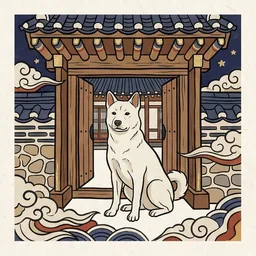
Byeong-sul (丙戌) Day Pillar: Personality, Love and Career
Byeong-sul (丙戌) is the late sun on a tile roof: a warm and loyal giver with a watchful dog's heart, who keeps its deepest feelings in a store of its own.
- Open-handed
- Loyal
- Protective
- Private inside
- Craftsmanlike
- Quietly intense
At a glance
- Day stem (the "self")
- Byeong (丙) · yang Fire
- Day branch
- Sul (戌) · Dog · yang Earth
- Growth stage of the day stem
- Storehouse (墓)
- Nayin ("sound") element
- Earth on the Roof (屋上土) · Earth
- Void branches (kongwang)
- O (午) · Mi (未)
- Stem that combines with yours
- Sin (辛) → Water
- Six-harmony partner
- Myo (卯)
- Clashing branch
- Jin (辰)
- Triad branches
- In (寅) · O (午)
- Traditional label
- Baekho (白虎)
Hidden stems
- Sin (辛)Direct Wealth (正財)
- Jeong (丁)Rob Wealth (劫財)
- Mu (戊)Eating God (食神) · main qi
Stems stored inside the branch, each shown with its ten god relative to your day stem. The last one is the main qi.
Stem and branch. The stem feeds the branch. Energy flows outward into the world, which makes for expressiveness and generosity, and a risk of being drained.
Growth stage of the day stem. The storehouse: thrifty, patient and good at keeping things inside, like treasure locked in a vault.
Traditional label. One of seven pillars the Korean tradition marks as Baekho, "white tiger": intense, sudden and dramatic in how events arrive, said to ask for care with health and haste.
Nature and personality
The Byeong-sul (丙戌) day pillar is the late sun resting on a tiled roof at dusk: generous, expressive and warm to the touch, with the deepest feelings kept in a private store. People born on a Byeong-sul day tend to be open-handed and loyal, more watchful than they first appear, and happiest when they are cooking for, teaching or looking after others. Saju, the Korean four pillars system, writes a birth as four stem-and-branch pairs, and the day pillar is the personal one. Its upper character, the day master, is the self; its lower character, the branch, is one of twelve animals and stands for your home ground and closest bonds. Here the day master is 丙, yang fire, the sun. The branch is 戌, the dog, which carries earth, and fire produces earth. The stem feeds the branch, so the sun pours itself downward into the ground: energy flows out into the world, which makes for expressiveness and generosity, and for a real chance of ending the day drained. The dog is also the Korean emblem of fidelity, as in the well-known folk tale of the Osu dog, which soaked itself in a stream to stop a grass fire from reaching its sleeping owner. The dog holds three hidden stems, smaller energies stored inside a branch, each named by a ten gods role, one of ten labels for how another stem relates to the day master. The main one is 戊, big yang earth, the Eating God: the gift of making and expressing, in cooking, craft, teaching or a job done with visible care. Beside it is 丁, the candle flame, the Rob Wealth, a sharing energy that gives freely and also notices who has what. The residual one is 辛, yin metal, the Direct Wealth, a practical sense of earnings, upkeep and detail. The day stem stands at the growth stage called Storehouse (墓), sometimes translated as Tomb but better pictured as a cellar where grain is put away: energy that is kept rather than spent. The dog is also traditionally the storehouse of fire itself, the place where the fire triad ends and the sun goes at the close of day. The nayin, a classical image attached to each pair, is Earth on the Roof (屋上土): the clay tile that shelters a house, warmth that works as shelter. The pillar also carries a traditional label, Baekho (白虎), the white tiger. Older texts read it as forceful, uncompromising energy, a label for strong will and intensity; modern readers more often take it as courage and a will that commits completely. It is one note among many in a chart, not a verdict.
Strengths
- Generosity that is real rather than performed
- Loyalty that holds through hard seasons
- Care and craft in making things for other people
- A practical eye for what a place or a person needs
- Calm, protective presence when others are anxious
Challenges
- Giving until the tank is empty, then resenting it quietly
- Keeping real feelings in the storeroom so others have to guess
- Slowness to ask for what you need
- A strong will that can tip into stubbornness
Love and relationships
Loyalty is the headline: once a Byeong-sul person decides you are theirs, they are in, and in is a whole-household word, covering your parents' birthdays, your friend's moving day and the odd job that needs a ladder. Affection arrives as protection and generosity more than as speeches, and it can take a while to begin, because the dog watches before it trusts. In saju the day branch is the spouse palace, the seat of the closest partner, and here it holds a dog: faithful, guarding, wary at first, with a private inner room that opens slowly. The Direct Wealth hidden inside points to steady, practical affection, while the Rob Wealth beside it adds a competitive streak, which can show up as a quiet awareness of who else gets your partner's attention. The usual lesson is to let a feeling out before it has been stored for too long. What they need is trust that is plain and returned out loud: a partner who says what they are grateful for, checks in without being asked and does not test loyalty with games. Time alone in the evening, to put the day away, is not a cooling of love.
Work and career
Give this pillar a group that needs looking after and a craft to do it with. Byeong-sul people often become the teacher a class keeps coming back to, the cook whose regulars are loyal, the manager whose team stays, the community organiser who knows every household. The Eating God and Direct Wealth together are traditionally read as earning by making something people use: teaching and tutoring, food and hospitality, crafts and trades, caregiving and counselling, community and non-profit work, and steady businesses built on repeat customers. The weak spots are pricing and boundaries. Generous people undercharge, say yes to the favour that eats the weekend and wait to be noticed instead of asking. Writing down a fee, a scope and a stop time before the work begins keeps the generosity yours to give rather than something taken.
Money
The Direct Wealth in the dog points to earned, practical money: steady income, an eye for upkeep and a dislike of waste. The Rob Wealth next to it is the traditional picture of money shared with peers, so the account tends to feel what friends and family need before it feels the owner's own wishes. The Storehouse stage, meanwhile, gives a real talent for putting things away once a plan exists. Two habits do most of the work: an automatic transfer into savings on payday, and a fixed monthly gifts-and-treats amount, so that generosity has a budget instead of a tab. Deciding ahead how much you could give away without needing it back also makes lending between friends easier on everybody.
Energy and wellbeing
A fire stem feeding an earth branch means the energy runs outward, so the usual theme is depletion rather than overheating: the person who cooks for everyone and forgets to eat, or who is warm and helpful all day and has nothing left by eight in the evening. Earth is traditionally linked with routine, meals and digestion, so regular eating times and an unhurried meal matter more than they might for other pillars. The dog is a dry, late-autumn branch, so water, soups and enough hours of quiet are good refills. A protected hour each evening, with no one needing anything, is the most direct way to restore this pillar. Read it as a lifestyle picture, nothing medical.
Who you get on with
The dog's traditional six harmony partner is the rabbit (卯), a gentle wood animal, and wood is what feeds a fire, so the rabbit tends to be read as a soothing, easy companion. The fire triad is the tiger (寅), the horse (午) and the dog: the tiger is a strong ally, while the horse is one of this pillar's void branches (午未). Void here means one of the two animals left out of this pillar's group of ten in the sixty-day count, a spot that tradition reads as a thinner or later-arriving link. The dragon (辰) is the traditional clash, earth against earth, two storehouses facing each other, which tradition pictures as a vault being forced open. In life it often feels like a person who asks the questions you keep behind the door. It is a challenge more than a curse, and can be a gentle teacher of honesty. The day stem 丙 is also said to combine with 辛, yin metal, toward water, and since the dog already holds 辛 inside, such a person can feel like a familiar fit. By element, wood refuels, water cools and refreshes, and fellow fire shares the load.
How life tends to unfold
The ten-year luck cycles of saju, called daewoon, take life one decade at a time, each ruled by one stem-and-branch pair, with the starting age and direction worked out from the birth date. With the day master at the Storehouse stage, this pillar often keeps its best material in reserve: early adulthood can be quiet, dutiful and full of giving to others, and the person's own voice and ambitions tend to come forward later, once they have allowed themselves to be seen. In general, wood cycles refuel the fire and bring warm company; fire cycles bring confidence and more people to share the load with; earth cycles increase output and demands on you, which is satisfying work and a drain at once; metal cycles bring earnings and recognition for craft; and water cycles bring structure and responsibility, steadying the pace. What an actual decade holds depends on the rest of the chart, so these are leanings, not predictions.
Advice
Pick one evening a week that is yours and treat it as non-negotiable. Decide the size of a favour before you say yes to it, and let the answer be no when the request exceeds that size. Once a month tell one person something you usually keep in the storehouse, a worry, a wish or a thank-you. Let people give back to you; being generous with everyone but yourself is not the same as generosity.
Frequently asked questions
What does the Baekho label on Byeong-sul mean, and should I worry?
No need to worry. Baekho, the white tiger, is one of the four guardian beasts of East Asian tradition, the one that holds the west and autumn, and it appears on ancient Korean tomb murals as a protector. As a label on a handful of day pillars it was read as sharp, forceful energy, and older books took it as a sign of strong will and intensity. Today it is mostly read as courage and determination, a small detail beside the rest of your chart.
Why is the dog called a storehouse, and what is the Storehouse stage?
The dog is the last branch of the fire triad, tiger, horse and dog, so tradition treats it as the cellar where fire is put away at the end of its run. The Storehouse stage (sometimes translated as Tomb) is the twelve-stage image of energy stored like grain rather than spent. It does not mean an ending. It points to depth, reflection and talents that mature late.
How is Byeong-sul different from Byeong-in or Byeong-o?
All three have 丙, the sun, as the self, and the branch makes the difference. Byeong-in stands on a wood tiger that feeds it and tends to be a bright starter. Byeong-o stands on a fire horse and burns double. Byeong-sul sits on an earth dog that it feeds, so the energy flows outward in generosity and loyalty. Same sun, three kinds of weather.
Learn the terms on this page
Is this your day pillar?
Your day pillar comes from your exact birth date, not your birth year. Enter it in our Four Pillars calculator and it shows all four of your pillars.
New to saju? Saju (四柱, "four pillars") describes a person by the year, month, day and hour of birth. The day pillar is the centre of it: its stem is you, and its branch is your closest circle and your home life.