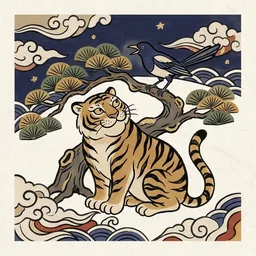
Byeong-in (丙寅) Day Pillar: Personality, Love and Career
Byeong-in (丙寅) is the dawn sun on a tiger's hill: a bright and brave starter fed by teachers and new ideas, who has yet to learn to finish what it starts.
- Fresh starter
- Bright-eyed
- Brave
- Well supported
- Restless
- Quick learner
At a glance
- Day stem (the "self")
- Byeong (丙) · yang Fire
- Day branch
- In (寅) · Tiger · yang Wood
- Growth stage of the day stem
- Birth (長生)
- Nayin ("sound") element
- Fire in the Furnace (爐中火) · Fire
- Void branches (kongwang)
- Sul (戌) · Hae (亥)
- Stem that combines with yours
- Sin (辛) → Water
- Six-harmony partner
- Hae (亥)
- Clashing branch
- Sin (申)
- Triad branches
- O (午) · Sul (戌)
Hidden stems
- Mu (戊)Eating God (食神)
- Byeong (丙)Companion (比肩)
- Gap (甲)Indirect Resource (偏印) · main qi
Stems stored inside the branch, each shown with its ten god relative to your day stem. The last one is the main qi.
Stem and branch. The branch feeds the stem. The day master is supported from below, so help and nourishment tend to arrive without much asking.
Growth stage of the day stem. A newborn's stage: hopeful, quick to learn and well supported by others, with a fresh start in the air.
Nature and personality
The Byeong-in (丙寅) day pillar is the sun coming up over a mountain full of young trees: a bright, brave, forward-facing personality that is at its best at the start of things. People born on a Byeong-in day tend to be optimistic, quick to try the untested road and unusually well supported, with the feeling of being fed from below. A day pillar is the stem-and-branch pair for the day you were born, and in saju, the Korean four pillars system, it is the one pair that speaks about you personally. The upper character is the day master, the self. The lower one is the branch, an animal sign that stands for your private temperament and your closest circle. Here the day master is 丙, yang fire, the sun itself, which lights everyone equally without asking who has earned it. The branch is 寅, the tiger, which carries wood, and wood is what fire burns. Because the branch feeds the stem, the sun has a whole forest underneath it. In everyday life this often looks like help arriving without much asking: a teacher who takes an interest, a family that makes room for a plan, a friend who passes on the right introduction. Every branch also holds hidden stems, smaller energies stored inside, and each is named by a ten gods role, one of ten labels for how another stem relates to the day master. The tiger's main hidden stem is 甲, big yang wood, the Indirect Resource: support of the unconventional kind, such as self-teaching, unusual subjects and hunches that turn out useful. Beside it sits 丙 again, the Companion, a firm trust in your own judgement, and 戊, yang earth, the Eating God, the gift of making and expressing things, whether that is cooking, explaining or playing. The day stem also stands at the growth stage called Birth (長生), the newborn phase of the twelve stages, which tends to keep a person curious and a little youthful for a long time. The pillar's nayin, a classical image attached to each pair, is Fire in the Furnace (爐中火): a fire that is housed and fed, more forge than wildfire, doing its best work when it has something to shape.
Strengths
- Starts things with a freshness that pulls other people along
- Learns quickly, often from unusual angles
- Optimism that survives a bad week
- Courage to take the untested route
- Shares ideas and credit without fuss
Challenges
- Many beginnings, fewer endings
- Restlessness when routine closes in
- Enthusiasm that outruns the plan
- Getting used to being carried, so personal drive can sit unused
Love and relationships
Courtship with a Byeong-in person tends to begin as an outing rather than a declaration: a dawn hike to watch the sunrise, a bus ride to a neighbourhood neither of you knows, a trip booked on a whim and then planned with real enthusiasm. Affection is shown by pulling the other person into whatever is new. In saju the day branch is also called the spouse palace, the seat of the closest partner, and here it holds a tiger: someone who loves boldly and protectively but goes quiet when fenced in. The Eating God hidden inside adds play, teasing and shared meals, and the Companion beside it asks for an equal rather than an audience. The usual weak spot is the second season. The first rush comes easily, and the work is staying curious about a person after the novelty has settled. What they need in return is a partner who can say yes to the next adventure and also hold a steady rhythm for the days in between, who treats an idea as an idea rather than a promise, and who allows solo time without taking it personally.
Work and career
This is the pillar of the first morning on a project: launch week, the first term of a new course, the first season of a venture. Byeong-in people are often the ones who open the new office, pitch the unproven idea or learn the new tool before anyone has asked for it, and they bring a contagious optimism while doing so. Teaching and mentoring, writing and publishing, design, product and start-up roles, travel and outdoor work, and food or hospitality ventures all give the fire room to burn, and the Indirect Resource makes unusual specialist niches a comfortable home. The weak point is the long, plain middle. Admin, reporting cycles and maintenance work tend to feel like a closing door. Splitting a project into short visible phases, or pairing with a colleague who loves finishing, turns this from a flaw into a division of labour.
Money
No wealth god sits inside the tiger, so money here is less a chase than a by-product of interests and skills. The Eating God is traditionally the one that produces wealth, which points to income that comes from something you make or teach rather than from bargain-hunting. What drains the account is usually enthusiasm: courses, equipment, tickets and deposits for the next big thing. A gentle rule is to give each new passion a fixed monthly allowance, and to let an automatic transfer to savings run first, before the allowance is spent. Finish, or consciously drop, the last purchase before buying the next. Whether money becomes a bigger theme depends on the rest of the chart.
Energy and wellbeing
Wood feeding fire with nothing cool or heavy nearby makes this a warm, dry, fast-running pillar. The everyday theme is a motor without a brake: late nights that grow out of a good idea, skipped meals when a project is hot, a body that is keen at seven in the morning and flat at four. Habits that give the fire a rhythm suit it: morning daylight and a walk among trees, regular meals, and a fixed lights-out time that survives the idea of the week. Quiet water habits, such as a glass of water on waking or an evening bath, add the cooling element the pillar lacks. This is a lifestyle reading, not medical advice.
Who you get on with
The tiger's traditional six harmony partner is the pig (亥), the closest natural match, and its fire triad partners are the horse (午) and the dog (戌). Here the picture is subtler, because this pillar's void branches are 戌 and 亥. Void branches, or gongmang, are the two animals left unpaired when the sixty pillars are counted in groups of ten, and tradition reads links to them as thinner, slower to arrive or more spiritual than practical. So the pig and the dog are connections to build on purpose rather than assume, while the horse is the easy, warm one, a triad partner that matches the tiger's pace. The monkey (申) is the traditional clash: wood against metal, a bold pioneer facing a precise editor. It is a contrast of method more than a curse, and often a productive one. Separately, the day stem 丙 is said to combine with 辛, yin metal, the polished jewel, toward water, so a 辛 day master often brings out a more refined side of the sun. By element, earth gives the fire a place to settle, metal gives it something to forge and water cools it down.
How life tends to unfold
Saju also measures life in ten-year stretches called daewoon, the great luck cycles. Each stretch is ruled by one stem-and-branch pair, the pairs follow each other in order, and the starting age and direction are worked out from your birth date. With the Birth stage under the day master, the early years of this pillar are often a period of curiosity and being taught: many Byeong-in people try several directions before one of them keeps its shine, and they commonly feel they are only getting going when peers are settling. In general, wood cycles add more fuel and make the restlessness louder; fire cycles bring bold company and a risk of too many fires at once; earth cycles give the energy form and often produce finished, visible work; metal cycles bring structure, contracts and money into focus, which is the forge doing its job; water cycles cool and steady the pace, and can feel like a slowdown before turning into maturity. What a particular decade holds depends on the rest of the chart, so read these as leanings, not a timetable.
Advice
Before you begin the next thing, write down in one sentence what finished looks like for the current one, and put a date beside it. Tell one person. Keep a plain morning routine as the pole the rest of the day swings around, spend your first hour outdoors if you can, and let a patient friend look at your plans before you commit money to them. Say thank you to your supporters out loud; the help that keeps arriving is easier to keep when it is noticed.
Frequently asked questions
Why is Byeong-in called the fire tiger when a tiger is a wood animal?
Because the name joins two different things. 丙 is yang fire, the day stem, and 寅 is the tiger, whose own element is wood. The stem is the self and the branch is the ground it stands on, so fire tiger means a fire person standing on wood. That arrangement, wood feeding fire, is why the pillar is read as supported and energetic rather than as two fires burning side by side.
Does a void branch mean something is missing from a Byeong-in chart?
No, nothing is missing. The void branches here are the dog and the pig, the two animals that fall outside this pillar's group of ten in the sixty-day count. Tradition reads them as areas where results come later or feel less tangible, which can also mean a freer, more reflective relationship with them. Other pillars in the chart can fill them in, so treat it as a small detail.
Does Byeong-in mean I will always start things and never finish them?
Not always. It is a tendency, not a rule. The Birth stage and the fresh fuel of wood make beginnings feel easy and rewarding, so the risk is losing interest at the plain middle. People with this pillar who set a visible finish line, share it with someone and break long projects into short phases finish just as well as anyone, and often with more enthusiasm.
Learn the terms on this page
Is this your day pillar?
Your day pillar comes from your exact birth date, not your birth year. Enter it in our Four Pillars calculator and it shows all four of your pillars.
New to saju? Saju (四柱, "four pillars") describes a person by the year, month, day and hour of birth. The day pillar is the centre of it: its stem is you, and its branch is your closest circle and your home life.