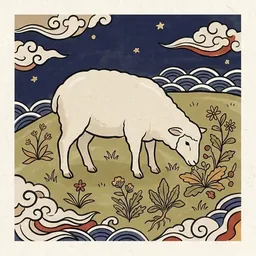
Eul-mi (乙未) Day Pillar: Personality, Love and Career
Eul-mi (乙未) is the wood goat: a vine in warm, dry soil. Soft in manner and practical in drive, it grows by steady work, and its worth is often read as showing later.
- gentle persistence
- quietly practical
- resourceful
- adaptable
- caring in small ways
- late-blooming value
At a glance
- Day stem (the "self")
- Eul (乙) · yin Wood
- Day branch
- Mi (未) · Goat · yin Earth
- Growth stage of the day stem
- Nurture (養)
- Nayin ("sound") element
- Gold in the Sand (沙中金) · Metal
- Void branches (kongwang)
- Jin (辰) · Sa (巳)
- Stem that combines with yours
- Gyeong (庚) → Metal
- Six-harmony partner
- O (午)
- Clashing branch
- Chuk (丑)
- Triad branches
- Hae (亥) · Myo (卯)
- Traditional label
- Baekho (白虎)
Hidden stems
- Jeong (丁)Eating God (食神)
- Eul (乙)Companion (比肩)
- Gi (己)Indirect Wealth (偏財) · main qi
Stems stored inside the branch, each shown with its ten god relative to your day stem. The last one is the main qi.
Stem and branch. The stem controls the branch. You press on your surroundings and act on them; practical drive is high and so is the effort.
Growth stage of the day stem. Being raised: gentle and receptive, supported by family and mentors, growing slowly but surely.
Traditional label. One of seven pillars the Korean tradition marks as Baekho, "white tiger": intense, sudden and dramatic in how events arrive, said to ask for care with health and haste.
Nature and personality
People born on an Eul-mi (乙未) day tend to be gentle on the surface and more persistent than they look: think of a vine or wild orchid rooted in the warm, dry soil of a late-summer hillside. They rarely push head-on. They lean, bend, find the next foothold, and keep growing in one direction until the wall they were climbing is covered. A day pillar is the two-character label for the day you were born in the traditional sixty-day cycle of Korean saju, the Four Pillars system. The upper character, the day stem, is called the day master and stands for you yourself; the lower one, the day branch, describes your home life and inner circle. Here the stem is 乙, yin wood: not a tall tree but the trailing, climbing kind of plant that survives by sensing where the light and the support are. The branch is 未, the goat, an earth sign that tradition links with the dry heat at the end of summer. Wood presses on earth, so in saju terms the stem controls the branch. A vine's roots grip the soil, and in daily life this pillar acts on its surroundings: the person who quietly reorganises the shared kitchen, becomes the one who ends up booking the whole family trip, or keeps a project moving by a hundred small nudges instead of one loud order. Practical drive is real, and so is the effort, though it is delivered softly. Three hidden stems sit inside the goat, each tagged with a ten god, a saju term for how another element relates to your day master. The main one is 己, Indirect Wealth: a feel for what things are worth and where small openings are. Beneath it sits 乙 itself, Companion, a self-reliant, stubborn core that does not need to be told twice what it wants. The faintest is 丁, Eating God: a taste for good food, handmade things and putting people at ease. The day master's growth stage is Nurture (養), the image of a young plant raised by many hands, so skills often arrive through a teacher, a senior colleague or a family friend. The nayin, a poetic nickname for the pillar, is Gold in the Sand (沙中金): value that is real but only shows after time and sifting. Eul-Mi is also one of the day pillars that carry the traditional Baekho (white tiger) label. It is said to point to intensity and strong will, and it is one label among many that does not decide anything on its own.
Strengths
- patient, steady effort that outlasts louder people
- adapts to people and situations without losing direction
- notices value, openings and small practical details
- looks after others through concrete acts, not speeches
- learns well from mentors and builds on what they give
Challenges
- steers things quietly instead of saying what they want
- can take on too much for others and feel unthanked
- stubborn once the mind is set, even when it bends in manner
- slow to show their real talent, so others may underrate it
Love and relationships
Affection from an Eul-mi person usually arrives as practical care: the lunch packed because you skipped breakfast, the umbrella in the bag, the remembered dislike of coriander. That tracks the hidden Eating God (丁), which loves feeding and looking after people, while the Indirect Wealth (己) in the goat makes them attentive to what a partner actually needs rather than what sounds romantic. The day branch is traditionally called the spouse palace, the seat of the partner in a chart, so the goat's contents show what they look for: someone dependable, pleasant to be around, and a true peer. The stem controls the branch, which is the pillar's love-life weak spot. Eul-mi may manage a relationship, planning the calendar and smoothing every edge, and then feel unseen when the partner does not notice the effort. The traditional pull of 乙 toward 庚, hard and decisive metal, suggests a liking for people with clear standards and a firm voice. What helps most is a partner who says plainly what they want, thanks the small things out loud, and does not mistake a soft manner for agreement. Eul-mi in turn does best when they ask directly instead of arranging things in advance.
Work and career
Work suits Eul-mi when it rewards steady growth over showy bursts. A common pattern is the colleague who ends up owning the shared spreadsheet or the supplier relationships because nobody else tends them, and who is quietly indispensable by the second year. Fields that fit the vine-on-earth image include coordination and administration, logistics and purchasing, teaching and tutoring, design of interiors or gardens, food and hospitality, and small businesses where careful handling of stock and people matters. The Indirect Wealth hidden in the goat also favours work with several small streams: a main job plus a craft, a side commission or a part-time class. Because the Nurture stage learns best under guidance, a good first mentor shapes the career more than the job title does. Eul-mi tends to be underrated in the first meeting and trusted by the third, so letting results be seen, not only done, is worth the small effort.
Money
Money habits here follow the Indirect Wealth in the goat: a good sense of what things are worth, pleasure in small bargains and side earnings, and a preference for several modest sources over one big bet. Goat earth also stores, so many Eul-mi people keep a quiet reserve and prefer to know where the money sits. The leak tends to be generosity: paying for the group meal, buying gifts, upgrading a household item for someone else. A fixed monthly transfer to savings made before spending money for others protects the kindness without draining the account.
Energy and wellbeing
In the five-element picture this pillar is wood rooted in dry earth with a trace of fire, which tradition reads as a tendency to run warm and tense when overloaded. Earth is linked with digestion and routine, so regular meals, enough water and an unhurried lunch matter more for Eul-mi than for most. Wood likes to stretch, so walks among plants, stretching and a window with green outside the desk help the vine breathe. For Eul-mi this is lifestyle symbolism drawn from the vine and the dry soil, not medical advice.
Who you get on with
Traditionally the goat has a six-harmony bond with 午, the horse, so people with a horse branch in their chart tend to feel an easy, warm closeness; the neighbouring pillar Gap-o (甲午), the tree above the horse, is the classic image of a vine finding its support. The goat also forms a wood triad with 亥 (pig) and 卯 (rabbit), so those branches bring a sense of growing together. The goat's clash is 丑, the ox, another stubborn earth sign: it is friction between two firm wills, not a curse, and often resolves when both say their preferences plainly. By element, water people refresh the vine, fire people (like Byeong-sin (丙申), the pillar after) bring warmth and cheer, and metal people sharpen it, sometimes pleasantly through the 乙庚 combination, sometimes with an edge. Finally, the void branches (空亡) for this pillar are 辰 (dragon) and 巳 (snake): in tradition, the areas of a chart where those branches fall feel lighter or less anchored. Read that as nuance depending on the rest of the chart, not as a flaw.
How life tends to unfold
The ten-year luck cycles of saju, called daewoon, move through the sixty pillars in order, each colouring one decade with its own element and animal. For Eul-mi the Nurture stage often means an early stretch of learning under other people's wing, followed by a slow, widening middle when practical skill and a network finally show. Cycles carrying water or wood usually feel supportive and growing; fire cycles invite more visible expression; metal cycles press and sharpen, which can feel strenuous but also refines; earth cycles bring resources and responsibility together. Gold in the Sand fits the overall shape: recognition that arrives later than the effort and comes from layers of experience. Which decades feel like which depends on the rest of the chart, including the year, month and hour pillars and the birth time.
Advice
Say the want out loud before arranging the room around it. A short sentence such as 'I would like us to go to the coast this weekend' costs less than a month of quiet steering and gives the people around you a fair chance to say yes. Keep one commitment that belongs only to you, a craft evening or a plant shelf, so the caretaking has a source. Name your price in work and let the results be seen. You are a late bloomer by design, and patience is part of the pillar, not a failing.
Frequently asked questions
Is the Eul-mi day pillar the same as being born in a goat year?
No. The goat in your year pillar is the animal most people mean by the zodiac, but the Eul-mi day pillar refers to the day you were born, a separate position in the same sixty-pillar cycle. A person of any birth year can have an Eul-mi day, and the year animal says something different. A full reading uses all four pillars together.
Does the Baekho (white tiger) label make Eul-mi a difficult pillar?
No, and it is worth keeping it in proportion. Baekho is a traditional label attached to a small group of day pillars, said to indicate strong will and an intense, forceful energy. Modern readers more often take it as courage and determination. It is one label among many in a chart, and it does not decide anyone's relationships, work or luck.
Is an Eul-mi person gentle or tough?
Both, and that is the pillar's signature. The wood stem looks soft, like a vine, yet in saju it controls the earth branch, so the person acts on their surroundings and finishes what they start. The effort is quiet rather than loud. Others often see the gentle manner first and only later realise how firm the direction was all along.
Learn the terms on this page
Is this your day pillar?
Your day pillar comes from your exact birth date, not your birth year. Enter it in our Four Pillars calculator and it shows all four of your pillars.
New to saju? Saju (四柱, "four pillars") describes a person by the year, month, day and hour of birth. The day pillar is the centre of it: its stem is you, and its branch is your closest circle and your home life.