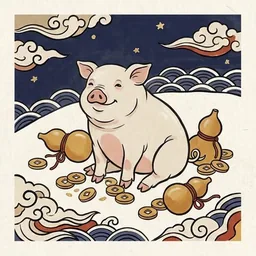
Eul-hae (乙亥) Day Pillar: Personality, Love and Career
Eul-hae (乙亥) is the wood pig: a reed by deep, still water. Kind, dreamy and well helped, it needs time alone and a nudge to turn its ideas into real plans.
- dreamy and kind
- helped from below
- inward imagination
- friend first
- adaptable
- needs quiet
At a glance
- Day stem (the "self")
- Eul (乙) · yin Wood
- Day branch
- Hae (亥) · Pig · yin Water
- Growth stage of the day stem
- Stillness (死)
- Nayin ("sound") element
- Fire on the Mountaintop (山頭火) · Fire
- Void branches (kongwang)
- Sin (申) · Yu (酉)
- Stem that combines with yours
- Gyeong (庚) → Metal
- Six-harmony partner
- In (寅)
- Clashing branch
- Sa (巳)
- Triad branches
- Myo (卯) · Mi (未)
Hidden stems
- Mu (戊)Direct Wealth (正財)
- Gap (甲)Rob Wealth (劫財)
- Im (壬)Direct Resource (正印) · main qi
Stems stored inside the branch, each shown with its ten god relative to your day stem. The last one is the main qi.
Stem and branch. The branch feeds the stem. The day master is supported from below, so help and nourishment tend to arrive without much asking.
Growth stage of the day stem. A still stage: introspective, deep and focused, sometimes seeming detached. The mind leads more than action does.
Nature and personality
The Eul-hae (乙亥) day pillar is the wood pig: a reed or willow growing at the edge of deep, still water. People born on an Eul-hae day tend to be kind, imaginative and easy to be around, with a rich inner life and help that seems to turn up from below without being asked for. A day pillar is the two-character label for the day you were born in the sixty-day cycle of Korean saju, the Four Pillars system. The upper character is the day master, the self; the lower is the day branch, your home life and the people nearest you. The day master here is 乙, yin wood, the supple kind: a grass, a vine or a reed that follows the wind and survives the storm. The branch 亥 is the pig, which carries water. Tradition places it at the start of winter and links it with the sea and the great river, where the big yang water 壬 sits. Water nourishes wood, so the branch feeds the stem. In daily life that means support tends to arrive: a senior who quietly puts your name forward, a landlord who lowers the rent, a friend who shows up with soup before you asked. The day master is carried, not pushed, and that is why Eul-hae people often look relaxed in situations that would worry others. Three hidden stems sit in the pig, each tagged with a ten god, one of ten roles that show how another stem relates to the day master. The main one is 壬, Direct Resource, which means learning, care and being looked after in a formal, steady way. In the middle is 甲, Rob Wealth, the stem of peers and companions: it loves sharing, and it also brings rivalry with people at the same level. The faintest is 戊, Direct Wealth, a sense for tidy accounts and honest earnings. The day master's growth stage is Stillness (死). The old word for it is often translated as Death, but it only means that outward activity comes to rest, a time of withdrawal and reflection. It adds depth, a taste for solitude and a vivid imagination. The nayin, the pillar's poetic nickname, is Fire on the Mountaintop (山頭火): a lantern lit high above a dark valley, visible from far and needing a little fuel.
Strengths
- kind, easy company that people confide in
- a vivid imagination and a thoughtful inner life
- learns well, and attracts teachers and helpers
- flexible, and gets through changes without drama
- generous with time, food and attention
Challenges
- drifts along when a decision is overdue
- avoids conflict and swallows what bothers them
- can be pulled around by other people's moods
- ideas that stay in the head, not on paper
Love and relationships
Eul-hae falls in love the way water finds low ground: gradually, then completely. In saju the day branch is the spouse palace, the place in the chart where the partner sits, and here it holds the pig with a main Direct Resource, so this person tends to seek and give care. They are the partner who senses a bad day from the way the door closes, and who becomes more tender, not less, when someone they love is tired. The hidden Rob Wealth (甲) gives love a friendship base: many Eul-hae relationships begin as ease and shared humour, and they end up with a partner who is also the best friend. The weak spot is drift. Because the branch feeds the stem, this pillar can slide into a relationship that is kind and convenient and not look closely at whether it is right, and can say yes to keep the peace. A good partner is open, warm and decisive enough to make plans without making Eul-hae guess, and who respects a night alone as a need, not a rejection. Saying what you want, early and plainly, saves a lot of quiet resentment.
Work and career
Work that fits Eul-hae uses imagination, care and learning rather than speed. The pillar leans toward education and tutoring, counselling and human-resources roles, writing, translation and editing, libraries and research, nursing and caring work, hospitality, design, travel, and water-linked fields such as shipping, fishing or beverages. The classic Eul-hae colleague is the person others drift over to at the coffee machine when something is wrong. With Rob Wealth in the pig, teamwork suits better than solo targets: shared studios, partnerships, co-operatives and groups where credit is divided fairly. Competition with equals can sting more than expected. The Stillness stage is reflective, so a role with some quiet time to think is worth more than a busy open office. The main risk is starting late: deciding, naming a price and pitching the idea are the skills worth practising.
Money
Money here tends to flow like the water of the pig: in easily and out generously. The hidden Direct Wealth points to honest, steady earnings and a liking for tidy accounts, while Rob Wealth shows the leak, which is sharing, as in picking up the group bill, lending to a friend or helping a sibling. None of this is a flaw, and it is also how the help comes back around. A practical habit is to give the generosity its own line in the budget, a set amount each month for friends and gifts, and move savings out of the main account on payday so the kindness never has to be refused.
Energy and wellbeing
In the five-element view this pillar is wood standing in a lot of water, and tradition reads too much water as dampness of mood: sleeping long, staying in, feeling heavy or slow and drifting through the afternoon. The balancing themes are sun, warmth and movement. A walk in daylight, cooked warm food, stretching and a regular wake-up time help the reed stand. Since this is a pillar that absorbs other people's feelings, a short routine of being alone afterward is good hygiene. This is traditional lifestyle symbolism, not medical advice; if low mood lingers, talk to a doctor.
Who you get on with
Traditionally the pig's six-harmony partner is the tiger (寅), the bright wood that stands on the other side of the winter door, and people with a tiger in their chart often feel mutual warmth. The pig also forms a wood triad with the rabbit (卯) and the goat (未), so those branches feel like growing together: the wood goat pillar Eul-mi (乙未) is one such friend. The pig clashes with the snake (巳), a fire sign: water against fire, a different tempo and temperature. It is friction and not a curse, and it asks for patience on both sides. The neighbouring Gap-sul (甲戌) before this pillar and Byeong-ja (丙子) after it, a bright fire stem over another water branch, give a feel of the cycle around it. By element, fire people warm and activate the reed, earth people give it a bank to stand on and wood people feel like companions. The void branches (空亡) for this pillar are the monkey (申) and the rooster (酉); traditionally those areas feel lighter. Anything beyond the day pillar depends on the rest of each chart.
How life tends to unfold
Daewoon are the ten-year luck cycles of saju, each decade coloured by a stem and a branch. For Eul-hae the Stillness stage often means a quiet, inward youth, with ideas and imagination well ahead of action, and a later gathering of confidence as the lantern gets lit. Early decades can feel like waiting to begin, and that is part of the pattern rather than a fault. In tradition, water and wood cycles feel nourishing and companionable, though too much water can make a person drift. Fire cycles match the Fire on the Mountaintop nayin and tend to bring visibility, expression and a push to act. Earth cycles bring structure and practical responsibility, and metal cycles bring pressure that can sharpen the focus and also feed the pig's water, so they are demanding but not hostile. When each decade begins and what it carries depends on the full chart.
Advice
Turn one idea a month into a page, a booking or a phone call. Imagination is your resource, and it only counts for something once it leaves your head. Practise the sentence 'I would rather not' on small things so that you can say it on large ones. Keep a corner of the week for being alone without apology, and a corner for being outdoors in daylight. And when help arrives, say thank you and also say what you are going to do with it, so the lantern gets lit.
Frequently asked questions
Does the Stillness stage mean an Eul-hae person lacks energy or drive?
No. Stillness (死) is often translated as Death, but it is only the stage where outward activity rests and attention turns inward. For Eul-hae it points to a reflective, imaginative temperament that prefers depth over noise. Drive tends to show up in bursts that follow thought, so the person is not lazy, just selective about where to spend energy.
Is Eul-hae easily taken advantage of because the water feeds the wood?
The branch feeding the stem means that support tends to come toward this pillar, not that the person is a target. The real risk is conflict avoidance: saying yes to keep the peace and absorbing other people's moods. People with this pillar do best when they learn to state a preference early, as kindness to the other side as well.
What does Rob Wealth in the Eul-hae pillar mean for money and friendship?
Rob Wealth (劫財) is the ten god for peers who share the day master's own element. The name sounds harsh, but in practice it describes companions, siblings and rivals at the same level, and a habit of sharing what you have. For Eul-hae it often means generosity to friends and some competition among equals, and it is balanced by a dedicated budget for giving.
Learn the terms on this page
Is this your day pillar?
Your day pillar comes from your exact birth date, not your birth year. Enter it in our Four Pillars calculator and it shows all four of your pillars.
New to saju? Saju (四柱, "four pillars") describes a person by the year, month, day and hour of birth. The day pillar is the centre of it: its stem is you, and its branch is your closest circle and your home life.