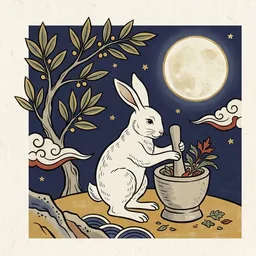
Eul-myo (乙卯) Day Pillar: Personality, Love and Career
Eul-myo (乙卯) is the wood rabbit, a spring meadow of grass and bloom. Soft to see, firm at heart, it grows by calm focus and at its own pace, with no rush.
- self-reliant
- soft but firm
- focused
- independent
- loyal to a small circle
- steady growth
At a glance
- Day stem (the "self")
- Eul (乙) · yin Wood
- Day branch
- Myo (卯) · Rabbit · yin Wood
- Growth stage of the day stem
- Prime post (建祿)
- Nayin ("sound") element
- Water of the Great Stream (大溪水) · Water
- Void branches (kongwang)
- Ja (子) · Chuk (丑)
- Stem that combines with yours
- Gyeong (庚) → Metal
- Six-harmony partner
- Sul (戌)
- Clashing branch
- Yu (酉)
- Triad branches
- Mi (未) · Hae (亥)
Hidden stems
- Gap (甲)Rob Wealth (劫財)
- Eul (乙)Companion (比肩) · main qi
Stems stored inside the branch, each shown with its ten god relative to your day stem. The last one is the main qi.
Stem and branch. Stem and branch share one element. The energy is concentrated and single-minded, strong in focus and short on variety.
Growth stage of the day stem. The stage of a person at a post of their own: steady strength, independence and the ability to stand on your own feet.
Nature and personality
The Eul-myo (乙卯) day pillar is the wood rabbit: a spring meadow where grass, clover and wildflowers grow thick because everything in it is the same kind of plant. People born on an Eul-myo day tend to be gentle in manner, independent in practice and surprisingly hard to move once they have made up their mind, someone who looks soft and will not be talked out of the things they care about. In Korean saju, the Four Pillars system, your birth day is written as a two-character pair from a sixty-day cycle, and Eul-myo is the pair that this day pillar names. The top character, the day stem, is called the day master and stands for you yourself; the bottom one, the day branch, describes your private circle and home temperament. Here the stem is 乙, yin wood, the supple kind of growth that bends in wind and straightens afterwards. The branch is 卯, the rabbit, also yin wood, the element tradition ties to the spring equinox and to the east. Stem and branch share one element, which makes the pillar concentrated and single-minded. In daily life that looks like the person who has had the same favourite cafe, the same way of folding laundry and the same close friends for ten years, and who is very good at whatever they have chosen to do. Range is the trade-off: there are fewer built-in contrasts here to push the person into trying something different. The rabbit holds two hidden stems, small energies inside a branch, each given a ten gods role, which is saju's set of ten ways another stem relates to the day master. The main one is 乙 itself, Companion: a self that is entirely its own. Beneath it sits 甲, Rob Wealth, the bigger and more forceful wood, the sibling or rival who is like you but bolder, which tradition links with sharing, competing and striving beside equals. The day master's growth stage is Prime post (建祿), the point where a young person stands on their own feet and earns their keep, which gives the pillar its self-sufficiency. The nayin, the pillar's poetic nickname, is Water of the Great Stream (大溪水): a stream running steadily down a valley, quiet, constant and always carrying on.
Strengths
- stands on its own feet and rarely needs rescuing
- deep, steady focus on what it has chosen
- gentle manner with a firm core
- loyal and dependable to a small circle
- quiet craftsmanship that improves year by year
Challenges
- holds to its own method even when a different one would work
- finds it hard to ask for help or hand over control
- narrow comfort zone, so new things get put off
- quietly competitive with people it sees as equals
Love and relationships
Eul-myo usually shows love by being present and consistent, not by grand gestures: the person who is always on time, who keeps your small secrets and who sits happily in the same room without needing to talk. They are a devoted partner and, equally, someone who needs their own corner of the day. A partner who treats solitude as a recharge, not a rejection, will see the warmest side. Tradition reads the day branch as the spouse palace, the seat of the partner. Here that palace holds only wood: the self (Companion) and its bolder sibling (Rob Wealth), with no wealth or officer star of its own, which tradition reads as a pillar that wants a partner who is an equal and a friend first, with the specific partner stars coming from the other pillars. The weak spot is guarding independence so closely that a partner may feel kept at the door. Telling them which parts of your life you want to share, instead of leaving it for them to guess, is the kindest fix. Tradition also notes a pull from 乙 toward 庚, firm and decisive metal, so many Eul-myo are drawn to people with clarity and a steady voice.
Work and career
Work goes well when there is a craft to refine and a measure of autonomy. A familiar scene is the colleague who is still quietly doing excellent work after three reorganisations because nobody ever had to supervise it. Fields that suit a meadow-like, patient wood include gardening and landscape, writing, editing and translation, research, design, handmade goods, teaching small groups, healthcare support, music and any freelance or specialist role in which you answer for your own output. The pillar holds many peer stars and no authority star in the branch, so it tends to feel better beside colleagues than beneath a ruler. Take care that friendly rivalry does not turn into silent comparison, and that deep focus does not become being unreachable. Once a year, do one visible thing outside your lane, such as speaking at a meeting or mentoring a junior, so that your work is seen as well as done.
Money
The rabbit's branch holds no wealth star of its own, only the Companion and Rob Wealth, so income does not usually arrive by a lucky break; it follows skill and steady output, and tradition looks to the other pillars of the chart for the rest of the picture. Rob Wealth is the sharing star: friends, siblings and colleagues are often the ones who share the table, and the habit of paying for the group or lending small sums is common. A separate account for savings, funded automatically on payday, protects generosity from the end of the month.
Energy and wellbeing
In the five-element picture this pillar is wood on wood with water running underneath it as the nayin, so the main balance is between strong growing energy and enough nourishment. Wood likes to stretch and move, so a morning walk, stretching the shoulders and neck and time among plants keep the stiffness of long focus from settling. The void branches here are 子 and 丑, the water and wet-earth branches that normally feed wood, and tradition reads that as a pillar that benefits from deliberately scheduling rest and fresh input, like holidays, a new book and time near water. These wood-and-water habits are traditional lifestyle symbolism rather than medical advice.
Who you get on with
Traditionally the rabbit has a six-harmony bond with 戌, the dog, a loyal and plain-spoken sign, so a dog branch often feels reliable and easy. The rabbit also forms a wood triad with 未 (goat) and 亥 (pig), a grouping that suggests a shared woodland: people from those branches may feel like family quickly. The clash is 酉, the rooster, wood against metal: the rooster's exacting nature can rub against the rabbit's quiet stubbornness, which often shows up as arguments about small details and not a real break. By element, water people replenish, fire people draw the shy meadow into the open, earth people give it ground, and metal people sharpen it, sometimes pleasantly through the 乙庚 combination. The neighbouring pillars are Gap-in (甲寅), the tall tree over the tiger, and Byeong-jin (丙辰), sun over the dragon, whose warmth tends to call the meadow out. The void branches 子 and 丑 are said to feel less anchored when they appear in a chart; that is nuance, and it depends on the rest of the chart.
How life tends to unfold
The ten-year luck cycles of saju, called daewoon, run through the sixty pillars in order, each colouring one decade with its own stem and branch. Eul-myo's growth stage, Prime post, tends to produce an early sense of independence, so many people with this pillar leave home, choose a field or become self-supporting a little ahead of schedule. The Great Stream nayin pictures progress as a steady flow that widens as it goes, not as a single dramatic leap. Wood and water cycles feel supportive but can deepen the sameness; fire cycles give expression and a wider stage; earth cycles bring resources and responsibilities; metal cycles bring structure, deadlines and demanding people. Tradition says water cycles of 子 or 丑 fill the void and may feel like a gentle springtime. Which decade is which depends on the rest of the chart, including year, month and hour.
Advice
Change one routine a month, deliberately and in a small way: a different route, a new class, a lunch with someone outside your usual circle. The pillar's strength is staying power, and a little variety stops it from turning into a rut. Hand one task to someone else each week and resist redoing it afterwards. And say what you want out loud; the people who love you would prefer to be told than to guess.
Frequently asked questions
What does the Prime post growth stage mean for Eul-myo?
Prime post is one of the twelve growth stages of saju, pictured as the age when a person stands on their own feet and earns a living. For Eul-myo it means the day master sits in a position of real strength, giving self-reliance, steady energy and a capacity for independent work. Strength is not superiority; it simply means the wood is well rooted.
Does Eul-myo have a problem with money because it has no wealth star?
No. The branch holds no wealth star of its own, but wealth in a chart is read from all four pillars, not from one branch. Many Eul-myo people earn well through skill and persistence. The pillar's habit to watch is generosity toward friends, which a simple automatic savings transfer handles easily.
Which day pillars are compatible with Eul-myo?
Tradition names the dog branch as the rabbit's six-harmony partner, and the goat and pig as its wood triad, so pillars with 戌, 未 or 亥 are often described as comfortable company. The rooster is the clash, which suggests friction in details, not a doomed match. A real compatibility reading compares whole charts, so take these as tendencies.
Learn the terms on this page
Is this your day pillar?
Your day pillar comes from your exact birth date, not your birth year. Enter it in our Four Pillars calculator and it shows all four of your pillars.
New to saju? Saju (四柱, "four pillars") describes a person by the year, month, day and hour of birth. The day pillar is the centre of it: its stem is you, and its branch is your closest circle and your home life.