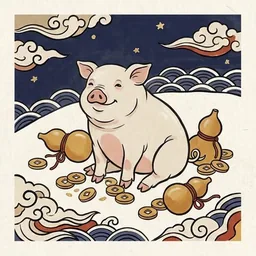
Gi-hae (己亥) Day Pillar: Personality, Love and Career
Gi-hae (己亥) is field soil by a big river: calm, loyal and wise with cash. It digs the ditches, keeps its word and turns plain work into a slow, sure gain.
- Level-headed
- Resourceful
- Loyal
- Thrifty
- Channels, not forces
- Slow-ripening
At a glance
- Day stem (the "self")
- Gi (己) · yin Earth
- Day branch
- Hae (亥) · Pig · yin Water
- Growth stage of the day stem
- Conception (胎)
- Nayin ("sound") element
- Wood of the Plain (平地木) · Wood
- Void branches (kongwang)
- Jin (辰) · Sa (巳)
- Stem that combines with yours
- Gap (甲) → Earth
- Six-harmony partner
- In (寅)
- Clashing branch
- Sa (巳)
- Triad branches
- Myo (卯) · Mi (未)
Hidden stems
- Mu (戊)Rob Wealth (劫財)
- Gap (甲)Direct Officer (正官)
- Im (壬)Direct Wealth (正財) · main qi
Stems stored inside the branch, each shown with its ten god relative to your day stem. The last one is the main qi.
Stem and branch. The stem controls the branch. You press on your surroundings and act on them; practical drive is high and so is the effort.
Growth stage of the day stem. A seed of potential: ideas are forming, plans come before action, and nurture matters a great deal.
Nature and personality
The Gi-hae (己亥) day pillar is garden soil lying beside a wide river: a practical, level-headed person who shapes the world by channelling it rather than forcing it. People born on a Gi-hae day tend to be sensible, thrifty and loyal, with a quiet knack for turning a vague plan into ditches, rows and, in the end, a harvest. In Korean saju, the Four Pillars system, every birth date has a day pillar: a pair of characters from the sixty-day cycle. The upper character, the day master, stands for you yourself; the lower one, the branch, stands for your private side and inner circle. Here the day master is 己, yin earth. It is not a mountain but worked soil, the kind that takes seed, holds moisture and gives back what was put in. The branch is 亥, the pig, whose element is water, a big and deep one like a river mouth. Earth dams water, so in saju terms the stem controls the branch. Picture a farmer's field and its irrigation channel: this person acts on the surroundings, directs resources and plans how they are used. Practical drive is high and so is the effort. In daily life that is the one who keeps the household accounts, draws the route for the group trip and quietly rewrites the rota until it works. Inside the pig sit three hidden stems, smaller energies tucked inside the branch, each named by a ten god, one of ten saju labels for how another stem relates to the day master. The main one is 壬, flowing water, called Direct Wealth: honestly earned income and a feel for what things cost. Under it lies 甲, tall timber, called Direct Officer: order, duty and a sense of how things should be done. The faintest is 戊, a second earth, called Rob Wealth: the peer who competes for the same resources and also shares them. The day master 己 is traditionally said to combine with 甲 toward earth, and 甲 is already inside this branch, so the pillar carries its own partner for structure. The growth stage is Conception (胎), the moment a seed is conceived and cannot yet be seen: potential at work before it shows. The nayin, the poetic nickname for the pillar, is Wood of the Plain (平地木), a tree on open flat ground, spreading and unshowy, with plenty of room and no cliff to hide behind.
Strengths
- Sensible planning that turns ideas into working routines
- An honest feel for what things cost and are worth
- Loyalty that keeps promises long after others forget them
- Calm under pressure, steadying a room by not hurrying
- Plays the long game and lets results accumulate
Challenges
- Arranging other people's plans as well as your own
- Holding worries in like a reservoir until they overflow
- A slow start, because the idea is still forming
- Putting duty first and postponing what you actually want
Love and relationships
Love for a Gi-hae is laid out like a field: slowly, in rows, with an eye on what will still be standing next season. The day branch is traditionally called the spouse palace, the seat of the closest partner in a chart, and here it holds Direct Wealth and Direct Officer. Classical texts read the wealth star as the partner star for men and the officer star for women, and this branch holds both, so the reading does not tilt either way. What it describes is someone who looks for steadiness: a partner with a job, a word that holds and a plan for the year. The weak spot comes from earth damming water: the stem 己 controls the branch 亥, the same structure that makes Gi-hae so capable. Gi-hae may begin to run the relationship, handling the money, the calendar and the in-laws' birthdays, and then feel unthanked when the partner simply goes along. Because of the Conception stage, feelings also tend to form slowly and be said late; a partner who waits will find the commitment deep. What helps most is someone who says thank you for the invisible administration, and who sometimes takes the planner's notebook and lets Gi-hae be a guest.
Work and career
Work suits Gi-hae when there is a flow to manage: a budget, a supply chain, a timetable, a harvest. The classic scene is the colleague who is handed the messy shared file because they will actually make sense of it, and who has turned it into a system by the second month. Fields that echo earth beside water include administration and operations, procurement and logistics, accounting-type roles, food production and distribution, agriculture, ports, shipping and water or utility work, as well as archives and libraries. The Direct Officer inside the branch gives a respect for rules and institutions, so large organisations, public service and well-run family businesses can feel comfortable. The pillar is less happy with careers made of constant improvisation or pure self-promotion. Gi-hae often rises by being the person everyone trusts with the keys, and does well to make sure that trust is seen by someone who decides on promotions.
Money
Direct Wealth is the main hidden star here, which traditionally points to steady, earned income and a natural habit of knowing where each coin went. Gi-hae usually likes a budget, a ledger or a spreadsheet and feels calmer once the numbers are written down. The leak is the Rob Wealth beside it, the peer who shares: lending to a friend, picking up the cost of a family event, quietly covering a colleague. A separate small pot for such favours, plus an automatic monthly transfer to savings on payday, protects both the kindness and the reserve.
Energy and wellbeing
Earth over water is a picture of banked-up flow, and in daily life the sign is often worry that is held in and tidily filed rather than spoken. Writing a list at night, a regular walk by water or through a park, warm meals at fixed times and a talk with a trusted friend all help the reservoir run instead of pooling. Dampness and heaviness are the traditional images, so lightness in the routine, such as movement after sitting, suits this pillar. This is a lifestyle reading from the five elements, not medical advice.
Who you get on with
Traditionally the pig has a six-harmony bond with the tiger (寅), a pairing that is said to turn toward wood, so tiger-branch people often feel an energetic, encouraging closeness. The pig also forms a wood triad with the rabbit (卯) and the goat (未), three branches that lean the same way; the Gi-mi pillar, which shares this stem, is the goat day, and its steady, earthy company is easy for Gi-hae to read. The traditional clash is the snake (巳), fire against water, which is also one of this pillar's void branches (辰巳), so tradition reads the friction as muted or distant rather than sharp. A day master of 甲 is the classical combining partner for 己, and many readers see a mutual feeling of being completed: structure meeting soil. As for elements, fire gives soil warmth, wood supplies direction and metal brings polish; water-heavy friends can feed the worry. The neighbouring pillars in the cycle are Mu-sul and Gyeong-ja. All of this is tendency, and what actually happens depends on the rest of each person's chart.
How life tends to unfold
Saju divides a life into ten-year stretches called daewoon, the luck cycles, each one coloured by its own stem and branch, and the starting age depends on the birth date. Gi-hae's growth stage is Conception, so the pattern is often a seed that grows quietly in the first decades: a slow start, a lot of observing, and abilities that show more clearly after thirty or so than at school age. The Wood of the Plain nayin suits that shape, since it spreads at its own pace. Wood cycles tend to bring responsibility and structure, such as a formal role or an obligation. Water cycles bring money flowing and a busier calendar. Earth cycles bring peers, shared costs and comparison. Fire cycles tend to warm and teach, and metal cycles invite expression and finishing. Traditionally 辰 and 巳 are void branches for this pillar, so when they turn up in a cycle or year, matters tied to them can feel less anchored; use it as a prompt to write things down. Which decade is which depends on the whole chart.
Advice
Plan the ditch, but let some of the water find its own way: once a month, hand the schedule to someone else and do not correct it. Say a worry out loud on the day you notice it, not after it has been filed away for a season. Keep a small, named fund for helping others, so that kindness has a limit you chose. And when a start feels slow, remember that a seed under the surface is still working, so measure yourself by the second year, not the second week.
Frequently asked questions
Is Gi-hae a good day pillar for money?
It has a real feel for money, because Direct Wealth is the main hidden star in the pig branch and tradition links that star with earned income and careful accounts. That is a temperament, not a verdict: no pillar is richer than another, and the rest of the chart and the luck cycles shape what actually happens.
What does the Conception growth stage mean for Gi-hae?
Conception is the stage of a seed that has just been planted: invisible, but already alive. For Gi-hae it points to a slow, private start in which ideas and skills form before anyone sees them, and to results that are often read as arriving later. It is a picture of timing, not a sign of weakness.
Which day master combines with Gi-hae?
Traditionally the stem 己 combines with 甲, yang wood, toward earth, so a Gap day master is the classic combining partner. It is a pairing of soil and timber, structure and ground. Combinations describe a pull of attraction in the old texts, not a promise, and a full match needs all four pillars of both people.
Learn the terms on this page
Is this your day pillar?
Your day pillar comes from your exact birth date, not your birth year. Enter it in our Four Pillars calculator and it shows all four of your pillars.
New to saju? Saju (四柱, "four pillars") describes a person by the year, month, day and hour of birth. The day pillar is the centre of it: its stem is you, and its branch is your closest circle and your home life.