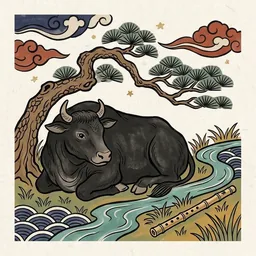
Eul-chuk (乙丑) Day Pillar: Personality, Love and Career
Eul-chuk (乙丑) is the wood ox: a tough grass in cold clay. Calm, hard on itself and good with detail, it starts slow and gets stronger as the years go by.
- slow to start, hard to stop
- self-demanding
- practical
- old soul
- stores up quietly
- slow to thaw
At a glance
- Day stem (the "self")
- Eul (乙) · yin Wood
- Day branch
- Chuk (丑) · Ox · yin Earth
- Growth stage of the day stem
- Decline (衰)
- Nayin ("sound") element
- Gold in the Sea (海中金) · Metal
- Void branches (kongwang)
- Sul (戌) · Hae (亥)
- Stem that combines with yours
- Gyeong (庚) → Metal
- Six-harmony partner
- Ja (子)
- Clashing branch
- Mi (未)
- Triad branches
- Sa (巳) · Yu (酉)
Hidden stems
- Gye (癸)Indirect Resource (偏印)
- Sin (辛)Seven Killings (七殺)
- Gi (己)Indirect Wealth (偏財) · main qi
Stems stored inside the branch, each shown with its ten god relative to your day stem. The last one is the main qi.
Stem and branch. The stem controls the branch. You press on your surroundings and act on them; practical drive is high and so is the effort.
Growth stage of the day stem. Just past the peak: calm, experienced and careful with energy. Wisdom counts for more than force.
Nature and personality
The Eul-chuk (乙丑) day pillar is the wood ox: a hardy plant rooted in cold, heavy clay that lives through the winter. People born on an Eul-chuk day tend to be patient, practical and quite hard on themselves, with a slow start and a long, durable middle. A day pillar is the two-character label for your birth day in the sixty-day cycle of Korean saju, the Four Pillars system. The upper character is the day master, which stands for you; the lower one is the day branch, your private life and the circle closest to you. Here the day master is 乙, yin wood: not a tree but the grass, the flower or the vine, something that bends instead of breaking. The branch 丑 is the ox, earth in its wettest and densest form. Tradition places it at the end of winter, when the ground is cold and full of stored things. In the five-element cycle wood is said to master earth, so the stem controls the branch, like roots working into clay. In daily life this person acts on their surroundings. They are the one who sorts out the landlord's paperwork, drags the household budget into shape or trains the new hire without being asked. The drive is real and so is the effort, and it comes out as steady, unfussy work rather than as announcements. Three hidden stems sit inside the ox, each tagged with a ten gods name, one of ten roles that show how another stem relates to the day master. The main one is 己, Indirect Wealth: a feel for cost and worth, and an eye for small openings other people walk past. Beneath it is 辛, Seven Killings, an old and dramatic name for the stem that tests you: it brings high standards, rivals, deadlines and a demanding inner voice. The faintest is 癸, Indirect Resource, which is unconventional learning, self-taught skill and a quiet intuition. So the inner circle is practical, self-critical and a little scholarly. The day master's growth stage is Decline (衰), the phase after a peak when energy turns inward and steadies. It suits calm, measured people who seem older than their years. The nayin, the traditional poetic nickname for the pillar, is Gold in the Sea (海中金): metal lying under deep water, valuable and not obvious, found by those who take the time.
Strengths
- patient work that keeps going when others stop
- a good eye for what things are worth
- calm, grown-up steadiness under pressure
- keeps good records and remembers the details
- learns well on their own, in their own order
Challenges
- an inner critic that sets the bar too high
- slow to warm up and slow to show feeling
- keeps score of who did what
- takes on duty first and rest last
Love and relationships
Affection comes slowly to an Eul-chuk person and leaves slowly too. They are unlikely to say the big sentence early, but they will fix your bike chain, learn how you take your tea and keep a spare charger in the drawer for you. That fits the ox's hidden Indirect Wealth, which pays attention to what a person actually needs, and the cold clay, which thaws a little at a time. The day branch is traditionally called the spouse palace, the seat of the partner in a chart, so what the ox holds shows what they look for: someone capable, dependable and of firm character, because the Seven Killings in the palace respects people who do not wobble. Their weak spot is the same standard turned on the person they love. The inner critic can start grading a partner's habits, and a kept tally of chores can sit between two people for a year before anyone mentions it. What helps is a partner who is warm without hurry, who is open about money and plans, and who says thank you for the invisible work. Eul-chuk does best when they say a feeling aloud once, early, before it turns into a list.
Work and career
This pillar does well in work where careful handling pays off over years. The typical Eul-chuk colleague is the person who knows where the receipt from 2019 is, keeps the shared drive in order and gets calmer as the deadline gets closer. Storage, record and craft fit the ox: bookkeeping and accounting, archives and libraries, logistics, property administration, ceramics and other hand skills, food production such as fermenting and curing, and anything with soil, seeds or stock. The hidden Seven Killings gives them a tolerance for demanding standards, so quality control, audit and operations roles are comfortable, and an exacting boss is often endured with more grace than the boss deserves. The risk is staying quietly in a role long after outgrowing it, because loyalty and a slow start make change feel heavy. Asking for the title that matches the work, once a year, is a modest habit worth having.
Money
With Indirect Wealth as the main hidden stem, money is a skill here and not a fantasy: Eul-chuk people usually know what they spent last month and why. The ox is a storehouse in the saju tradition, so saving feels natural and a reserve in the drawer is calming. They tend to earn through patient craft, trade or steady employment, often with a small second stream such as a side service or a resold skill. The leak is not luxury but austerity: refusing to spend on comfort, rest or a decent chair because the old measure of enough is set too low. A fixed yearly line in the budget for something purely pleasant, spent without guilt, balances the ledger.
Energy and wellbeing
In the five-element view this pillar is a small plant in cold wet ground with metal pressing on it, which tradition reads as a tendency toward chill, stiffness and a mind that carries work home. Warmth is the useful theme: warm meals, a layer on cold days, a daily walk to wake up the wood, and an hour a week with no list. Shoulders and neck often hold the pressure, so stretching is practical advice. This is traditional lifestyle symbolism, not medical advice; for persistent pain or exhaustion, see a doctor.
Who you get on with
Traditionally the ox's six-harmony partner is the rat (子). The pillar just before this one in the cycle, Gap-ja (甲子), is the wood rat, and rat and ox together suggest a pair who are quietly comfortable, one curious and one solid. The ox also forms a metal triad with the snake (巳) and the rooster (酉), so people with those branches feel familiar quickly, with the same precision and taste for order. Because metal is the element that presses on wood, that company can also double the sharpness, and it is worth noticing when a friendship becomes mutual criticism. The ox's clash is the goat (未): two earth signs that disagree on what matters, and a pillar like Eul-mi (乙未), the wood goat, shows it. It is friction between two firm wills and often resolves with plain talk. By element, fire people bring the warmth that cold clay likes, and water people refresh without pressing. The void branches (空亡) for this pillar are the dog (戌) and the pig (亥); in tradition, matters tied to them feel less anchored. All of this depends on the rest of the chart.
How life tends to unfold
Daewoon are the ten-year luck cycles of saju, each decade coloured by one stem and one branch. For Eul-chuk the Decline stage often means an early adulthood that feels older than it looks, a serious, work-first start, and a middle age that is more relaxed than the beginning. The same weight that feels heavy at twenty-five often becomes steadiness at forty-five. In tradition, water cycles feed the plant and ease the reading, wood cycles bring peers and company, and earth cycles bring practical gain and responsibility together. Fire cycles bring warmth to the cold clay and encourage a person to be visible and expressive, which can ease the pressure of the Seven Killings. Metal cycles press hardest and can feel like strict years, though they are also when skills are sharpened. Which decade feels like which depends on the whole chart, including the year, month and hour pillars.
Advice
Decide in advance what counts as done, and let it be done. The standard that made you good at the work can quietly keep you from enjoying any of it. Say one warm sentence a day to someone close, aloud, even when the day was only logistics. Put one fixed pleasure in the calendar, such as a long bath or a market walk, and treat it as a duty you are not allowed to skip. Your pace is not a problem: you were built for the long season.
Frequently asked questions
Is the Decline stage a bad sign for the Eul-chuk day pillar?
No. Decline (衰) is one of twelve growth stages that follow a life from birth to rest, and it simply marks the phase after a peak, when energy steadies and turns inward. It is often read as maturity, patience and a calm manner, not weakness. Many Eul-chuk people seem older than their age early on and more relaxed than their peers later.
Does Seven Killings in the Eul-chuk pillar mean a violent or dangerous nature?
No. Seven Killings (七殺) is an old and dramatic label for a ten god, the stem that presses on the day master. In practice it points to discipline, ambition, a strong sense of standards and an ability to work under pressure. Handled well it is the engine behind a lot of competence. Handled badly it shows up as harsh self-criticism and constant tension.
What does the nayin Gold in the Sea say about an Eul-chuk person?
Nayin are poetic nicknames given to each pair of pillars in the sixty-day cycle. Gold in the Sea pictures metal sunk beneath deep water: real value that sits out of sight. For Eul-chuk it is read as talent and worth that others notice late, and as a person who does not need to advertise. It adds colour to the reading, but it does not override the stem and branch.
Learn the terms on this page
Is this your day pillar?
Your day pillar comes from your exact birth date, not your birth year. Enter it in our Four Pillars calculator and it shows all four of your pillars.
New to saju? Saju (四柱, "four pillars") describes a person by the year, month, day and hour of birth. The day pillar is the centre of it: its stem is you, and its branch is your closest circle and your home life.