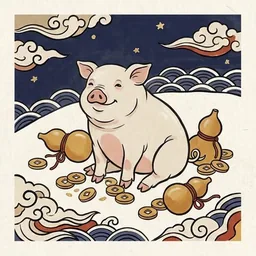
Gye-hae (癸亥) Day Pillar: Personality, Love and Career
Gye-hae (癸亥) is rain falling in the sea: a deep, dreamy, shy soul and the last of the sixty pillars, with one firm focus at a time and a big inner world.
- Deep
- Intuitive
- Self-contained
- Imaginative
- Single-minded
- Far-sighted
At a glance
- Day stem (the "self")
- Gye (癸) · yin Water
- Day branch
- Hae (亥) · Pig · yin Water
- Growth stage of the day stem
- Peak (帝旺)
- Nayin ("sound") element
- Water of the Great Ocean (大海水) · Water
- Void branches (kongwang)
- Ja (子) · Chuk (丑)
- Stem that combines with yours
- Mu (戊) → Fire
- Six-harmony partner
- In (寅)
- Clashing branch
- Sa (巳)
- Triad branches
- Myo (卯) · Mi (未)
Hidden stems
- Mu (戊)Direct Officer (正官)
- Gap (甲)Hurting Officer (傷官)
- Im (壬)Rob Wealth (劫財) · main qi
Stems stored inside the branch, each shown with its ten god relative to your day stem. The last one is the main qi.
Stem and branch. Stem and branch share one element. The energy is concentrated and single-minded, strong in focus and short on variety.
Growth stage of the day stem. The height of strength: confident and commanding, with a real risk of overreaching or going it alone.
Nature and personality
The Gye-hae (癸亥) day pillar is rain falling into the open sea: a deep, imaginative and self-contained personality with a wide inner world and an unusually steady focus. People born on a Gye-hae day tend to be intuitive, independent and hard to read at first glance, someone who thinks in long arcs and follows their own current rather than the crowd's. Saju, the Korean four pillars system, writes the day you were born as a pair of characters: a heavenly stem above and an earthly branch below, one of the twelve animals. This pair is the day pillar (ilju in Korean); the stem is the day master, the self at its core, and the branch is your private temperament and nearest circle. The pairs of the cycle are numbered, and Gye-hae is number sixty, the last. Its stem 癸 is the final one of the ten stems and its branch 亥 the final one of the twelve animals, and the next day in the cycle starts over with Gap-ja. Tradition likes to read that position as completion, a pillar with the feel of having seen the whole circle. The day master is 癸, yin water, dew and fine rain, and the branch is 亥, the pig, which is also water: the tenth month, the start of winter, when water begins to gather. Because stem and branch share one element, the energy is concentrated and single-minded, very strong in focus and depth and a little short on variety. In daily life that is the person who reads the whole book on a subject they were only asked to summarise, who can sit in a noisy room and be somewhere else entirely, and whose private interests have an odd, specific shape. The pig holds three hidden stems, each a ten god, one of ten labels for how another stem relates to the day master. The main one is 壬, yang water, the ocean itself, which counts as Rob Wealth (劫財): the energy of peers, sharing and a faint streak of rivalry. Beneath it is 甲, a young tree, the Hurting Officer (傷官): the urge to express, originality and an allergy to rules that make no sense. The faintest is 戊, the mountain, the Direct Officer (正官): a sense of structure, reputation and what ought to be done properly. Picture a sea, a seedling and a shoreline in one branch. The day stem sits at the stage called Peak (帝旺), the fullest strength of the twelve growth stages, and the nayin, a classical nickname for the pillar, is Water of the Great Ocean (大海水). Water at that depth is powerful and also looks for a shore; the hidden wood and earth are where it finds one.
Strengths
- Concentration that can stay with one question for hours
- Intuition for moods, undercurrents and what is left unsaid
- Imagination that sees several moves ahead
- Independence: comfortable alone and not easily swayed
- Deep loyalty to the few people who are let in
Challenges
- Disappearing into your own head when things get hard
- Mood tides whose cause nobody else can see
- Repeating the familiar approach because it works well enough
- Keeping people at the shoreline and not explaining what you need
Love and relationships
Closeness with a Gye-hae person is a matter of depth rather than frequency. They may text rarely, then talk until two in the morning about everything from a childhood memory to what the universe is made of, and a long silence in the same room is, for them, a form of intimacy. The day branch is traditionally called the spouse palace, the seat of the closest partner, and here it is water inside water: tradition reads this as a love that is private, loyal and a little hard to see from outside. The hidden Direct Officer is the traditional picture of commitment and responsibility, so when they decide, they decide completely. What they need is a partner who does not take withdrawal personally, can sit comfortably in quiet, and gently asks again if the first answer was nothing. The weak point is the unspoken: assuming a partner can feel the current without being told. Someone a little warm, a little direct and a little structured is the best companion for an ocean.
Work and career
Work suits Gye-hae when it rewards concentration and gives the mind a long runway: the analyst who finds the pattern in a spreadsheet nobody else would read, the translator who hears the register of a sentence, the archivist, the composer, the strategist who sees three moves ahead. Fields that fit the sea-and-rain image include research and data analysis, writing and translation, music and sound, philosophy, psychology and counselling-type work, design and film, maritime and travel trades, and drinks and water-related businesses. The Peak stage means they can work alone for long periods without losing momentum. The Hurting Officer makes close micromanagement hard to bear, and the Rob Wealth prefers collaboration among equals to being supervised. The weak points are finishing and visibility: a brilliant draft that lives on the hard drive, and a habit of staying with a subject until it has no variety left. A fixed deadline and an audience, even a small one, turn depth into something others can use.
Money
Money moves like water in this pillar: it comes in on one current and leaves on another, and with the main hidden stem being Rob Wealth, tradition pictures shared pots, favours for peers and money that is hard to keep apart from other people's. In daily life that can look like paying for the group trip first and sorting out the split later, or lending without a date for repayment. Two simple structures help: separate accounts for bills, for savings and for spending, each with its own transfer, and a figure agreed with yourself in advance for what you would give instead of lend. Because the pillar is single-minded, a set-and-forget arrangement suits it better than frequent decisions.
Energy and wellbeing
With water in both stem and branch, and at its fullest stage, this pillar has a lot of tide and few banks: tradition links that with a mind that runs deep at night, with overthinking and with a tendency to run cold and withdrawn. Habits that add warmth and edges suit it: regular daylight, warm food, exercise that gets you out of the head and into the body, such as brisk walking, dancing or swimming laps, and a fixed bedtime that works as a shoreline. Hands-on work like cooking or gardening helps the thoughts settle. Take it as a lifestyle image drawn from the five elements, not as medical advice.
Who you get on with
Traditionally the pig has a six harmony bond with the tiger (寅): water feeding wood, with the tiger's drive and courage giving direction to the pig's depth. The pig also forms a wood triad with the rabbit (卯) and the goat (未), three branches that grow the same way, which tends to bring easy, creative company. The traditional clash is the snake (巳): fire against water, the snake's quick, calculating heat set against the pig's slow depth. It is a mismatch of temperature, not a curse, and often settles when each side admits what it needs. The day stem 癸 is said to combine with 戊 (yang earth, the mountain) toward fire, and 戊 already sits inside the pig as the Direct Officer, so the pillar carries its own bank. The neighbouring pillars are Im-sul before (water over the dog's dry earth, a shore for water) and Gap-ja after, where the cycle begins again. By element, earth gives banks, wood gives water something to grow, fire warms it and metal adds more water. The void branches (空亡) are the rat (子) and the ox (丑); tradition reads the areas where they fall as lighter or less anchored, a nuance that depends on the rest of the chart.
How life tends to unfold
Saju divides a life into ten-year stretches called daewoon, the great luck cycles, each a stem-and-branch pair that colours a decade as a season colours a year; the start age and direction come from the birth date. With the day stem at Peak, this pillar often feels capable and self-contained early, and the first lessons of adulthood tend to be about direction: where to point so much depth. As the sixtieth pillar, tradition also gives it a flavour of endings and fresh starts, a life with several clear chapters instead of one straight line. In general, earth cycles add banks: structure, responsibility and a shape for the energy. Wood cycles give the water something to grow, in the form of creative work, study, travel and projects. Fire cycles bring warmth, money and company, which can feel like a welcome change of climate. Metal and water cycles add more water, which deepens reflection and can either clarify or flood. Which of these decades feels like which is set by the other pillars of the chart, so hold them as leanings and not as dates.
Advice
Give the depth a shore: a daily task with a time limit, a deadline that someone else knows about, a person who expects to hear from you. Say the half-formed thought aloud before it is polished, since other people only see the surface of the sea. Change the scenery on purpose, a new route, a new cafe, a new subject each month, because this pillar is strong on focus and short on variety. And keep your money arrangements simple enough that you never have to think about them on a bad night.
Frequently asked questions
What is the Gye-hae day pillar like?
It pairs 癸, yin water such as dew and rain, with 亥, the pig, also water, so the whole pillar is one element. People with it are usually deep, imaginative and self-contained, with strong focus and a rich inner life, but less variety and more need for a shoreline. Your day pillar comes from your birth date, and a four pillars calculator will work it out.
Does Gye-hae being the last of the sixty pillars mean anything?
It is the sixtieth pillar, the last stem with the last branch, and the next day in the cycle returns to Gap-ja. Tradition reads that as completion, and people sometimes describe Gye-hae as having an old-soul quality. It is a symbolic reading, not a ranking: pillars are not better or worse by position, and the rest of your chart carries equal weight.
Does Gye-hae have too much water, and what does it need?
The pillar is certainly water-heavy, with the stem, the branch and the main hidden stem all water, and the day stem at its Peak stage. In tradition, banks (earth), outlets (wood) and warmth (fire) are what balance it. But whether your chart as a whole is short or full of water depends on the other pillars, so treat this as a tendency, not a verdict.
Learn the terms on this page
Is this your day pillar?
Your day pillar comes from your exact birth date, not your birth year. Enter it in our Four Pillars calculator and it shows all four of your pillars.
New to saju? Saju (四柱, "four pillars") describes a person by the year, month, day and hour of birth. The day pillar is the centre of it: its stem is you, and its branch is your closest circle and your home life.