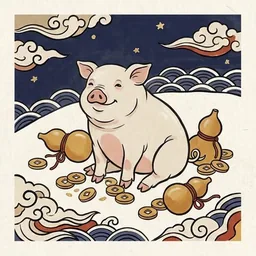
Jeong-hae (丁亥) Day Pillar: Personality, Love and Career
Jeong-hae (丁亥) is a lantern on dark water: dutiful, deep and full of ideas, it keeps a steady light in a storm, and it thinks a lot more than it says.
- Dutiful
- Reflective
- Inventive
- Disciplined
- Private
- Under pressure
At a glance
- Day stem (the "self")
- Jeong (丁) · yin Fire
- Day branch
- Hae (亥) · Pig · yin Water
- Growth stage of the day stem
- Conception (胎)
- Nayin ("sound") element
- Earth on the Roof (屋上土) · Earth
- Void branches (kongwang)
- O (午) · Mi (未)
- Stem that combines with yours
- Im (壬) → Wood
- Six-harmony partner
- In (寅)
- Clashing branch
- Sa (巳)
- Triad branches
- Myo (卯) · Mi (未)
Hidden stems
- Mu (戊)Hurting Officer (傷官)
- Gap (甲)Direct Resource (正印)
- Im (壬)Direct Officer (正官) · main qi
Stems stored inside the branch, each shown with its ten god relative to your day stem. The last one is the main qi.
Stem and branch. The branch controls the stem. There is a constant pull of pressure and duty that builds discipline and inner tension together.
Growth stage of the day stem. A seed of potential: ideas are forming, plans come before action, and nurture matters a great deal.
Nature and personality
The Jeong-hae (丁亥) day pillar is a lantern carried across dark water at night: a thoughtful, dutiful and deeply feeling personality that keeps a small steady light going in the middle of larger pressures. People born on a Jeong-hae day tend to be reflective, responsible and quietly inventive, with a conscience that is always switched on and a dry, private sense of humour. In Korean saju, the Four Pillars system, every chart has four pairs of characters, and the day pillar (ilju) is the pair for your birth date. Its upper character is the day master, the core self, and its lower character is the branch, an animal, standing for your inner life and nearest people. Here the day master is 丁, yin fire: a candle, a lantern, the ember that stays in the hearth overnight. The branch is 亥, the pig, a water sign tradition connects with the start of winter, the sea and the late evening hours. A small light over a very large dark: that is why this person feels both needed and tested. Water puts out fire, so the branch controls the stem. There is a constant pull of pressure and duty, which builds discipline and inner tension together. In daily life that is the person who is always the one who locks up, who answers the family message first and who cannot leave a promise half done, and who also grinds their teeth about it at 2 a.m. Three hidden stems sit inside the pig, each tagged with a ten gods role, one of ten ways another stem relates to the day master. The residual one is 戊, mountain earth, Hurting Officer: sharp insight, an inventive streak and an itch to fix whatever does not work. In the middle is 甲, the big tree, Direct Resource: learning, mentors, a moral compass. The main one is 壬, the great river, Direct Officer: duty, proper roles, reputation, a sense of what is expected. Tradition notices that Officer feeds Resource and Resource feeds the self, so pressure can turn into learning and learning into character. It also notices that Hurting Officer and Officer pull in opposite directions, obeying and questioning, which is the inner tension in a single sentence. The day master is at the Conception (胎) stage of the twelve growth stages, the seed forming in the womb: potential not yet visible, ideas being put together in private. It gives a mind that is always incubating something. The nayin, the traditional poetic name for the pillar, is Earth on the Roof (屋上土): baked roof-tile clay laid over a house, earth that has already been through fire and now shelters the people below, which fits a temperament that carries the weight of the rain so others can stay dry.
Strengths
- A conscience people can rely on; does what was promised
- Inventive eye for how things work and where rules fail
- Calm, disciplined effort when the load is heavy
- Learns steadily from mentors and from long study
- Protective of those in their care
Challenges
- Carries more duty than anyone has asked for
- An inner critic that argues late into the night
- Swings between self-control and one sharp remark
- Keeps half-formed ideas private, so others see only the pressure
Love and relationships
Romance with a Jeong-hae person is told through what they do when it is inconvenient: the drive across town at midnight, the message that says text me when you are home, the afternoon spent helping with a relative's move. The day branch is called the spouse palace, the seat of the partner in a chart, and here it holds the pig, which is warm-hearted, honest and generous, with feelings that run far deeper than the surface shows. The tension in this pillar becomes visible in love. Duty can speak louder than desire, so the person does what is right for the partner and forgets to say what they themselves want, then lets one sharp sentence out when pressed too hard. What helps is a partner who shares the load of responsibilities, respects private time and does not test loyalty; it also helps to talk about feelings in a quiet place first and later together. A traditional detail: 丁 combines with 壬, and a 壬 sits in the pig's own hidden stems, so some classical readings see a pull toward binding oneself to one dependable commitment. Take it as tradition, not a rule.
Work and career
This pillar is an unusual blend of rule-keeper and rule-improver, and it does best in structured places that still leave space to invent. Public administration, education, research and development, engineering and systems design, quality and compliance work, editing, writing and design with strict standards, and long-form investigation all give both sides of the pillar something to do. The Direct Officer in the main position gives trust with responsibility, so this person is often promoted into charge of things before they have asked. Two settings wear it down: chaos with no standard to work to, and a boss who breaks their own rules. The Hurting Officer cannot keep quiet about the second for ever. The pillar's habit is to build the argument in silence and then say it all at once, so it helps to raise one improvement a week, as it occurs to you, instead of storing it up.
Money
None of the pig's hidden stems is a wealth star, so money tends to arrive through a position, a salary and a reputation for being reliable, more than through trading or deals. Spending follows duty: family needs, shared costs and a general readiness to cover emergencies for others. The risk is carrying everyone's obligations while your own are left unplanned. Set up an automatic monthly transfer to a savings account first, keep a small separate fund for annual costs so they do not arrive as surprises, and decide in advance how much you can give to family without it worrying you.
Energy and wellbeing
In the five-element picture, a small fire is pressed by a lot of water, and the usual theme is guarding the flame: broken sleep, an inner voice that runs late, and a body that stays braced. Warmth and light are the plain remedies, so look to daylight, warm food, a tidy and well-lit room, and hands-on hobbies that finish something in one evening. Earth contains water in the five-element system, so steady routines and regular meals help hold the pressure in a channel. Give play a place in the calendar too. This is a lifestyle reading and not medical advice; ongoing sleeplessness or low mood deserves a doctor.
Who you get on with
Traditionally the pig has a six-harmony partner in the tiger (寅): wood and water, and the tiger's wood feeds this fire, so tiger-branch days such as Byeong-in (丙寅) or Mu-in (戊寅) often feel warm and easy. The pig also forms a wood triad with the rabbit (卯) and the goat (未). The rabbit is the warm, nourishing one here; the goat is one of this pillar's void branches (午未), which tradition reads as a link that feels thinner or arrives later. The snake (巳) is the pig's clash, water against fire: it can feel like two people with the same sense of duty who argue about who bears it. It is a pairing of opposite pushes, not a curse, and it tends to ease once each hears the other's worry. By element, wood people bring help and teachers, fire people share the load and restore confidence, and earth people keep the water in its channel. As with every pillar, anything beyond the day depends on the rest of each chart.
How life tends to unfold
The daewoon are saju's ten-year luck cycles, each decade tinted by its own stem and branch. With the Conception stage and an Officer-heavy branch, Jeong-hae often takes on duties early and grows through responsibility, while real ideas and confidence take shape slowly, often later than for peers. Wood cycles bring teachers, study and relief. Fire cycles give the lamp company and visibility, with the sense of being on equal footing with the pressure. Earth cycles give the inventive side a form: finished work, a voice, a way to shelter the water. Metal cycles open income and results, though they also feed the water that presses on the flame. Water cycles bring formal roles and heavier duty, which can mean honour and weight at once. Traditionally the branches 午 and 未 are void for this pillar, so when they turn up in a cycle or a year, the matters tied to them can feel less solidly anchored. Read that as a prompt to check details, not as a warning. The actual shape of each decade depends on the rest of the chart.
Advice
Write down what is actually yours to carry, then let the rest be someone else's. Say the objection at the meeting, in one sentence, instead of building the case at night. Keep one project that nobody is waiting for, so that the inventive part of you has somewhere to play. Eat, sleep and walk at regular hours; they are not a reward for finishing but the oil in the lantern. And when the old voice says you should, check first whether it is your own or one you inherited.
Frequently asked questions
Why is Jeong-hae described as both disciplined and tense?
Because the water branch controls the fire stem. In saju terms that creates a steady pull of duty and pressure, which builds discipline, and at the same time an inner strain between obeying and questioning. Many Jeong-hae people are very reliable and also quietly restless. It is a tendency, and the rest of the chart can calm or sharpen it.
What does the Conception stage mean for Jeong-hae?
Conception (胎) is the growth stage of a seed just formed, with potential that is not yet visible. For Jeong-hae it suggests a mind that is always incubating something and ideas that are slow to be shown. It is not a verdict on ability; it often means that confidence and recognition arrive later than the effort, once the idea has had time to form.
Is a Jeong-hae day the same as a Fire Pig year?
It is the same pair of characters in a different place. The sixty stem-and-branch pairs repeat as days every sixty days and as years every sixty years, and 2007 was a Fire Pig year. Your day pillar comes from your own birth date and describes you personally, while the year pillar is only one other layer of the chart.
Learn the terms on this page
Is this your day pillar?
Your day pillar comes from your exact birth date, not your birth year. Enter it in our Four Pillars calculator and it shows all four of your pillars.
New to saju? Saju (四柱, "four pillars") describes a person by the year, month, day and hour of birth. The day pillar is the centre of it: its stem is you, and its branch is your closest circle and your home life.