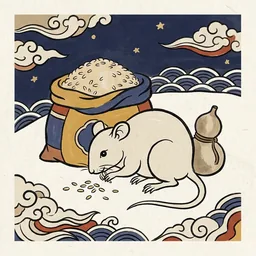
Gap-ja (甲子) Day Pillar: Personality, Love and Career
Gap-ja (甲子) is a tall pine by deep water: calm, upright and curious, it gets help with no big fuss, loves to learn and needs room to grow, not to obey.
- Upright
- Quietly curious
- Well supported
- Self-directed
- Lifelong learner
At a glance
- Day stem (the "self")
- Gap (甲) · yang Wood
- Day branch
- Ja (子) · Rat · yang Water
- Growth stage of the day stem
- Bathing (沐浴)
- Nayin ("sound") element
- Gold in the Sea (海中金) · Metal
- Void branches (kongwang)
- Sul (戌) · Hae (亥)
- Stem that combines with yours
- Gi (己) → Earth
- Six-harmony partner
- Chuk (丑)
- Clashing branch
- O (午)
- Triad branches
- Jin (辰) · Sin (申)
Hidden stems
- Im (壬)Indirect Resource (偏印)
- Gye (癸)Direct Resource (正印) · main qi
Stems stored inside the branch, each shown with its ten god relative to your day stem. The last one is the main qi.
Stem and branch. The branch feeds the stem. The day master is supported from below, so help and nourishment tend to arrive without much asking.
Growth stage of the day stem. The bathing stage: youthful, charming and restless. Sensitivity and attractiveness come with changeable moods.
Nature and personality
The Gap-ja (甲子) day pillar is the Wood Rat: a tall, straight pine growing beside deep, quiet water. People born on a Gap-ja day tend to be upright, self-directed and quietly curious, someone who grows toward their own idea of the light and would rather learn a thing properly than look as if they already know it. In Korean saju, the day pillar (ilju) is the pair of characters for the day you were born. Its upper character, the day master, is the self; its lower character, the branch, is your inner circle and private temperament. Here the day master is 甲, yang wood, the image of a big tree with a single trunk. It does not like to bend: Gap-ja people have clear principles, a long view and a visible dislike of being micromanaged. The branch is 子, the Rat, which carries water, and water is what wood drinks. The branch feeds the stem, so the tree is nourished from below. In daily life that looks like help turning up without much asking: a teacher who takes you on, a parent or senior who quietly clears the path, a book that arrives the week you need it. Every branch also holds hidden stems, smaller energies tucked inside, and each is named by its ten gods role, one of ten ways another stem relates to the day master. The Rat holds 癸 (Direct Resource, the main one) and 壬 (Indirect Resource, the residual one). Resource means learning, protection and being looked after. Direct Resource is the formal kind: school, mentors, credentials, a steady hand. Indirect Resource is the unconventional kind: self-teaching, odd hobbies, hunches. So this inner circle is made almost entirely of the hunger to understand and the habit of being cared for, which is why Gap-ja people often seem composed on the outside and are reading three things at once on the inside. The day master sits in the Bathing (沐浴) stage of the twelve growth stages, the moment a newborn is washed: fresh, exposed, easily moved. It adds a beginner's openness, sensitivity to atmosphere and a pull toward new people and new interests. The nayin, the traditional poetic name for the pillar, is Gold in the Sea (海中金): metal still under the water, valuable but not yet shaped, which fits a person whose best qualities show once they have been given time and a worthwhile task.
Strengths
- Principled and straight-speaking
- Learns deeply and keeps learning
- Attracts mentors and quiet support
- Independent, with a long view
- Fresh, open curiosity about people and ideas
Challenges
- Pride that waits to be offered help instead of asking
- Stiffness when told to bend or take orders
- Overthinking in the deep water, especially at night
- Many interests begun, fewer carried through to the end
Love and relationships
Gap-ja tends to fall for minds before faces. The Bathing stage makes this pillar quietly magnetic and a little romantic, and the Rat's water makes it observant: this is the person who remembers the name of your grandmother's soup, notices you went quiet at dinner and never mentions it until later. Affection comes out as conversation, shared books and small, well-timed acts of practical help. What Gap-ja needs from a partner is an equal who can talk, who is curious about the world and who does not try to prune the tree. Being corrected in front of other people or managed like a project makes the pine go rigid. The pillar's weak spot in love is pride: you may wait for the other person to say it first, or assume they already understand. Saying the plain sentence out loud, even once a month, does more than any amount of silent loyalty. In a chart that also shows the earth stem 己, tradition sees a natural attraction, soil that lets the roots hold; it is a lean, not a promise.
Work and career
Work goes best when it has a purpose that Gap-ja can believe in and room to run it in their own way. The pillar's two hidden Resource stars point toward fields built around knowledge: teaching and mentoring, research, writing and editing, publishing, planning, counselling, design, architecture or landscape, and any role where you are the person who has read the whole document before the meeting. Wood also likes things that grow, so careers with a visible long arc, such as training a team or building a body of work, suit it. The pine is a poor fit for constant instruction from above, and for jobs that reward speed over understanding. Gap-ja usually earns authority by being right more than by being loud, and it often does best as the second-in-command who becomes first when the first leaves. A Gap-ja can start strongly, so choose a few commitments and give each a finish line.
Money
Gap-ja tends to earn through knowledge, reputation and skill rather than through hustle, since the pillar carries no money star of its own in the Rat's hidden stems and wealth is grown rather than grabbed. Spending leans toward courses, books, good tools and anything that makes you better at something. The risk is not extravagance so much as drift: buying the next interesting thing, or leaving money unplanned because you are thinking about other matters. A simple habit works well here, such as an automatic monthly transfer into a separate savings account the day the salary lands, with a modest learning budget set apart so that curiosity does not eat the rest.
Energy and wellbeing
In the five-element view, wood wants room to stretch and water wants regular rest, and Gap-ja holds both. When the water runs too deep the usual sign is not a physical collapse but a head that will not switch off, with thoughts circling at night. Time outdoors, ideally among trees, some stretching or walking, and a fixed bedtime keep the wood moving; a few hours of unplanned quiet keep the water calm. If you often feel low, exhausted or unable to sleep, a doctor is the right person to ask, since saju is a lens for habits and temperament, not a diagnosis.
Who you get on with
Gap-ja is easiest with people who bring warmth, or a steady footing, without trying to take over. Traditionally the Rat's closest partner is the Ox (丑), its six-harmony match, a patient, practical presence that gives a restless mind somewhere to land; the neighbouring Eul-chuk (乙丑) pillar is exactly that, with a gentler wood stem. The Rat also draws together with the Monkey (申) and the Dragon (辰) in the water triad, so these signs often feel familiar fast: quick talk, shared jokes, similar rhythms. The Horse (午) is the Rat's clash, meaning two different tempos pulling against each other, fire against water. Many couples and friends in that pairing are close; it simply asks for patience when one wants to act at once and the other wants to think it through. As for elements, fire people tend to coax the pine into the open, while another water-heavy friend can leave you both overthinking. Gap-ja only sets the opening note; how any one pairing plays out also depends on the other three pillars in both charts.
How life tends to unfold
Daewoon are the ten-year luck cycles that run alongside a life, each one coloured by a stem and a branch. Gap-ja is number one of the sixty pillars, the start of the whole sequence, and its early decades often feel like a long season of study: finding teachers, building a base, deciding what the tree is for. Cycles that bring more wood or water usually feel like growth seasons, with good timing for study and for beginning something. Fire cycles tend to push the quiet pine into visibility, with more speaking, leading and being seen, and the Horse year can ask for a change of pace. Metal cycles bring structure, deadlines and honest critics, which can be what lets the Gold in the Sea take shape. Traditionally the branches 戌 and 亥 are void for this pillar, meaning that when they turn up in a cycle or a year, matters tied to them can feel less solidly anchored. Treat that as a reason to put agreements in writing rather than as a warning. When a cycle begins and what it holds depends on the whole chart.
Advice
Ask for help earlier than feels natural; the support is already around you, and the tree grows faster when it says what it needs. Choose one thing a quarter to finish, not begin. Leave one evening a week unscheduled, so the water can settle. And when someone challenges you, spend a moment asking whether the principle is under attack or only your pride, since the answer is usually the second, and it is easier to bend a branch than a trunk.
Frequently asked questions
Does being the first of the sixty day pillars make Gap-ja special?
Gap-ja opens the sixty-day sequence because it pairs the first stem with the first branch, so it marks a beginning rather than a rank. No pillar is luckier than another. Traditionally the image is a seed or a new shoot, which is why Gap-ja people so often keep a beginner's curiosity for life.
What does the Bathing stage mean for a Gap-ja day pillar?
Bathing is the second of twelve growth stages and pictures a newborn being washed: fresh, open and sensitive. For Gap-ja it adds charm, a quick interest in new people and ideas, and a tendency to be affected by the mood in a room. The same openness can mean restlessness, so it helps to anchor it with routine.
How do I find out whether my day pillar is Gap-ja?
Your day pillar is determined by your exact birth date, and sometimes your birth time if you were born near midnight, because calculation methods differ on when one day ends and the next begins. A Four Pillars calculator will work it out for you. Remember that the day pillar is only one of four pillars, so a full reading also needs the year, month and hour.
Learn the terms on this page
Is this your day pillar?
Your day pillar comes from your exact birth date, not your birth year. Enter it in our Four Pillars calculator and it shows all four of your pillars.
New to saju? Saju (四柱, "four pillars") describes a person by the year, month, day and hour of birth. The day pillar is the centre of it: its stem is you, and its branch is your closest circle and your home life.