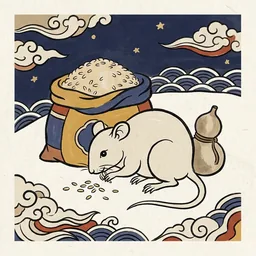
Gyeong-ja (庚子) Day Pillar: Personality, Love and Career
Gyeong-ja (庚子) is a steel blade in a cold stream: sharp, frank and quick with words, it thinks best alone at night and gives out far more than it takes in.
- Sharp-minded
- Frank
- Quick with words
- Generous
- Night thinker
- Cool-faced
At a glance
- Day stem (the "self")
- Gyeong (庚) · yang Metal
- Day branch
- Ja (子) · Rat · yang Water
- Growth stage of the day stem
- Stillness (死)
- Nayin ("sound") element
- Earth on the Wall (壁上土) · Earth
- Void branches (kongwang)
- Jin (辰) · Sa (巳)
- Stem that combines with yours
- Eul (乙) → Metal
- Six-harmony partner
- Chuk (丑)
- Clashing branch
- O (午)
- Triad branches
- Jin (辰) · Sin (申)
Hidden stems
- Im (壬)Eating God (食神)
- Gye (癸)Hurting Officer (傷官) · main qi
Stems stored inside the branch, each shown with its ten god relative to your day stem. The last one is the main qi.
Stem and branch. The stem feeds the branch. Energy flows outward into the world, which makes for expressiveness and generosity, and a risk of being drained.
Growth stage of the day stem. A still stage: introspective, deep and focused, sometimes seeming detached. The mind leads more than action does.
Nature and personality
The Gyeong-ja (庚子) day pillar is the Metal Rat: a steel blade lying in a cold stream at midnight. People born on a Gyeong-ja day tend to be sharp-minded, frank and quick with words, the kind who spots the weak joint in a plan within five minutes and says so, yet who will also hand over their own coat, notes or evening to someone in trouble. Saju, the Korean Four Pillars system, writes a birth date as four pairs of characters. The pair for the birth day is called the day pillar (ilju in Korean). Its top half, the day stem, is read as the day master, the 'self'; its bottom half is an earthly branch, one of the twelve zodiac animals, which speaks for your private temperament and your nearest circle. Here the day master is 庚, yang metal: not a ring or a coin but raw, hard metal, an axe head or an iron beam before anyone has polished it. It values directness and loyalty and has no patience for ornament. The branch is 子, the Rat, which holds water and stands for midwinter and the stillest hour of the night. In the cycle of the elements metal gives rise to water, so the stem feeds the branch and the energy flows outward: words, ideas, favours, explanations. That makes Gyeong-ja expressive and generous, and also easy to drain. After a day of advising and fixing things for everyone else, there may be nothing left for the evening. Two hidden stems sit inside the rat, and saju tags each with a ten god, one of ten labels for how another element relates to the day master. The main one is 癸, rain and dew, the Hurting Officer (傷官): despite the name it is simply the talent for sharp expression, mimicry and wit, and the habit of questioning rules that nobody can justify. Beneath it is 壬, a broad river, the Eating God (食神): the gentler cousin, a love of good food, easy company and making others comfortable. The day master's growth stage is Stillness (死), a name from the twelve stages that has nothing to do with mortality; it is the point where outward activity goes quiet and the mind turns inward, and it suits a person whose real life happens in thought. The nayin, the poetic nickname attached to the pillar, is Earth on the Wall (壁上土): plaster laid on by hand, a thin finish that takes patience and a good eye for detail.
Strengths
- Spots the flaw in a plan within minutes
- Speaks plainly, so people know where they stand
- A gift for words, jokes, teaching or clear explanation
- Generous with help once trust is there
- Unhurried and clear-headed when others panic
Challenges
- Accurate remarks that land harder than intended
- Giving until empty, then going silent without explanation
- Suspicion of rules and authority, even sensible ones
- Real feelings kept behind a cool face
Love and relationships
Conversation is the love language here. A Gyeong-ja partner is the one who will pick apart a film with you until midnight, send a link with the single line 'this made me think of you', and tease in a way that is really a form of attention. In saju the day branch is called the spouse palace, the traditional seat of the closest partner, and here it holds a rat with two kinds of output inside it: the Eating God's warmth and the Hurting Officer's wit. Affection and criticism come out of the same mouth. The difficulty is the cool delivery. When tired or hurt, Gyeong-ja goes quiet, then precise, and an accurate remark lands like a verdict while the real feeling stays behind a calm face. A good partner is at ease with direct talk, treats the jokes as jokes, and asks 'what is going on in there?' once, kindly, instead of guessing. In return Gyeong-ja is loyal, unimpressed by grand gestures and very good at saying the thing everyone else is avoiding. Someone with a rich inner world of their own fits well; someone who needs constant reassurance in words may find the economy of feeling thin.
Work and career
Work goes well where a sharp mind and a free tongue count as assets. This is the colleague who is asked to read the contract draft, the presentation or the code before it goes out, because nothing gets past them. Editing, translation, writing, research, analysis, teaching, scriptwriting, comedy, quality control, troubleshooting and consulting all give the blade something to cut. The Hurting Officer in the branch dislikes empty hierarchy and approval chains that exist for show, so a boss who explains the reasons is worth more than a grander title. The weak spot is diplomacy at the sign-off stage: the criticism is right, but the wrapping is missing. Pairing with someone who smooths the delivery, or writing the blunt version first and sending the kind one, keeps the insight and loses the friction.
Money
Income here tends to follow skill rather than office politics: fees for an expert opinion, freelance work, a well-paid specialism. Both hidden stems are of the output kind, so the pillar earns by what it says, makes or explains. Wealth in the saju sense, which for metal is wood, is not found inside this pillar, so how money builds up depends on what the rest of the chart supplies. Spending goes to the mind: books, courses, good tools, gadgets and generous treats for friends. The leak is time and favours more than cash, plus the occasional loan to someone who asked well. A standing order into savings on payday, and invoicing promptly if you work for yourself, give a cool head something steady to lean on.
Energy and wellbeing
Cold water and hard metal with little warmth inside the pillar: tradition reads this as a person who runs cool and whose mind turns over at night. Practical habits borrow the missing warmth. A warm drink in the evening, a bath, sunlight in the morning, regular meals and a fixed hour for switching off the screen all help a mind that likes to keep working at midnight. Saying the day out loud to a friend, or writing it down, empties the head better than lying awake sorting it. Take it as a lifestyle reading from tradition, not as medical advice.
Who you get on with
The rat's traditional six harmony partner is the ox (丑), earth that feeds metal; steady, patient ox days such as the neighbouring Sin-chuk (辛丑) are the classic place to look for an easy, unhurried closeness. The opposite sign is the horse (午), the one clash for the rat: midnight against noon, quiet analysis against bold impulse. It is a pairing of opposite tempos, not a curse, and each often supplies what the other lacks. The rat sits in a water triad with the monkey (申) and the dragon (辰). The monkey is an easy ally, quick-minded in the same way, while the dragon is one of this pillar's void branches (辰巳), which tradition reads as a link that feels lighter or arrives later. The day stem 庚 is also said to combine with 乙, yin wood, the climbing vine, so gentle and flexible people tend to soften the blade. By element, earth supports you, fire shapes you, and metal peers recognise you; what the chart as a whole says matters more than any single pairing.
How life tends to unfold
Saju divides life into ten-year luck cycles called daewoon. Each is a stem-and-branch pair that colours a decade the way a season colours a year, and where they start and which way they run is worked out from the birth date. With a day master at the Stillness stage, this pillar often begins quietly: a watchful childhood, ideas formed inward and shared late. The voice tends to find its audience in the middle of life, once there is something worked out to say. In general earth cycles nourish and steady, metal cycles bring more peers and a sharper edge, water cycles open the floodgates of talk and work, which is exciting and tiring, wood cycles turn attention to practical matters such as money and projects, and fire cycles act as the forge, bringing pressure that eventually gives the blade shape. What a given decade brings depends on the rest of the chart, so read these as tendencies and not a timetable.
Advice
Write the blunt version and then send the kind one that keeps the same point. Spend the first hour of a free evening with someone, not a screen, before you disappear into your thoughts. Say one real feeling a week without a joke attached to it. Decide in advance what you will not give away, whether time, money or opinions, so that your generosity is a choice and not a leak.
Frequently asked questions
What does the Gyeong-ja day pillar mean in saju?
It pairs 庚, yang metal, with 子, the water rat, in the day position of a Korean Four Pillars chart. People with it are usually sharp, direct and expressive, with a private, thoughtful core. Your own day pillar comes from your birth date, and a Four Pillars calculator will work it out for you.
Does the Stillness stage in Gyeong-ja mean bad luck?
No. Stillness (死) is one label in a cycle of twelve growth stages, and it describes the energy going quiet and turning inward, not misfortune. In a person it tends to read as a reflective mind and a late-developing voice. How things actually go depends on the rest of the chart and the luck cycles.
Is a Gyeong-ja day the same as being born in a Metal Rat year?
The characters are the same, but the use is different. The sixty pairs repeat as years and as days, and 2020 was a Metal Rat year. Your day pillar depends on your birth date alone and describes you personally, while the year pillar is another layer of the chart, and the two are not related.
Learn the terms on this page
Is this your day pillar?
Your day pillar comes from your exact birth date, not your birth year. Enter it in our Four Pillars calculator and it shows all four of your pillars.
New to saju? Saju (四柱, "four pillars") describes a person by the year, month, day and hour of birth. The day pillar is the centre of it: its stem is you, and its branch is your closest circle and your home life.