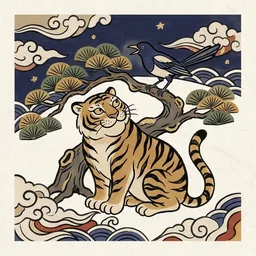
Gap-in (甲寅) Day Pillar: Personality, Love and Career
Gap-in (甲寅) is a tall tree in its own wood: a frank, self-reliant, upright soul who is first to act, hates being told what to do, and is warm deep inside.
- Self-reliant
- Pioneering
- Straight-backed
- Frank
- Warm underneath
- Leads from the front
At a glance
- Day stem (the "self")
- Gap (甲) · yang Wood
- Day branch
- In (寅) · Tiger · yang Wood
- Growth stage of the day stem
- Prime post (建祿)
- Nayin ("sound") element
- Water of the Great Stream (大溪水) · Water
- Void branches (kongwang)
- Ja (子) · Chuk (丑)
- Stem that combines with yours
- Gi (己) → Earth
- Six-harmony partner
- Hae (亥)
- Clashing branch
- Sin (申)
- Triad branches
- O (午) · Sul (戌)
Hidden stems
- Mu (戊)Indirect Wealth (偏財)
- Byeong (丙)Eating God (食神)
- Gap (甲)Companion (比肩) · main qi
Stems stored inside the branch, each shown with its ten god relative to your day stem. The last one is the main qi.
Stem and branch. Stem and branch share one element. The energy is concentrated and single-minded, strong in focus and short on variety.
Growth stage of the day stem. The stage of a person at a post of their own: steady strength, independence and the ability to stand on your own feet.
Nature and personality
The Gap-in (甲寅) day pillar is the Wood Tiger: a great tree standing in the middle of its own forest. It describes an independent, upright, energetic person who leads from the front, learns by doing and would rather cut a new path than follow a map drawn by someone else. Wood sits on both levels of the pillar, so the character is concentrated and unmistakable: confident, direct, hard to talk out of a plan, and warmer than the straight back suggests. In saju, the Korean four pillars system, a birth moment is written as four stem-and-branch pairs, and the day pillar is the pair for your birth date. Its stem is the day master, the self; its branch, here the tiger, is the private side of you and your closest circle. The stem 甲 is yang wood, the trunk that grows straight up rather than a vine that climbs. The branch 寅 is also wood, the first month of spring when the sap rises and everything starts to move. Stem and branch share one element, which tradition reads as being rooted in your own ground: no need for borrowed land, and little patience for being told where to stand. The tiger holds three hidden stems, smaller energies tucked inside the branch, each named by a ten god, saju's term for how that energy relates to the day master. The main one is 甲 again, Companion (比肩): the self-reliant, peer-minded core that wants equals, not bosses or followers, and that does not like being told twice what to do. Next is 丙, Eating God (食神), wood's natural offspring in the form of sunlight: a talent for expression, humour, hospitality and the pleasure of making something. The faintest is 戊, Indirect Wealth (偏財), broad earth: a practical eye for openings and for the size of a task. The day master sits at the growth stage named Prime post (建祿, Geonrok), the point in the twelve-stage cycle when a person takes up their own post and earns their own keep. In daily life that is the young adult who moves out early, pays their own way and does not enjoy owing anyone. The nayin, the pillar's poetic nickname, is Water of the Great Stream (大溪水): a large mountain stream running down a ravine. There is no water inside the pillar itself, so the name works as an image, fresh water passing the roots of a tree that has always stood firm.
Strengths
- Starts without waiting for permission
- Plain, honest speech that people can trust
- Leads by example rather than by lecture
- Hard to knock off course once the roots are set
- Generous warmth beneath a straight-backed manner
Challenges
- Hears advice as interference before hearing the point
- Carries things alone when a team would be quicker
- Impatience with indirect people and slow decisions
- Pride that makes it hard to admit being tired or needing help
Love and relationships
A Gap-in partner is the one who tells you about the row they had with their manager and then asks, and means it, what you really think. Affection is frank and loyal rather than flowery. The day branch is traditionally called the spouse palace, the seat of the closest partner in a chart, and here it holds Companion as the main hidden star. Tradition reads that as a wish for a partner who is an equal, with opinions, a life and a spine of their own, not someone to be rescued or to rescue them. The Eating God tucked inside shows up as humour and love expressed through shared meals, a walk outdoors, cooking something for someone who had a hard day. The weak spot is the same independence seen from the other side: two people in a room, both used to deciding alone, and a Gap-in who goes quiet or says 'I'll handle it' where a partner wanted to be asked. Pride also makes apologies slow. What works best is a partner secure enough to disagree out loud, and a habit of giving a plain sentence about needs before they harden into a position. Tradition pairs 甲 with 己, soft farmland, as a natural attraction, and the tiger's six harmony branch is the pig; both are leanings only.
Work and career
Gap-in wants ownership: a project to start, a team to open, a new branch, a venture, a role where the first draft is theirs. Fields that fit the tree-in-its-own-forest image include founding or running a business, leading a small team, consulting and freelance work, education and training, publishing and writing, landscape and forestry, environmental work and sport or outdoor leadership. Eating God adds another seam: cooking, design, content creation, teaching through demonstration, and anything where making is the point. Layered approval and close supervision are hard to bear for this pillar, and the chronic risk is the solo habit: building a good thing that only one person understands. Two practices lengthen the reach, which are naming a deputy early and asking for criticism before the launch, not after it. Gap-in tends to be the person colleagues go to when something has to start, so it helps to decide, in advance, who will carry it through the middle.
Money
Money for Gap-in is mostly a measure of freedom: enough to say no, to move, to fund the thing you want to build. Prime post is the stage of earning one's own living, so many people with this pillar become self-supporting early and are wary of debt and of obligations that tie them down. Indirect Wealth is only the faintest of the hidden stars, which suggests that accumulation is a by-product of capability more than a goal in itself. Spending tends toward tools, travel, courses and meals for friends. Because this person often works alone, nobody checks the numbers. A fixed monthly transfer to savings and a quarterly look at the whole picture, preferably with someone you trust, covers the blind spot.
Energy and wellbeing
With wood on both levels and fire hidden in the tiger, the typical pattern is a restless, forward-leaning body: a lot of vigour, not much stillness, and a habit of working through tiredness. There is no water inside the pillar to cool or steady it, so tradition suggests borrowing some: regular sleep, enough to drink, quiet hours without a screen, time by a stream or sea. Wood wants to stretch and be outdoors, so walking, climbing and stretching suit it better than long hours in a chair. Treat this as lifestyle symbolism and not a medical judgement.
Who you get on with
Traditionally the tiger's six harmony partner is the pig (亥), which carries water and wood and so feeds the tree; a pig day such as Eul-hae (乙亥) is the usual example. The tiger also forms a fire triad with the horse (午) and the dog (戌), and since wood feeds fire, people with those branches, as in Gap-o (甲午) and Gap-sul (甲戌), often bring out Gap-in's expressive, performing side. These are pairings of energy that moves in the same direction. The monkey (申) is the traditional clash. Gap-sin (甲申) is the same stem on metal, an axe at the foot of the tree, and the friction is usually two direct people with opposite rhythms, not dislike. By element, water supports you, fire draws you out, earth gives you something to build on, and metal gives shape through discipline and frank feedback. The void branches (空亡) here are the rat (子) and the ox (丑); the rat is the water that nourishes the tree, so tradition reads the pillar as learning to grow without waiting for help from above, and as having mentors who arrive later or more lightly. It is a nuance, not a flaw, and it depends on the rest of the chart.
How life tends to unfold
Daewoon are saju's ten-year luck cycles, each a stem-and-branch pair that colours a decade the way a season colours a year. The Prime post stage suggests an early adulthood in which this person is already standing on their own feet, taking responsibility and making decisions, and the first lesson of the later decades is often how to share the lead without losing the direction. Water cycles tend to feel nourishing, good for study and for steadying a hard pace. Fire cycles give wood a stage: visibility, teaching, creating. Earth cycles bring practical gain along with a heavier workload. Metal cycles press the tree into shape with structure, standards and honest critics. Wood cycles bring more peers, which can be companionship and competition together. When the rat or ox arrives through a cycle or a year, tradition says matters linked to them feel less solidly anchored, which is a cue to write agreements down. The timing depends on the whole chart and on the exact birth time.
Advice
Before you decide alone, ask one person whose judgement you trust to find the hole in the plan, while you can still change it. Keep one weekly slot in which you are not in charge: a class, a team sport, a friend's choice of restaurant. Say 'I'm tired' or 'I need a hand' the first time, not the fourth. And let your pace be an offer rather than a standard, since most people will happily follow a tree that does not keep checking whether they are keeping up.
Frequently asked questions
What does 'wood tiger' mean for the Gap-in day pillar?
It names the two halves of the pillar: 甲, yang wood, the tall trunk, standing on 寅, the tiger, also a wood branch. It points to someone independent, direct and quick to start things. The tiger here is spring and growth rather than ferocity, so the temperament is more pioneering than aggressive, though it can sound blunt.
What does the Prime post stage mean for Gap-in?
Prime post (Geonrok in Korean) is one of twelve growth stages and pictures a person who has taken up their own post and earns their own living. For Gap-in it adds self-reliance, early independence and a capable, practical manner. It describes confidence and a habit of standing on your own feet, not a guarantee of wealth or rank.
Which day pillars get along well with Gap-in?
Tradition points to the pig for six harmony, and to the horse and the dog for the fire triad, which suit Gap-in's expressive side. The monkey is the clash, meaning two direct tempos rubbing together. These are leanings only. Honest communication between two people matters far more than any pillar pairing, and the full chart matters more than the day alone.
Learn the terms on this page
Is this your day pillar?
Your day pillar comes from your exact birth date, not your birth year. Enter it in our Four Pillars calculator and it shows all four of your pillars.
New to saju? Saju (四柱, "four pillars") describes a person by the year, month, day and hour of birth. The day pillar is the centre of it: its stem is you, and its branch is your closest circle and your home life.