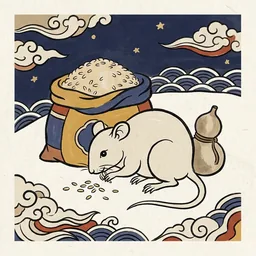
Im-ja (壬子) Day Pillar: Personality, Love and Career
Im-ja (壬子) is the sea at winter midnight: calm, private, self-reliant, all water, deep in focus. It is slow to let you in, but once in, it is in for good.
- Deep
- Private
- Self-reliant
- Steady focus
- Still waters
- Quietly loyal
At a glance
- Day stem (the "self")
- Im (壬) · yang Water
- Day branch
- Ja (子) · Rat · yang Water
- Growth stage of the day stem
- Peak (帝旺)
- Nayin ("sound") element
- Mulberry Wood (桑柘木) · Wood
- Void branches (kongwang)
- In (寅) · Myo (卯)
- Stem that combines with yours
- Jeong (丁) → Wood
- Six-harmony partner
- Chuk (丑)
- Clashing branch
- O (午)
- Triad branches
- Jin (辰) · Sin (申)
Hidden stems
- Im (壬)Companion (比肩)
- Gye (癸)Rob Wealth (劫財) · main qi
Stems stored inside the branch, each shown with its ten god relative to your day stem. The last one is the main qi.
Stem and branch. Stem and branch share one element. The energy is concentrated and single-minded, strong in focus and short on variety.
Growth stage of the day stem. The height of strength: confident and commanding, with a real risk of overreaching or going it alone.
Nature and personality
The Im-ja (壬子) day pillar is the Water Rat: a deep, wide sea at midnight in the middle of winter. People born on an Im-ja day tend to look calm and turn out to be enormous underneath: private, thoughtful, self-sufficient, and able to hold a great deal without showing it. In Korean saju each birth date carries a two-character name from a sixty-day cycle, its day pillar. The top character is the day master, the self; the lower one is the branch, the home ground of your private life. Here both are water. The stem 壬 is yang water, the open river or sea, and the branch 子 is the Rat, the depth of winter and the middle of the night. Because stem and branch share one element, the energy is concentrated and single-minded: strong focus, long stamina for what matters, and less appetite for variety. In daily life that is the person who sits with one question for three hours and comes back with the whole answer, who says little in the meeting and then sends a long, exact message afterwards. The Rat holds only two hidden stems, and both are water: 壬 (Companion), the residual one, and 癸 (Rob Wealth), the main one. The ten gods are ten roles that other stems play for the day master, and here both are peer roles. Companion is an equal, a second version of yourself; Rob Wealth is the peer who shares resources with you or competes for them. So the inner circle holds no wood, fire or earth at all: no built-in outlet and no outside pressure. Self-reliance becomes the core, and what the water is poured into is answered by the rest of the chart. The day master sits at Peak (帝旺), the fullest strength among the twelve growth stages. This is someone who feels capable early and is hard to move once decided, so the lesson is less about finding strength than about using it kindly. The nayin, the poetic image attached to each pillar, is Mulberry Wood (桑柘木), the tree grown for silkworms, whose leaves turn into silk after a patient, quiet process. It suits depth that eventually becomes something fine.
Strengths
- Deep concentration that stays on one problem for hours
- Calm under pressure and hard to rattle
- Self-reliant, with no need for an audience
- Loyal to a few people rather than many
- Sees the long arc and the whole picture
Challenges
- Feelings so deep that others cannot find them
- Stubborn once decided, and slow to back down
- Quiet rivalry with peers, or refusing offered help
- Long silences and a mood that sinks into one groove
Love and relationships
Love with an Im-ja day arrives slowly and then runs deep. They can look unreadable for the first months and turn out to have been paying attention all along; the evidence is a practical kindness at exactly the right moment, a lift to the airport at five in the morning, a lamp left on for you. They seldom announce a feeling. They settle in and stay. The day branch is traditionally called the spouse palace, the seat of the partner in a chart. Here it holds only peer stars, which tradition reads as a partner who is an equal and a household where both people keep their own space. The weak spot is withholding: Im-ja may go silent when hurt and expect to be understood without words, and a partner can feel shut out of a sea they cannot see into. What helps is someone comfortable with quiet, who does not need constant narration, who asks gently and does not take the silence personally. Naming one feeling a day, even in a single sentence, keeps the water from settling into something nobody can reach.
Work and career
Work suits Im-ja when it rewards depth and leaves room for solitude: research, data analysis, programming, long-form writing, translation, counselling, archive or laboratory work, planning and strategy. Tradition also links water with flow and trade, so shipping, logistics, travel and drinks businesses sit comfortably here. A typical scene is the colleague at the quiet desk who has the whole picture and the unglamorous spreadsheet, and who is asked at the end of the meeting what they think because they said nothing and thought the most. The weak points are self-promotion and delegation. Peer stars make Im-ja trust their own hands, and can leave them doing the work of three while others see only a calm face. Authority here is earned through reliability, so an accurate account of what has been done, told out loud now and then, is part of the job.
Money
Im-ja has no wealth star of its own among its hidden stems, only peer stars, and Rob Wealth is the traditional picture of money shared with peers: covering a friend's bill, lending, splitting costs, or feeling pulled to match what the people around you have. In practice earnings tend to come from steady skill and care, and they stay when there are clear rules. A written rule for lending, an amount you could give away without resentment, spares both the friendship and the account. A separate account for shared costs and a plain monthly saving habit suit this carefulness better than anything fast or clever.
Energy and wellbeing
With water on both levels and no fire inside, the pillar's usual theme is cold and stillness: long nights, thoughts circling, a body that stays indoors, and a mood that can slide from reflective into brooding. Warmth and motion are the corrective: warm food, morning sun, walking, anything physical that makes you sweat, a hobby for the hands. Pair the long solitary stretches with one reliable social appointment a week. This is lifestyle symbolism, not medical advice; persistent low mood is a matter for a doctor.
Who you get on with
Traditionally the Rat's six-harmony partner is the ox (丑), a patient, steady earth sign that holds water as a bank holds a river; the Gye-chuk (癸丑) pillar after this one is exactly that pairing with a gentler water stem. The Rat also forms a water triad with the monkey (申) and the dragon (辰), so those signs often feel familiar fast. The horse (午) is its clash, fire against water: a pair of opposite tempos, often attracted and sometimes exhausting, and fine when both say plainly what they need. On the element side, the day stem 壬 is said to combine with 丁, the candle flame, toward wood, so 丁 day masters can bring a warmth that the deep water rarely gives itself. Earth people give the river banks and a direction, metal people feed it, and another very watery friend can leave both of you in the deep end. Im-ja's void branches (空亡) are 寅 and 卯, the tiger and the rabbit, both wood; tradition reads these as links that feel thinner or arrive later. How much any of this shows depends on the rest of each chart.
How life tends to unfold
Daewoon, the ten-year luck cycles of saju, run through the sixty pillars and colour a decade each with a stem and a branch; their timing and order depend on the whole chart. With a day master at Peak, Im-ja often seems self-contained and responsible early, with a first adult lesson about asking for help rather than finding strength. In general, wood cycles give the water somewhere to go: creative output, teaching, ideas finally spoken, and since the tiger and rabbit are Im-ja's void branches, tradition says these years can feel like learning a new language. Fire cycles bring warmth, people and practical results. Earth cycles give banks to the river, which can feel like duty and structure and often settles into steady work. Metal and water cycles add more depth, and the thing to watch there is flood: too much study, too much solitude, too little movement. Mulberry Wood suggests a life that produces its finest results through patient process rather than a single burst.
Advice
Give every deep dive a deadline, and every long silence a sentence at the end of it. Say one feeling aloud a day before it sinks. Put something warm on the schedule each week, a shared meal or a sunny walk, and let one person help you with something small each month. Strength that never asks for anything is easy to admire and hard to love, and the sea does not lose its depth by letting others stand on the shore.
Frequently asked questions
Is Im-ja the strongest day pillar because of the Peak stage?
No. Peak is the stage where a day master has its fullest strength in the twelve-stage cycle, so Im-ja often feels capable and decisive. In saju, though, strong only describes how much energy the self carries, not its worth, and no pillar is ranked above another. How that strength meets life depends on the other pillars in the chart.
Why do Im-ja people seem so quiet and private?
With water in both stem and branch and only peer stars hidden inside, this pillar is self-contained and thinks before it speaks. The depth is real: many Im-ja people notice a lot and say little, and feel known when someone gives them time. Quiet is a temperament here, not coldness, though naming a feeling aloud helps the people close to you.
What are void branches, and do they matter for Im-ja?
Void branches (空亡) are the two branches left out when the sixty-day cycle is counted in tens against twelve animals. For Im-ja they are the tiger and the rabbit. Tradition reads a void as a place that feels less anchored or arrives late, never as a defect. Treat it as a detail of flavour, to be weighed with the rest of the chart.
Learn the terms on this page
Is this your day pillar?
Your day pillar comes from your exact birth date, not your birth year. Enter it in our Four Pillars calculator and it shows all four of your pillars.
New to saju? Saju (四柱, "four pillars") describes a person by the year, month, day and hour of birth. The day pillar is the centre of it: its stem is you, and its branch is your closest circle and your home life.