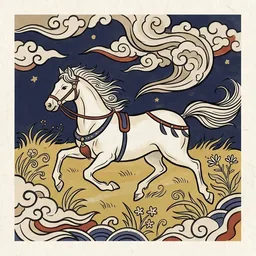
Gap-o (甲午) Day Pillar: Personality, Love and Career
Gap-o (甲午) is a tree in full summer bloom: it talks well, gives a lot, thinks fast, and pours out so much that it needs real quiet to fill up again.
- Expressive
- Generous
- Eloquent
- Quick-witted
- Inwardly still
- Easily drained
At a glance
- Day stem (the "self")
- Gap (甲) · yang Wood
- Day branch
- O (午) · Horse · yang Fire
- Growth stage of the day stem
- Stillness (死)
- Nayin ("sound") element
- Gold in the Sand (沙中金) · Metal
- Void branches (kongwang)
- Jin (辰) · Sa (巳)
- Stem that combines with yours
- Gi (己) → Earth
- Six-harmony partner
- Mi (未)
- Clashing branch
- Ja (子)
- Triad branches
- Sul (戌) · In (寅)
Hidden stems
- Byeong (丙)Eating God (食神)
- Gi (己)Direct Wealth (正財)
- Jeong (丁)Hurting Officer (傷官) · main qi
Stems stored inside the branch, each shown with its ten god relative to your day stem. The last one is the main qi.
Stem and branch. The stem feeds the branch. Energy flows outward into the world, which makes for expressiveness and generosity, and a risk of being drained.
Growth stage of the day stem. A still stage: introspective, deep and focused, sometimes seeming detached. The mind leads more than action does.
Nature and personality
The Gap-o (甲午) day pillar is a tall tree at high summer noon, in full leaf and flower with the sun right on it. People born on a Gap-o day tend to be expressive, generous and quick with words: they talk easily, give freely, are rarely short of a joke or an opinion, and need more time alone than anyone guesses. A day pillar is the stem-and-branch pair for the day you were born in saju, the Korean Four Pillars system. Its upper character is the day master, meaning you; the lower one is the day branch, your inner circle and home life. The day master here is 甲, yang wood, a big upright tree with a single trunk. The branch is 午, the horse, fire at the midpoint of the year. Wood burns to make fire, so the stem feeds the branch: the tree pours itself into the flame. In daily life energy goes outward, into teaching, hosting, cheering and solving other people's problems, which makes for warmth and abundance and also a real risk of ending the week with nothing left for yourself. Three hidden stems sit inside the horse, each given a ten gods label, one of ten names for how a stem relates to the day master. The main one is 丁, a candle flame, Hurting Officer: despite the name it is not harmful, just the label for the sharpest kind of output, meaning wit, performance, eloquent talk and little patience for pointless rules. Beside it is 丙, the sun, Eating God: the gift of enjoyment, good food and an easy ability to nourish others. Third is 己, farmland, Direct Wealth: steady earnings and a practical anchor. That 己 is also the stem that 甲 traditionally combines with, so the day master's classic partner already lives inside the branch. The growth stage is Stillness (死). The name sounds grim, but it describes the point where outward motion stops and everything turns inward, a blaze outside with a quiet room inside. The nayin, the pillar's poetic nickname, is Gold in the Sand (沙中金): flecks of gold carried in river sand, found by washing and sifting patiently, which suggests that the best of this person shows with time.
Strengths
- Eloquent: explains, cheers on and entertains with ease
- Generous with time, attention and ideas
- Quick wit and a talent for performing or presenting
- Practical streak that wants steady, reliable ground
- A still centre that appears with age
Challenges
- Pours out more than comes back, then goes suddenly quiet
- A quick tongue that says the true thing a little too fast
- Impatience with rules that seem to exist for show
- Gives skills away for free and under-charges
Love and relationships
Gap-o tends to love through conversation, attention and enthusiasm: the long late call, the playlist made for you, the toast that makes the table go quiet. The Eating God in the branch makes affection a pleasure to give and to receive, with shared meals and plenty of laughter, and the Hurting Officer as the main hidden star gives a sharp, funny tongue that teases and also says the true thing slightly too fast. The day branch is the traditional spouse palace, and here it holds Direct Wealth (己), the tree's own combination partner. In many traditional readings Wealth is the partner star in a man's chart and Officer stars in a woman's, and either way tradition reads this pillar as wanting a settled, committed and practical bond. The drain shows in love as outflow: you may do the emotional work for two and then withdraw into silence once you are spent. A partner who does not take offence at that withdrawal, and who does not require a performance every night, suits best; someone who can sit in a room with you without talking is worth keeping. Say 'I need an evening alone' as a plain request ahead of time, instead of letting it arrive as a mood.
Work and career
The Gap-o desk needs people in it. Teaching, presenting, hosting, writing, content and brand work, design, media, performing arts, music, public relations, cooking and hospitality, and any role that turns complicated things into something an audience enjoys, all fit the Hurting Officer and Eating God, the pillar's talent for output. Direct Wealth adds a wish for steady, reliable pay in place of uncertain commissions, so a good salary while building a creative sideline is a common and sensible shape. A typical scene: the person asked to explain the new policy because they can make it make sense, who is then handed the training too. The weak points are that the Hurting Officer dislikes arbitrary rules and rigid hierarchy, which can earn a reputation for speaking out in meetings, and that output without refilling leads to burnout. Look for work with an audience, some autonomy and built-in thinking time, and set a price on what you give.
Money
Direct Wealth is a hidden star in the horse, the traditional picture of regular earnings and a settled attitude to money; Gap-o tends to prefer predictable income and to feel uneasy when finances are vague. The question is outflow, which mirrors the energy: this is the hand that pays for the round, buys the gift, sponsors the friend's project and is soft on discounts when the work is its own. Spending leans toward experiences, food, gatherings and things that make a home lively. A workable habit is to fix the bills and a monthly savings transfer first, then give generosity a set budget and a name, and keep a minimum fee for freelance work so that talent is not given away by default.
Energy and wellbeing
Wood feeds fire, so this pillar is a tree burning in a summer sun with no water in sight, and the pattern tradition describes is depletion: a voice gone hoarse after a day of talking, a body that runs on enthusiasm until it stops, thoughts that speed up at night. Refilling is the whole game. Water and quiet are the counterweights: a cool shower, a swim, tea, time alone without a screen, and a bedtime that does not move. The Stillness stage argues for deliberate pauses, a daily stretch of silence, more than for another push. Wood itself wants fresh air and green. This is lifestyle symbolism, not medical advice.
Who you get on with
The horse's traditional six-harmony partner is 未, the goat, an earth sign that cools the heat and holds it softly; the next pillar in the cycle, Eul-mi (乙未), is exactly that pairing. The horse's triad is with the dog (戌) and the tiger (寅), the same-stem Gap-sul (甲戌) and Gap-in (甲寅): three branches running the same direction toward fire, with shared enthusiasm and quick recognition. The clash is the rat (子), as in Gap-ja (甲子): water against fire and opposite tempos, where the rat plans in the dark and the horse speaks in daylight. It is not a curse; it works when each names the pace they need. By element, water people refill the tree, earth people ground the blaze, metal people supply structure and an editor's eye, and other fire people join the party but can double the heat. The stem 甲 traditionally combines with 己, soft earth, a natural pull that the horse already holds within. The void branches (空亡) for this pillar are the dragon (辰) and the snake (巳); tradition reads them as places where connections arrive later or feel lighter. What the whole picture looks like depends on the rest of the chart.
How life tends to unfold
Daewoon are the ten-year luck cycles of saju, each coloured by a stem and a branch, like a season lasting a decade. The Stillness stage suggests a pillar that grows more settled and more interesting with age: the early decades are loud, social and generous, and over time a quieter centre grows, so that the person talks less and says more. Water cycles refill the tree, while wood cycles add fuel and company, with more energy and more outflow. Fire cycles turn the flame up, bringing visibility, performance and recognition and the risk of burnout together. Earth cycles turn output into results, such as income, steady work and built things, and metal cycles bring structure, critics and editors, which can feel like being cut down and can also be what lets the Gold in the Sand be sifted out. A rat year or cycle touches the clash, often as a change of tempo, a move or an abrupt turn. Which decade holds which depends on the rest of the chart.
Advice
Fill first, then pour: ten quiet minutes in the morning before the phone. Say 'let me think and get back to you' once a week; the answer will be better than the fast one. Turn the best of your talk into something that lasts, a lesson, a page or a recipe, so the outflow leaves something behind. Put a price on your skill. And choose one friend who gives back as much as you give, and tell them when you are running low.
Frequently asked questions
Does the Stillness stage mean Gap-o is a gloomy pillar?
No. Stillness (死) is the Korean name of a growth stage that is usually translated as Death, but it describes a pause, the point where outward motion stops and energy turns inward. For Gap-o it works as a counterweight to the bright horse beneath it: a person who is lively in company and needs real solitude, and who gets deeper with age.
What is the Hurting Officer, and is it harmful for Gap-o?
It is the ten god for the output of a day master that is the opposite polarity, and the name is a literal translation. It is not a harm done to you. It stands for sharp wit, performance, eloquence and a dislike of arbitrary authority. In Gap-o it is the main hidden star, so talking and creating come naturally, and a quick tongue is the thing to manage.
Is a Gap-o person extroverted?
Outwardly, often yes: wood feeding fire gives talk, hospitality and generosity. But the Stillness stage and the energy that flows out mean many Gap-o people recharge in solitude and can be surprisingly private. It is better read as a sociable person with a need for quiet than as a pure extrovert. The rest of the chart can tip it either way.
Learn the terms on this page
Is this your day pillar?
Your day pillar comes from your exact birth date, not your birth year. Enter it in our Four Pillars calculator and it shows all four of your pillars.
New to saju? Saju (四柱, "four pillars") describes a person by the year, month, day and hour of birth. The day pillar is the centre of it: its stem is you, and its branch is your closest circle and your home life.