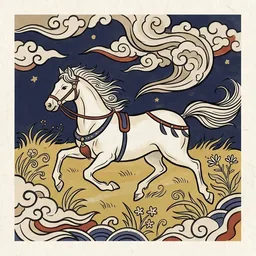
Gyeong-o (庚午) Day Pillar: Personality, Love and Career
Gyeong-o (庚午) is raw steel in a forge on a fast horse: blunt, loyal, strict with itself, and the heat of a task makes it sharp, not weak, as it goes.
- Forged by pressure
- Straight-edged
- Dutiful
- Fast-moving
- Loyal
- Self-demanding
At a glance
- Day stem (the "self")
- Gyeong (庚) · yang Metal
- Day branch
- O (午) · Horse · yang Fire
- Growth stage of the day stem
- Bathing (沐浴)
- Nayin ("sound") element
- Earth by the Roadside (路傍土) · Earth
- Void branches (kongwang)
- Sul (戌) · Hae (亥)
- Stem that combines with yours
- Eul (乙) → Metal
- Six-harmony partner
- Mi (未)
- Clashing branch
- Ja (子)
- Triad branches
- Sul (戌) · In (寅)
Hidden stems
- Byeong (丙)Seven Killings (七殺)
- Gi (己)Direct Resource (正印)
- Jeong (丁)Direct Officer (正官) · main qi
Stems stored inside the branch, each shown with its ten god relative to your day stem. The last one is the main qi.
Stem and branch. The branch controls the stem. There is a constant pull of pressure and duty that builds discipline and inner tension together.
Growth stage of the day stem. The bathing stage: youthful, charming and restless. Sensitivity and attractiveness come with changeable moods.
Nature and personality
The Gyeong-o (庚午) day pillar is raw steel standing in forge fire on a galloping horse: a direct, fast-moving and dutiful personality with a very clear idea of what is right. People born on a Gyeong-o day tend to be decisive, loyal and hard on themselves, and they are usually sharpened by pressure instead of spoiled by it. In saju, the Korean Four Pillars system, a birth chart has four pillars (year, month, day and hour), and each pillar is a pair: a heavenly stem on top and an earthly branch, one of the twelve animals, below. Of the four, the day pillar is the one about you. Its stem is called the day master and stands for you yourself; its branch describes your private temperament and your nearest circle. Here the day master is 庚, yang metal: not the jewel but the raw ore, the axe or the sword before it is polished, hard and unrefined. The branch is 午, the horse, fire at its midday height. Fire is what melts and forges metal, so in saju terms the branch controls the stem. There is a constant pull of expectation and duty from below, and many Gyeong-o people hear it as a voice saying 'do it properly'. It builds discipline and hard-won competence, and it also brings inner tension: the feeling of being tested even when nobody is testing you. Inside the horse sit three hidden stems, each labelled with a ten god, a saju term for how another energy relates to the day master. The main one is 丁, Direct Officer: rules, role and reputation, the wish to be respected for doing the job correctly. Beneath it is 丙, Seven Killings: raw pressure and challenge, and the nerve to walk towards the hard thing. The faintest is 己, Direct Resource: soft earth that teaches and shelters, which is why this pillar is traditionally said to soften when it finds a mentor or a cause worth the effort. The day master's growth stage is Bathing (沐浴), the picture of a newborn being washed: open, exposed and a little vain, quick to feel the mood of a room. The nayin, the poetic name attached to each pair, is Earth by the Roadside (路傍土): plain ground that everyone walks over and that carries the traffic without complaint.
Strengths
- Decisive once the facts are on the table
- Loyal, with a clean sense of duty
- Steady in a crisis when others tense up
- Plain speech that people can rely on
- Learns fast under a mentor they respect
Challenges
- Holding yourself to an exam that never ends
- Edges that cut before you mean them to when tired
- Treating every task as urgent, and rest as slacking
- Hiding the soft side even from those closest to you
Love and relationships
Gyeong-o seldom says it in poetry. Love shows up as turning up on time, fixing the leaking tap the weekend you mentioned it, and staying put through your worst week without making a speech about it. The Bathing stage adds real charm and an openness that can surprise people who only know the work face, and the horse makes affection warm, physical and fast. The day branch is traditionally called the spouse palace, the seat of the closest partner in a chart. Here it holds the horse with a Direct Officer inside, so Gyeong-o looks for someone with standards, reliability and a spine, and expects the same loyalty it gives. The Seven Killings in the branch means tempers can flare quickly under stress, then be over in an hour. What helps is a partner who says things straight rather than dropping hints, who knows that a clipped tone at the end of a hard day is tiredness and not coldness, and who occasionally asks, 'what is it like to be you this week?' Gyeong-o rarely volunteers that answer unprompted. Traditionally the day master 庚 is said to combine with 乙, gentle wood, which many readers take to mean an affinity for softer, more flexible companions; it is a lean, not a rule.
Work and career
Pressure with clear stakes is where this pillar does its best work. It is the colleague who stays calm on the night the system goes down, who knows exactly which step comes next and who does not need a pep talk to start. The hidden Direct Officer likes organisations with clear roles and a real standard, and the Seven Killings gives a taste for hard, high-stakes tasks. Engineering and manufacturing, operations and logistics, emergency and public services, skilled trades, sports coaching, project management, quality control and any job with a measurable target and a deadline tend to suit. Vague bosses and shifting goals wear this pillar down faster than hard work does. The weak point is the feeling that everything is urgent: without deliberate pauses Gyeong-o can run itself dry before the busy season ends. A boss or mentor who is fair and says plainly what good looks like brings out the best, and it is worth learning to ask for exactly that.
Money
No wealth star sits inside the horse, so money tends to come through duty and a defined role, a steady salary or a trade with a clear rate, rather than through speculation or side hustles. Fire melts metal, and the traditional picture is money that softens under stress: the pricey tool or gear bought after a punishing week, the treat that was a reward for getting through. Gyeong-o tends to buy quality and keep it for years. A simple rule helps: pay yourself first with an automatic transfer on payday, and let any purchase above a set amount wait forty-eight hours. Having a small, named 'recovery' budget turns the post-crunch treat into a plan instead of a leak.
Energy and wellbeing
With fire controlling metal, the recurring theme is heat and tension that accumulates without anyone noticing: a clenched jaw, shoulders near the ears, a mind still running the checklist at midnight. Cooling and loosening routines suit this pillar, such as a walk after dinner, swimming or a cold shower, slow stretching after exercise, regular meals and a fixed bedtime. The Bathing stage is sensitive to atmosphere, so a tidy, quiet space helps rest arrive. These are lifestyle readings, not medical advice.
Who you get on with
Traditionally the horse has a six harmony partner in the goat (未), the quiet pairing in which earth steadies fire. The neighbouring Sin-mi (辛未) day pillar sits on exactly that branch, and Eul-mi (乙未) adds the combining stem 乙 above it, a classic image of softness meeting steel. The horse also joins a fire triad with the tiger (寅) and the dog (戌); the dog branch happens to be one of this pillar's void branches (戌亥), which tradition reads as a link that feels thinner or comes later than expected. The clash is the rat (子): water against fire, two opposite tempos, with the horse acting at once and the rat planning in the dark. Many close pairs sit in that pattern and simply need patience. By element, earth supports metal and tempers fire, water cools the whole pillar, and other metal people understand its bluntness at once. Gi-sa (己巳), the pillar just before it in the cycle, is earth over a fire snake, a gentler way of getting the same warmth. How two people actually fit depends on both full charts, not on this pairing alone.
How life tends to unfold
Over a lifetime saju reads ten-year stretches called daewoon, the great luck cycles; each is a stem-and-branch pair that tints a decade as a season tints a year, with start age and direction worked out from the birth date. With the Bathing stage, the early decades often carry some restlessness: trying roles on, meeting a lot of people, and feeling expectations from family or school in the background. In general, earth cycles feed the metal and tend to bring mentors, study and steadier ground; water cycles cool the forge and give the pillar a voice and room to think; wood cycles hand the blade something to cut, which often feels like opportunity and workload at once; fire cycles raise the heat and can feel like either sharpening or exhaustion; and metal cycles bring peers, rivals and allies. The branches 戌 and 亥 are traditionally void for this pillar, so years carrying them can feel less anchored, a good time to put agreements on paper. Which decade feels like which is settled by the whole chart, not by this pillar alone.
Advice
Decide in advance what 'finished' looks like for the week, and then let yourself be finished. Put one non-productive thing in the diary that nobody can reasonably call a task, such as a long meal or a slow walk. When you feel the edge coming, say 'I am tired, not angry' before you say anything else. And let someone who respects you see the unpolished version of you sometimes; the steel was never meant to be perfect on the first strike.
Frequently asked questions
Is fire over metal a bad combination for Gyeong-o?
No. In the five elements fire melts and shapes metal, which is how raw ore becomes a tool, so the traditional reading is pressure that forges rather than harms. It tends to show as discipline, a strong sense of duty and some inner tension. Whether that feels heavy or useful depends on the rest of the chart and the luck cycles.
What does the Bathing stage mean for the Gyeong-o day pillar?
Bathing is the second of the twelve growth stages and pictures a newborn being washed: fresh, open and exposed. For Gyeong-o it adds charm, a pull towards new people and sensitivity to atmosphere, as well as some restlessness. It softens an otherwise hard, dutiful metal-and-fire pillar, so people often seem more approachable than they expect.
Is a Gyeong-o day the same as a metal horse year?
It is the same pair of characters, but they are used in different places. The sixty stem-and-branch pairs repeat as days every sixty days and as years every sixty years, so a metal horse year comes round only once in sixty years. The day pillar describes you personally, while the year pillar is only one other layer of a chart.
Learn the terms on this page
Is this your day pillar?
Your day pillar comes from your exact birth date, not your birth year. Enter it in our Four Pillars calculator and it shows all four of your pillars.
New to saju? Saju (四柱, "four pillars") describes a person by the year, month, day and hour of birth. The day pillar is the centre of it: its stem is you, and its branch is your closest circle and your home life.