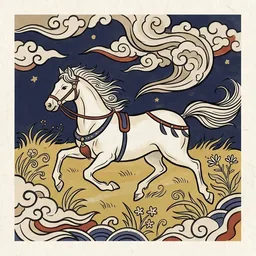
Im-o (壬午) Day Pillar: Personality, Love and Career
Im-o is a river in the noon sun: calm outside, warm and hands-on inside. It tends the practical side of life, knows what things cost and is quick to act.
- Practical
- Warm-handed
- Driven
- Flexible
- Self-reliant
- Quietly busy
At a glance
- Day stem (the "self")
- Im (壬) · yang Water
- Day branch
- O (午) · Horse · yang Fire
- Growth stage of the day stem
- Conception (胎)
- Nayin ("sound") element
- Willow Wood (楊柳木) · Wood
- Void branches (kongwang)
- Sin (申) · Yu (酉)
- Stem that combines with yours
- Jeong (丁) → Wood
- Six-harmony partner
- Mi (未)
- Clashing branch
- Ja (子)
- Triad branches
- Sul (戌) · In (寅)
Hidden stems
- Byeong (丙)Indirect Wealth (偏財)
- Gi (己)Direct Officer (正官)
- Jeong (丁)Direct Wealth (正財) · main qi
Stems stored inside the branch, each shown with its ten god relative to your day stem. The last one is the main qi.
Stem and branch. The stem controls the branch. You press on your surroundings and act on them; practical drive is high and so is the effort.
Growth stage of the day stem. A seed of potential: ideas are forming, plans come before action, and nurture matters a great deal.
Nature and personality
The Im-o (壬午) day pillar is a wide river running in the noon sun: calm to look at, warm and capable underneath, and quicker to act than most people expect. People born on an Im-o day tend to be practical, hands-on and big-hearted, with a real head for what things cost and what the people around them need. In saju, the Korean Four Pillars system, the day pillar (ilju) is the stem-and-branch pair for the day you were born. The stem on top is the day master, the self; the branch below is your private temperament and closest circle. Here the day master is 壬, yang water, the big flowing kind, and the branch is 午, the Horse, a fire sign: the hour of noon and the height of summer. Water sits on fire, so the stem controls the branch. You press on your surroundings and act on them; practical drive is high, and so is the effort, because a person with this pillar usually carries more of the workload than they let on. Inside the Horse are three hidden stems, each with a ten gods role, which is one of ten labels for how another energy relates to the day master. The main one, 丁, is Direct Wealth: earned money, careful accounts and a feel for what is worth keeping. Beside it 丙 is Indirect Wealth, a taste for trade, side ventures and the unexpected opening, and 己 is Direct Officer, duty, standing and a sense of how things should be done. Money and responsibility sit side by side. There is also a quiet tie: 壬 is said to combine with 丁, so the main hidden stem is exactly the partner the day master pairs with, which tradition reads as a pull toward home, partner and one's own people. The day stem stands at the Conception stage (胎) of the twelve growth stages, a seed just taken and not yet visible, so ideas often arrive before there is a form for them. The nayin, the old poetic name, is Willow Wood (楊柳木): a willow by the water, which bends in the wind and stays rooted.
Strengths
- Realistic about money, time and what a plan really needs
- Takes responsibility without being asked
- Generous with practical help, not just words
- Bends under pressure like a willow without breaking
- Moves fast once the picture is clear
Challenges
- Takes charge so quickly that others never get a turn
- Manages people who only wanted company
- Keeps going warm and tense, rarely stopping before the tank is empty
- Ideas can run ahead of the means to carry them
Love and relationships
Im-o loves by doing. This is the person who, on a first visit to your flat, notices the dripping tap and has found a repairman by the weekend, and who learns your work schedule so that dinner lands when you can actually eat it. The day branch is the spouse palace, the seat of the closest partner, and here it holds the Horse with Direct Wealth and Direct Officer in it: a partner who is cared for, defended and provided for, and who is in turn expected to be reliable. Because the main hidden stem 丁 is the very energy 壬 combines with, tradition reads this pillar as strongly drawn in once the door is open, loyal to the point of staying too long. The flaw sits in the stem controlling the branch: care slides into management. Im-o may plan the recovery, the budget and the route before the partner has said what they want, then wonder why the gratitude feels thin. What they need is a partner who accepts help without turning it into a debate, says what they want in plain words, and notices when the helper is tired. A good habit for Im-o is to ask "do you want me to fix this, or just listen?" before acting.
Work and career
Work suits Im-o when results can be counted and the person gets to run something real. Two wealth stars and an Officer star in the branch draw the classic steady builder: the floor manager who knows every supplier by name, the finance lead who has read the numbers before the meeting, the owner of a small restaurant or clinic who also writes the rota. Fields that fit include operations and administration, sales and account management, trade and retail, hospitality and food, logistics and transport (the Horse likes to move), event planning and property management. Water over fire also suits anything where heat and flow meet, such as energy, cooking, ceramics and styling. The Direct Officer gives respect for rules and structure, so Im-o usually does well inside organisations, but the Horse chafes when kept stationary. The risk is becoming the one who carries everyone. Good roles come with a deputy, clear boundaries and a recognised title.
Money
Money is in the foreground for this pillar. Direct Wealth is the main hidden stem and Indirect Wealth sits beside it, which tradition reads as a person who thinks about earnings, budgets and what a household needs, and who likes a salary plus a side channel. Im-o often knows to the unit what the month cost. Spending goes toward family, food, home and whatever keeps daily life running, and now and then toward an impulse upgrade when the Horse wants a change of pace. The trap is the Conception stage: ideas that outrun the funds, such as a renovation or a trip planned before the money is there. A monthly review on paper, a fixed transfer to savings on payday and a rule to sleep a week on any large purchase turn a strong instinct into a steady habit.
Energy and wellbeing
Water above fire in one pair means a cool surface with warmth, and sometimes steam, below. Tradition reads the everyday theme as a mind that stays switched on after the body has stopped: a calm face in the meeting, a racing list at midnight. The five elements here ask for rhythm rather than a cure: a regular bedtime, a short midday pause away from the desk, a walk beside water, evening stretching and one outlet where nobody needs anything from you. Willow likes moisture and gentle movement, so swimming or a long bath fits the image. This is lifestyle symbolism, not medical advice.
Who you get on with
Traditionally the Horse has its six harmony partner in the Goat (未), a warm, quiet pairing where the Goat's softness takes some of the speed out of the Horse. Gye-mi (癸未), the very next day in the cycle, is yin water over the Goat, and Jeong-mi (丁未) adds the stem that 壬 combines with. The Horse also forms a fire triad with the Tiger (寅) and the Dog (戌), three branches that run in the same direction, so people with those animals tend to understand your pace. The Rat (子) is the clash, water against fire, and Im-ja (壬子) is the same stem on the Rat. It reads as opposite tempos: the Rat waits and calculates, the Horse is already out of the stable. Neither is a curse; they match well when they agree who decides what. The void branches (空亡) here are the Monkey (申) and the Rooster (酉), both metal, the element that feeds water. Tradition reads that as help from teachers and seniors feeling thinner or more conditional, so this pillar learns to rely on itself. By element, wood people let your water move, metal people support and calm it, and fire people bring heat and good company. Beyond the day pillar, the rest of each chart has the final say.
How life tends to unfold
Saju divides life into daewoon, ten-year luck cycles that each carry one stem and one branch and are timed from the birth date. A day master at the Conception stage often has an early stretch where ideas and plans outrun what is visible, while the wealth and officer stars bring work and money responsibilities into view by early adulthood. Wood cycles ask you to express and make things; fire cycles bring money and practical results with more pressure attached; earth cycles stress structure, duty and rank; water cycles bring peers, stamina and company. Cycles whose branch is 申 or 酉 fall on this pillar's void branches, which tradition reads as quieter, with less outside support and more self-reliance. Years carrying 丁 or 未 are read as warm and cooperative, since 丁 combines with 壬 and 未 harmonises with 午. How a given decade actually plays out depends on the other pillars and the birth time.
Advice
Ask before you fix. One question, "do you want a solution or company?", saves more goodwill than a perfect plan. Put one afternoon a week in the diary where nothing is yours to manage. Review the month's money on paper, let a savings transfer run on payday, and let an idea wait a week before it costs anything. Handing over the second half of a task is not the same as letting go of the first.
Frequently asked questions
What does the Im-o day pillar mean when water sits over fire?
Im-o is yang water, 壬, standing on the Horse, 午, which belongs to fire. Water cools fire, so in saju the stem controls the branch. In practice it describes someone composed on the outside, active inside and used to acting on the people and tasks around them. It is a temperament image, not a conflict; many people with it feel steady rather than torn.
Is Im-o a good day pillar for money?
Saju does not rank pillars, so it is not a question of luck. This pillar does carry Direct Wealth and Indirect Wealth in its hidden stems, which tradition reads as strong attention to earnings, budgets and what a household needs. That attention is a habit and a talent, not a guarantee. How money actually goes depends on the other three pillars and the luck cycles.
Do a Horse year like 2026 and the Goat year 2027 matter for Im-o?
Tradition reads a year that repeats a branch already in your chart as the same themes turned up, so a Horse year such as 2026 puts home, partner and pace in the spotlight. The Fire Goat year 2027 (丁未) brings a stem that combines with 壬 and a branch that is the Horse's six harmony partner, a gentler, more cooperative colour. Both depend on the whole chart and your current luck cycle.
Learn the terms on this page
Is this your day pillar?
Your day pillar comes from your exact birth date, not your birth year. Enter it in our Four Pillars calculator and it shows all four of your pillars.
New to saju? Saju (四柱, "four pillars") describes a person by the year, month, day and hour of birth. The day pillar is the centre of it: its stem is you, and its branch is your closest circle and your home life.