Gi-chuk (己丑) Day Pillar: Personality, Love and Career
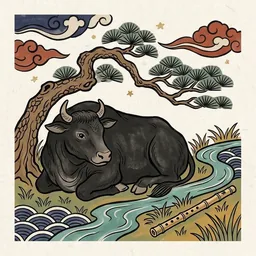
Gi-chuk (己丑) is a winter field and the ox that tills it: slow to speak, firm and loyal, it keeps a lot in store and has a spark that can surprise.
- Steady
- Dependable
- Reserved
- Patient
- Thrifty
- Slow-burning
At a glance
- Day stem (the "self")
- Gi (己) · yin Earth
- Day branch
- Chuk (丑) · Ox · yin Earth
- Growth stage of the day stem
- Storehouse (墓)
- Nayin ("sound") element
- Thunderbolt Fire (霹靂火) · Fire
- Void branches (kongwang)
- O (午) · Mi (未)
- Stem that combines with yours
- Gap (甲) → Earth
- Six-harmony partner
- Ja (子)
- Clashing branch
- Mi (未)
- Triad branches
- Sa (巳) · Yu (酉)
Hidden stems
- Gye (癸)Indirect Wealth (偏財)
- Sin (辛)Eating God (食神)
- Gi (己)Companion (比肩) · main qi
Stems stored inside the branch, each shown with its ten god relative to your day stem. The last one is the main qi.
Stem and branch. Stem and branch share one element. The energy is concentrated and single-minded, strong in focus and short on variety.
Growth stage of the day stem. The storehouse: thrifty, patient and good at keeping things inside, like treasure locked in a vault.
Nature and personality
The Gi-chuk (己丑) day pillar is a winter field and the ox that works it: a steady, reserved and very dependable personality that says little, keeps its word and holds more in reserve than it shows. People born on a Gi-chuk day tend to be patient, practical and hard to rush, and are often the quiet point of stability in a family or a team. Korean saju, or the Four Pillars system, writes your birth day as a pair of characters called the day pillar. The upper one, the day master or day stem, is you; the lower one, the day branch, is one of twelve animals and describes your private temperament and closest relationships. Here the day master is 己, yin earth, a tended field or garden bed. The branch is 丑, the ox, which is also earth: the cold, damp ground of deep winter, with a barn and stores. Stem and branch share one element, so the energy is concentrated and single-minded, strong in focus and short on variety. Think of the person who has ordered the same lunch at the same place for six years and sees no reason to apologise. Inside the ox are three hidden stems, each named by a ten god, a label for how another stem relates to the day master. The main one is 己 itself, the Companion: self-reliance, stubbornness and a strong sense of what is mine. Beneath it is 辛, the Eating God, the gift of making and expressing things calmly, a love of food, craft and doing a task well. The faintest is 癸, Indirect Wealth: a feel for small opportunities and modest, varied income. The growth stage is Storehouse (墓), the image of a thing put away in the ground for safe keeping: stored feelings, stored talent and a habit of saving. It can take a long while for others to see everything inside. The nayin, the traditional poetic name of the pillar, is Thunderbolt Fire (霹靂火), a fitting contrast: a calm field with a sudden, bright spark that appears when pushed hard enough.
Strengths
- Keeps promises and finishes what it starts
- Patient under pressure, hard to rattle
- Practical hands: fixing, saving, making things last
- Loyal to people and places for the long term
- Quiet craft skill that improves with years
Challenges
- Sticks to the known way and resists change
- Keeps feelings stored until they come out all at once
- Slow to start and slow to say 'I need help'
- Can seem closed or unreadable to people who have only just met
Love and relationships
Gi-chuk is the partner still sitting at the same cafe table five years in, with the same order, and glad of it. Affection is built from repetition: the daily call at the same hour, the repaired shelf, the soup made when you are tired. There are few grand gestures, and a lot of showing up. The day branch is traditionally called the spouse palace, the seat of the partner in a chart, and here it is a double-earth ox with a Companion at its core. Tradition reads that as a relationship that feels like home: lasting, plain, and slow to open. The cost is the storehouse habit. Things are filed away, unsaid, until they spill over after months, and a partner may be confused by the sudden size of a small complaint. What helps is a partner who is patient with silences, who does not need constant talk, and who is gentle in asking what is inside. Gi-chuk can help by saying a feeling in the moment, even if it is a tiny one, before it is stored.
Work and career
Work suits Gi-chuk when it rewards reliability and the long game: accounting and bookkeeping, logistics and warehouse management, farming and food production, ceramics and other handwork, maintenance and engineering upkeep, archives and libraries, property management and any craft where hands improve with years. The hidden Eating God points to the pleasure of a well-made thing, and the hidden Indirect Wealth to a knack for small steady income lines. This is the colleague who knows exactly where everything is stored and why, and is hard to replace for it. The weak spot is change: new systems, new bosses and restructures are slow to be accepted. Ask for time to try the new process in practice, and offer your knowledge of how things actually work, as it is the strongest contribution you can make. Speak up about promotions, since quiet reliability is easily taken for granted.
Money
Saving comes naturally here, and the Storehouse stage underlines it: Gi-chuk is the person who keeps a reserve, repairs rather than replaces, and feels uneasy with an empty account. The hidden Indirect Wealth suggests several modest income lines rather than one big one. The drawback is a reluctance to spend even when spending is the right thing: postponing a needed repair, a holiday or a fair price for good work. A useful routine is an automatic monthly transfer on payday, plus a named 'pleasure fund' that is allowed to be used up every year, so thrift does not turn into never enjoying anything.
Energy and wellbeing
In the five-element picture this is earth upon earth, cold ground in winter, and tradition reads the tendency as heaviness and stagnation: slow mornings, a stiff body, a mind that sits on a worry. Warmth and movement are the cure in the symbolism: daily walking, warm cooked meals, sunlight, and some gentle sweating from exercise, which echoes the Thunderbolt Fire of the nayin. Because Gi-chuk stores feelings, talking with a trusted friend each week acts like airing out a storeroom. This is lifestyle symbolism, not medical advice.
Who you get on with
Traditionally the ox has a six-harmony partner in 子, the rat: a quick, resourceful sign that finds the ox dependable, while the ox finds the rat's talk and ideas refreshing. The ox also forms a metal triad with 巳 (snake) and 酉 (rooster), so snake and rooster people often share your practical, orderly pace. The clash is 未, the goat, another earth sign: two stubborn, soft-hearted people who each wait for the other to give in. Since 未 is also one of this pillar's void branches (午 and 未), tradition sees that link as thinner or less binding, so the clash is often milder than it sounds. As a stem, 己 is said to combine with 甲, big yang wood, toward earth, a tree that roots in this field. By element, fire people thaw the cold ground, wood people bring growth and some pressure, metal people give the earth something to make and say, and water people bring variety and moisture. The details depend on the rest of each chart.
How life tends to unfold
The luck cycles of saju, called daewoon, last ten years apiece. Each carries its own stem and branch, like a season for a decade, and your birth date decides the age when the first one begins. Gi-chuk is number twenty-six of the sixty pillars, and its early years often feel slow: a long period of being quietly useful, with a base of skills and savings building under the surface. Fire cycles tend to warm and wake the field, with more visibility and a push to speak up; wood cycles bring growth, demands and new directions; metal cycles reward craft and output; water cycles bring contacts, movement and ideas that loosen the settled routine. Thunderbolt Fire hints that the big moves often arrive as a sudden change after a long stretch of waiting. The void branches (午 and 未) are traditionally read as spots where things feel less anchored, a nudge to put plans on paper. What a particular decade holds depends on the rest of the chart.
Advice
Say one small feeling aloud each day before it goes in storage. Say yes to one unfamiliar thing a month, such as a different route or a new tool, and give it a fair three tries before deciding. Spend deliberately on something that makes the daily routine better. And let people know what you have been quietly doing, since steady work counts for more when it is seen.
Frequently asked questions
What does the Storehouse stage mean for Gi-chuk?
Storehouse is the tinth of twelve growth stages, pictured as something put into the ground or a storeroom for safe keeping. For Gi-chuk it points to reserve: saving habits, stored feelings and talent that is not obvious at first meeting. It is a quiet stage, not a weak one, and it simply describes how the energy is kept.
Is a Gi-chuk person stubborn?
Often, yes, in the sense of steadfast. Stem and branch are both earth and the main hidden stem is a Companion, so the pillar trusts its own judgement and dislikes being hurried. Many people see that as dependability once they know the person. It becomes hard only when change is needed, and a little time is usually all it takes.
Why is the nayin called Thunderbolt Fire for such a calm pillar?
The nayin is a classical poetic name attached to each pair of characters, and it does not describe the personality directly. Thunderbolt Fire is a spark out of still, heavy conditions. Readers take it as a hint that Gi-chuk is calm for a long time, then acts decisively and brightly when a situation finally demands it.
Learn the terms on this page
Is this your day pillar?
Your day pillar comes from your exact birth date, not your birth year. Enter it in our Four Pillars calculator and it shows all four of your pillars.
New to saju? Saju (四柱, "four pillars") describes a person by the year, month, day and hour of birth. The day pillar is the centre of it: its stem is you, and its branch is your closest circle and your home life.