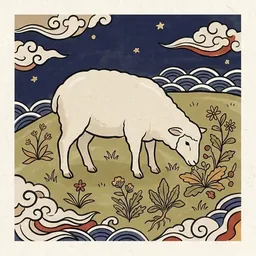
Gye-mi (癸未) Day Pillar: Personality, Love and Career
Gye-mi (癸未) is rain on warm clay: quiet, dutiful and inward, it sets a high bar, holds a lot in and shows a soft, wry, creative side to those it trusts.
- Dutiful
- Inward
- Self-disciplined
- Quietly creative
- Keeps much inside
- Flexible in manner
At a glance
- Day stem (the "self")
- Gye (癸) · yin Water
- Day branch
- Mi (未) · Goat · yin Earth
- Growth stage of the day stem
- Storehouse (墓)
- Nayin ("sound") element
- Willow Wood (楊柳木) · Wood
- Void branches (kongwang)
- Sin (申) · Yu (酉)
- Stem that combines with yours
- Mu (戊) → Fire
- Six-harmony partner
- O (午)
- Clashing branch
- Chuk (丑)
- Triad branches
- Hae (亥) · Myo (卯)
Hidden stems
- Jeong (丁)Indirect Wealth (偏財)
- Eul (乙)Eating God (食神)
- Gi (己)Seven Killings (七殺) · main qi
Stems stored inside the branch, each shown with its ten god relative to your day stem. The last one is the main qi.
Stem and branch. The branch controls the stem. There is a constant pull of pressure and duty that builds discipline and inner tension together.
Growth stage of the day stem. The storehouse: thrifty, patient and good at keeping things inside, like treasure locked in a vault.
Nature and personality
The Gye-mi (癸未) day pillar is soft rain soaking into warm clay: a quiet, dutiful and inward temperament that holds high standards for itself, keeps more feeling than it shows and has a gentle, creative streak that appears with people it trusts. If you were born on a Gye-mi day you are probably the one who carries a responsibility without being asked, and who is both tired of it and rather good at it. In saju, the Korean Four Pillars system, the day pillar (ilju) is the pair of characters for the day you were born. The upper one, the day master, is the self; the lower one, the branch, is your private side and closest circle. Here the day master is 癸, yin water, the gentlest water there is: mist, dew, light rain, groundwater. The branch is 未, the goat, an earth sign that the old calendar ties to the hot, dry stretch at the end of summer. Earth dams water, so the branch controls the stem, and in saju terms you are pressed on from below. In everyday life that shows as a steady pull of obligation: things need doing, you ought to be more careful, other people are counting on you. It builds discipline, and it sits next to a certain inner tension. Three hidden stems sit inside the goat, each named with a ten god, the saju way of describing how another energy relates to the day master. The main one is 己 (Seven Killings), the sternest kind of authority, which shows up as deadlines, rules, high standards and a conscience that does not take holidays. Beneath it is 乙 (Eating God), the gentle, expressive side: enjoyment of food, handwork and easy talk, a vent that lets the pressure out. The faintest is 丁 (Indirect Wealth), a feel for small openings, side work and what things are worth. The inner circle is therefore a strict supervisor, a cook and a small shopkeeper sharing one house, which is why Gye-mi can seem solemn in the meeting and unexpectedly funny while stirring something on the stove. The day master's growth stage is Storehouse (墓), the ninth of the twelve stages and the picture of being laid in a vault, not as an ending but as a storing away. For Gye-mi it means keeping things inside, memories, feelings, savings, skills, and bringing them out slowly and rarely. The nayin, the traditional poetic name of the pillar, is Willow Wood (楊柳木): a willow bends in the wind without breaking and keeps its roots near water, a good match for someone flexible in manner who is not easily uprooted.
Strengths
- Responsible, and finishes what it promised
- Quiet, steady self-discipline
- Gentle humour and warmth with trusted people
- Capable hands for cooking, making and mending
- Remembers and keeps what really matters
Challenges
- Carries too much and says so too late
- Keeps feelings in the storehouse until they sit heavy
- Harsh self-judgement and high standards for everyone
- Slow to relax, because rest can feel like a debt
Love and relationships
With Gye-mi, how deep the feeling goes shows in what they do over a year, not in what they say in a month. This is the partner who learns your mother's phone number, sorts out the paperwork without comment and cooks the rice porridge when you are ill. The Eating God inside the goat turns care into food and small handmade gestures, while the Storehouse stage means that words of love come rarely and then as one carefully chosen sentence. The day branch is called the spouse palace, the seat of the partner in a chart, and here its main energy is Seven Killings. Tradition reads that as taking relationships seriously, holding a high standard for oneself as a partner and being drawn to capable, responsible people. The risk is that duty and love merge: the relationship becomes a list of tasks, the partner feels managed, or Gye-mi quietly feels the weight of it all alone. What helps is a partner who shares the load without being asked twice, who asks open questions at quiet moments and who understands that silence is not coldness. Gye-mi grows by naming one want a week, even a small one. Tradition also pairs 癸 with 戊, a large earth stem, toward fire, a liking for solid, warm-hearted people; take that as an old reading, not a rule.
Work and career
Work suits Gye-mi when there is a clear standard and a person or a process to be responsible for. This is the one who keeps the schedule, watches the budget and quietly takes the incident report that nobody else wants. The Seven Killings as main star favours structured settings: administration, operations, project coordination, public service, education, compliance and quality work, logistics, and the caring professions. The Eating God points toward food and handwork, such as cooking, baking, ceramics, textiles and gardening, and the Willow Wood nayin suggests landscape or woodwork. The Indirect Wealth hints at a side income from a practical skill. The weak point is taking on everything. Make the duties visible, say what a task actually costs in hours and ask for the title that matches the work you are already doing.
Money
The Storehouse stage and the Indirect Wealth together make a saver by instinct. Gye-mi usually keeps a reserve, knows where the money sits and buys things because they are useful. Income often comes in modest side streams, a weekend class, a repair job, a recipe notebook that becomes a small stall, instead of one large jackpot. The leak is obligation: family needs, covering for others, paying out of a sense of duty, or the opposite, guilt about spending anything on yourself. A good habit is an automatic transfer on payday into an account named for a purpose, plus a small fixed amount each month that is yours with no justification required.
Energy and wellbeing
Think of water held back by heavy earth: in the five-element picture the pressure of this pillar tends to collect as tension, in tight shoulders, a clenched jaw or a mind that will not stand down at the end of the day. Habits that let water move suit it well: a warm bath, drinking water through the day, writing the day's worries on paper, stretching and a hobby with no purpose. Earth is linked with the stomach in the old texts, so regular meals eaten sitting down matter more than they seem to. Read the water-held-by-earth picture as old lifestyle symbolism for this pillar, not as medical advice.
Who you get on with
Traditionally the goat's six-harmony partner is the horse (午), fire that warms earth. Im-o (壬午), the pillar just before Gye-mi in the cycle, carries that branch and is the classic place to look for the feeling of a stove lit in a cold room. The goat also forms a wood triad with the pig (亥) and the rabbit (卯), branches that tend to feel easy and trusting because they loosen the earth's grip. The ox (丑) is the traditional clash, earth against earth, two firm wills that both hate to be the first to give way; it is friction between equals rather than a curse and usually eases when one of them says out loud what they want. By element, wood people relax the pressure, since wood breaks up hard clay; metal people refresh the water's source; and fire people bring warmth and a bit of money-mindedness. The void branches (空亡) for this pillar are the monkey (申) and the rooster (酉), and tradition reads areas of a chart touched by them as lighter or less anchored. Treat that as one nuance that depends on the rest of the chart.
How life tends to unfold
Gye-mi moves through daewoon, saju's ten-year luck cycles, each of which paints a decade with a single stem and branch. Gye-mi is the twentieth of the sixty pillars, the last of the second run of ten, and the Storehouse stage often means a long period of collecting: taking on duties early, absorbing skills and keeping them until the right use appears. Recognition tends to arrive after the work, not alongside it. The cycles that matter most for this pillar are the ones that release pressure or refill the source. Wood cycles give the Eating God a stage, so cooking, teaching, making and travelling feel freer. Metal and water cycles refresh the stem and often bring more rest and more help. Fire cycles bring the Wealth element and with it money matters and a warmer social life, while earth cycles press harder, which can feel heavy but also builds real standing and responsibility that others rely on. What a given decade brings depends on the rest of the chart, including the year, month and hour pillars.
Advice
Write down everything you are carrying, then cross out one item that was never yours to carry and hand over another with a date. Name the want before the resentment forms: 'I would like one evening off this week' is a smaller sentence than the one you will say later. Treat rest as a task with a start time. And let one person see the soft, funny, handmade side you show the stove, since it is the part of you that makes the strictness bearable for others.
Frequently asked questions
Why does the Gye-mi day pillar feel so responsible?
The goat branch controls the water stem, and its main hidden star is Seven Killings, the energy of duty, standards and pressure. Together they make a person who feels the weight of obligations early and holds themselves to them. It is a real strength in work and family, and it needs a matching habit of resting and asking for help.
What does the Storehouse growth stage mean?
Storehouse is the ninth of twelve stage names, and it pictures things being stored away. It does not mean decline. For Gye-mi it describes a person who keeps feelings, savings and skills inside and releases them slowly, so others may not guess how much is there. It tends to bring depth and privacy, together with a need for a trusted listener.
Is Gye-mi a water person or an earth person?
Water is you; earth is your surroundings. The day master 癸 is yin water, and that is the self in saju. The goat below is earth, so the inner circle presses on the water, which is where the pillar's duty and tension come from. In practice you feel like a soft, flexible person living with a stern, practical household.
Learn the terms on this page
Is this your day pillar?
Your day pillar comes from your exact birth date, not your birth year. Enter it in our Four Pillars calculator and it shows all four of your pillars.
New to saju? Saju (四柱, "four pillars") describes a person by the year, month, day and hour of birth. The day pillar is the centre of it: its stem is you, and its branch is your closest circle and your home life.