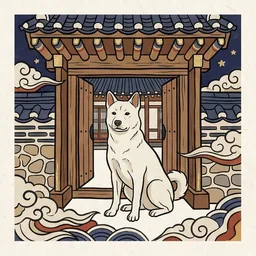
Im-sul (壬戌) Day Pillar: Personality, Love and Career
Im-sul (壬戌) is a big river held in by a strong dyke: it is dutiful, kind to its own and able, and it turns real pressure into both discipline and loyalty.
- Dutiful
- Protective
- Disciplined
- Watchful
- Capable
- Self-demanding
At a glance
- Day stem (the "self")
- Im (壬) · yang Water
- Day branch
- Sul (戌) · Dog · yang Earth
- Growth stage of the day stem
- Capping (冠帶)
- Nayin ("sound") element
- Water of the Great Ocean (大海水) · Water
- Void branches (kongwang)
- Ja (子) · Chuk (丑)
- Stem that combines with yours
- Jeong (丁) → Wood
- Six-harmony partner
- Myo (卯)
- Clashing branch
- Jin (辰)
- Triad branches
- In (寅) · O (午)
- Traditional label
- Baekho (白虎)
Hidden stems
- Sin (辛)Direct Resource (正印)
- Jeong (丁)Direct Wealth (正財)
- Mu (戊)Seven Killings (七殺) · main qi
Stems stored inside the branch, each shown with its ten god relative to your day stem. The last one is the main qi.
Stem and branch. The branch controls the stem. There is a constant pull of pressure and duty that builds discipline and inner tension together.
Growth stage of the day stem. Coming of age: ambition, pride in appearance and a wish to be recognised for what you can do.
Traditional label. One of seven pillars the Korean tradition marks as Baekho, "white tiger": intense, sudden and dramatic in how events arrive, said to ask for care with health and haste.
Nature and personality
The Im-sul (壬戌) day pillar is the Water Dog: a big river held in by a sturdy embankment. People born on an Im-sul day tend to be dutiful, capable and watchful, warm with their own circle, hard on themselves, and driven by a strong sense of what has to be done. In Korean saju every birth date has a two-character name, its day pillar, from a sixty-day cycle. The upper character is the day master, the self; the lower is the branch, the ground of your private life. Here the day master is 壬, yang water: a broad river that likes to travel and think. The branch is 戌, the dog, an earth sign that tradition links with late autumn, dry ground and the guard post at the gate. Earth dams water, so in saju terms the branch controls the stem, and there is a steady pull of pressure and duty that builds discipline and inner tension together. In daily life that is the person who picks up the family phone call on Sunday, becomes the group's organiser because somebody has to, and tidies the spreadsheet at midnight before anyone has asked. The dog holds three hidden stems, each named by its ten gods role, one of ten labels for how another stem relates to the day master. The main one is 戊 (Seven Killings), high mountain earth, the harshest role: it is not about violence but about a demanding standard, authority and courage under load. Beside it sits 丁 (Direct Wealth), the candle flame, the star of earned income and practical care, and notably the very stem 壬 combines with. The residual one is 辛 (Direct Resource), the polished jewel, the star of learning, protection and being supported. So the pressure is cushioned on both sides by help and by reward. The day master stands at the Capping (冠帶) stage of the twelve growth stages, named for the ceremony in which a young person first puts on the adult cap: stepping into the world and wanting to be taken seriously. It suits the ambition, the tidy manner and the wish to be seen as capable. The nayin, the poetic image attached to each pillar, is Water of the Great Ocean (大海水): vast water, a very large inner capacity kept inside a dutiful frame. Im-sul also belongs to the small group of day pillars that traditional texts mark with the Baekho (White Tiger) label. Older writers linked it with forceful moments and a strong character; today it is usually read simply as determination. Think of it as flavour, not a verdict.
Strengths
- Reliable: keeps promises and finishes what is taken on
- Strong sense of responsibility and fairness
- Clear-headed when others tense up
- Protective and loyal to those inside the circle
- Large vision behind a practical manner
Challenges
- Takes on every duty and calls it normal
- Holds tension in silently until it spills over
- Self-criticism that lingers long after others have moved on
- Slow to trust, and rigid about rules once trust is broken
Love and relationships
When someone with an Im-sul day says 'I'll handle it', they mean it, and that is how love tends to sound in this pillar: the ticket booked, the awkward phone call made, the promise remembered a year later. The dog is a watchful animal. Trust is given slowly, and once given, it is kept without announcement. The day branch is traditionally the spouse palace, the seat of the partner in a chart. Older texts look to the wealth star for a man's partner and to the officer stars, of which Seven Killings is one, for a woman's; this palace holds both, so tradition reads partnership here as a serious, formative matter, though no modern couple is bound to it. The weak spot is that the dutiful part of Im-sul can crowd out the playful one: a partner may feel looked after and also managed. What helps most is someone who shares the load without being asked, notices effort without ceremony, and can make them laugh at a rule they were about to follow too tightly. Letting the partner see tiredness, not just competence, is where the closeness starts.
Work and career
Work suits Im-sul when there is structure, responsibility and a standard worth meeting: management and operations, project coordination, public service, education, engineering, accounting and administration, logistics, security and compliance, healthcare administration. A typical scene is the colleague who is made team lead after the previous one left, and whose desk is where the checking happens. The Direct Resource hidden in the dog also favours professional credentials and trained skills, and Capping makes rank and standing matter, so a clear path upward holds this pillar's interest. The risk is burnout by duty: Im-sul says yes to extra work because the extra work is there. Delegating a task before it becomes a crisis is a skill worth practising, and so is naming the limit before the limit arrives.
Money
The Direct Wealth in the dog is the traditional image of steady earned income, honest dealing and money handled properly. Im-sul tends to pay bills on time, remembers what is owed and likes a clear budget. Two habits are worth watching. Pressure can turn into reward spending, the expensive thing bought after a hard fortnight, and duty can turn into quietly covering other people's costs, a relative's rent or a colleague's lunch. A budget with a line for yourself in it, a savings transfer set up before the month begins, and a modest guilt-free amount for pleasure keep the care from becoming a leak.
Energy and wellbeing
In the five-element picture Im-sul is a river pressed by earth, and tradition reads that as tension held rather than released: shoulders up, a jaw set, a mind that does not clock off at night. What helps is unstructured movement and a day with no obligations to anyone: a swim or a walk beside water, long stretching, meals at regular hours, and a weekly evening that nobody else has a claim on. This is lifestyle symbolism, not medical advice.
Who you get on with
Traditionally the dog's six-harmony partner is the rabbit (卯), a gentle wood sign that eases earth's hardness; the dog also sits in a fire triad with the tiger (寅) and the horse (午), three branches that tend to feel warm and energetic together. The dragon (辰) is the dog's clash, two earth signs pushing at each other, often a pair of strong wills who respect each other and need to agree who decides what. The void branches (空亡) are 子 and 丑, the rat and the ox, which tradition reads as links that feel looser or come later. By element, metal people support the river, as 辛 inside the dog already does, and the Sin-yu (辛酉) pillar before this one is the pure form of that help. Wood people loosen the pressure by giving the water somewhere to go, and fire people bring warmth and results. Another water person is a peer who refreshes the river, as with the Gye-hae (癸亥) pillar after, though too much water without banks can overflow. How these play out between two real people is settled by both full charts.
How life tends to unfold
Daewoon, the ten-year luck cycles of saju, run through the sixty pillars in order and give each decade a stem and a branch to colour it; where yours start depends on the whole chart. With a Capping-stage day master, Im-sul often steps into responsibility early, presenting well and being asked to carry things before feeling ready. In general, metal cycles bring support: study, mentors, qualifications and people who take some of the weight. Wood cycles loosen the dam by turning pressure into output, usually welcome after a long stretch of duty. Fire cycles tend to bring income and visible results. Earth cycles can intensify structure and obligation, often meaning promotion and strain together, and are best met with a deliberate rest plan. Water cycles bring peers and flow. The Great Ocean image suggests a life that grows more spacious as the dam is understood as a tool rather than a wall.
Advice
Choose one duty each month and hand it to someone else, with the reason said aloud. Keep one hour in the week that is not for anyone's needs. When you catch yourself saying 'someone has to', ask whether that someone must be you today. Let people see you rest; discipline looks better when it is allowed a pause, and the embankment holds longer when the water has places to go.
Frequently asked questions
Is Im-sul a Baekho day pillar, and should I worry about it?
Yes, Im-sul is among the day pillars that carry the traditional Baekho (White Tiger) label, and no, there is no need to worry. Older texts tied it to strong will and intensity, but modern readers usually take it as determination and courage. It is one label among many, and it decides nothing about your relationships, work or luck on its own.
What does it mean that the branch controls the stem in Im-sul?
In saju the earth of the dog restrains the water of the stem, like an embankment holding a river. In ordinary terms it describes a person who feels a standing pull of duty and discipline, and who builds structure out of that pressure. It is a tension, not a flaw: many Im-sul people do their best work inside clear boundaries.
What does the Capping stage mean for Im-sul?
Capping is the third of the twelve growth stages, named for the coming-of-age ceremony in which a young person first wears the adult cap. For Im-sul it describes a wish to look capable and be taken seriously, tidy habits, ambition and an early sense of responsibility. The risk is carrying the cap all day, so scheduled rest matters as much as achievement.
Learn the terms on this page
Is this your day pillar?
Your day pillar comes from your exact birth date, not your birth year. Enter it in our Four Pillars calculator and it shows all four of your pillars.
New to saju? Saju (四柱, "four pillars") describes a person by the year, month, day and hour of birth. The day pillar is the centre of it: its stem is you, and its branch is your closest circle and your home life.