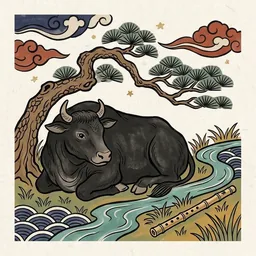
Gye-chuk (癸丑) Day Pillar: Personality, Love and Career
Gye-chuk (癸丑) is meltwater running through a field in winter: a shy, calm soul who took on a load as a child, is slow to trust, and is loyal for good once it does.
- Reserved
- Dutiful
- Self-reliant
- Disciplined
- Resilient
- Slow to open up
At a glance
- Day stem (the "self")
- Gye (癸) · yin Water
- Day branch
- Chuk (丑) · Ox · yin Earth
- Growth stage of the day stem
- Capping (冠帶)
- Nayin ("sound") element
- Mulberry Wood (桑柘木) · Wood
- Void branches (kongwang)
- In (寅) · Myo (卯)
- Stem that combines with yours
- Mu (戊) → Fire
- Six-harmony partner
- Ja (子)
- Clashing branch
- Mi (未)
- Triad branches
- Sa (巳) · Yu (酉)
- Traditional label
- Baekho (白虎)
Hidden stems
- Gye (癸)Companion (比肩)
- Sin (辛)Indirect Resource (偏印)
- Gi (己)Seven Killings (七殺) · main qi
Stems stored inside the branch, each shown with its ten god relative to your day stem. The last one is the main qi.
Stem and branch. The branch controls the stem. There is a constant pull of pressure and duty that builds discipline and inner tension together.
Growth stage of the day stem. Coming of age: ambition, pride in appearance and a wish to be recognised for what you can do.
Traditional label. One of seven pillars the Korean tradition marks as Baekho, "white tiger": intense, sudden and dramatic in how events arrive, said to ask for care with health and haste.
Nature and personality
The Gye-chuk (癸丑) day pillar is meltwater running through a frozen winter field: a reserved, dutiful and quietly tough personality that carries more than it shows. People born on a Gye-chuk day tend to be self-reliant, observant and slow to open up, with a sense of responsibility that arrived early and an inner life far richer than the composed face they present. In saju, the Korean four pillars system, the day you were born is written as a pair of characters, a heavenly stem above and an earthly branch below, and this pair is the day pillar (ilju in Korean). The stem is the day master, the core self; the branch is the home ground of your temperament and the circle you keep closest. The day master here is 癸, yin water, the finest water in saju: dew, mist, a spring that rises without a sound. It is not a river that announces itself; it finds a way through. The branch is 丑, the ox, which is earth, the twelfth month at the bottom of winter: cold, wet, heavy soil that holds water in and lets very little run off. Earth blocks water, so the branch controls the stem, and this pillar lives with a constant pull of pressure and duty. In daily life that is the person handed the keys early because they would not lose them, still at the desk checking the figures once more, with a rule for most things. The pressure builds discipline and, in the same stroke, an undertow of inner tension; both come from one source. The ox holds three hidden stems, and each carries a ten god, one of ten labels for how another stem relates to the day master. The main one is 己, soft damp earth, the Seven Killings (七殺): despite the dramatic name it means pressure, challenge and demanding standards, the energy that makes a person toughen up and take on hard things. Beneath it is 辛, yin metal like a jewel, the Indirect Resource (偏印): a taste for unconventional knowledge, self-teaching and specialist interests. The faintest is 癸 again, the Companion (比肩): an independent core and the loyalty of one peer to another. The day stem's growth stage is Capping (冠帶), named for the cap placed on a young person at the old coming-of-age ceremony, the moment of wanting to be seen as capable and grown. Its nayin, a classical nickname for the pillar, is Mulberry Wood (桑柘木), the tree whose leaves feed silkworms, an image of patient, unglamorous work that ends up as something fine, like silk. Gye-chuk is also one of the pillars that carry the traditional Baekho (white tiger) label. Older texts attach it to strong will and intensity, and modern readers more often take it as courage and resolve. It is one small label among many and decides nothing by itself.
Strengths
- Reliability: you do what you said, when you said it
- Endurance for long, unglamorous work
- Sharp private judgement and an eye for what is genuinely good
- Calm in a crisis, because you have already pictured it
- Loyalty that deepens with time instead of fading
Challenges
- Holding tension in until it comes out sideways
- Treating rest as something that must be earned
- Slowness to let people in, which can read as coldness
- An inner critic that sets standards nobody could meet
Love and relationships
Trust comes first with a Gye-chuk person, and trust is slow, so affection is more often shown than said: the one who rarely says the three words but remembers the date of your exam and turns up at the station when the rain is coming down. Early dates can feel reserved, even formal, because they are watching how you handle small promises. The day branch is traditionally called the spouse palace, the seat of the closest partner, and here it holds the ox with the Seven Killings inside, which tradition reads as high standards and a heavy sense of duty toward the person they love. They tend to treat a relationship as something to look after properly, and hold themselves to that harder than anyone else does. The weak point is carrying it all alone and answering that they are fine to every question. What they need is a partner who is consistent, does not push for disclosure on a schedule, and offers a place where nothing has to be earned: a simple meal, an evening with no agenda. Warmth and patience melt this pillar more reliably than persuasion.
Work and career
This pillar builds a career the way a field is worked, row by row and season by season, and it is strongest in roles where accuracy and reliability are the product. The colleague trusted with the month-end close, the audit, the archive or the safety checklist is often a Gye-chuk. Fields that fit the cold-field-and-ox image include accounting and auditing, research and libraries, engineering and quality control, logistics and operations, agriculture and food production, conservation and restoration, editing and project management. The Seven Killings makes exacting, high-stakes settings feel natural instead of frightening, and the Indirect Resource favours deep specialist knowledge that few others bother to acquire. The Capping stage wants recognition for competence, so credentials and a clear track record matter to morale. Watch for two habits: doing the work of three because delegating feels like a risk, and waiting to be noticed instead of saying what has been done.
Money
Money is handled the way a farmer handles grain: counted, stored and not wasted. Gye-chuk people tend to know what is in each account, prefer to pay bills early and feel more at ease with a reserve than with a plan. In tradition the ox is called a storehouse branch, a place where things are kept, which suits this pattern of quiet accumulation. The tendency to watch is tightness with yourself: putting off the good coat or the holiday for another year because spending without a reason feels wrong. A fixed monthly amount that is yours to enjoy with no justification, set beside the savings transfer, keeps discipline from turning into deprivation. Shared costs are best split by a rule agreed once, so fairness is never something to renegotiate.
Energy and wellbeing
Still water held in cold, wet earth is an image of weight and held tension: shoulders that sit near the ears, a jaw that stays clenched through a long day, a mind that cannot put the task down at night. Tradition suggests bringing warmth and movement to the pillar: warm meals and baths, daylight in the morning, walking or stretching that opens the upper back, and a fixed evening hour when work is closed. A conversation with someone safe is also a form of warmth. This is a lifestyle reading in the vocabulary of the five elements, not medical advice.
Who you get on with
Traditionally the ox has a six harmony bond with the rat (子), water joining earth: a close, quiet pairing in which the rat's flexibility softens the ox's weight. The pillar just before this one in the cycle, Im-ja, sits on exactly that rat. The ox also forms a metal triad with the snake (巳) and the rooster (酉), three branches that lean the same way, and metal is the element that feeds water, so those two bring a sense of support and sharper focus. The traditional clash is the goat (未), earth against earth: two firm characters with different tempos, where the ox's sense of duty meets the goat's softer approach to the same job. It is friction of method, not a curse, and it eases when each says what done means. The day stem 癸 is also said to combine with 戊 (yang earth, the mountain) toward fire, a pairing of water and bank, and a 戊 day master tends to feel steady to a Gye-chuk. By element, metal and water support you, wood loosens heavy soil and gives room to breathe, and fire thaws what has stayed cold too long. The void branches (空亡) are the tiger (寅) and the rabbit (卯); tradition reads the areas where they fall as lighter or less anchored, a nuance that depends on the rest of the chart.
How life tends to unfold
Saju divides a life into ten-year stretches called daewoon, the great luck cycles; each is a stem-and-branch pair that colours a decade as a season colours a year, with the start age and direction worked out from the birth date. The Capping stage suggests that this pillar grows up early: responsibility tends to arrive young, and a person may feel older than their classmates for a long time before the calendar catches up. The usual arc runs toward a slow loosening, as competence turns into trust and the need to prove it fades. In general, fire cycles thaw the field and often bring warmth, visibility and money; wood cycles loosen the soil and bring movement, new settings and a lighter touch; metal cycles feed the water with learning, mentors and finer judgement; earth cycles lay on more weight and duty, which can feel strenuous but builds what lasts; and water cycles bring peers and flow, with a need for rest alongside. What a given decade brings depends on the rest of the chart, so read these as tendencies, not a timetable.
Advice
Let one task a week be merely good enough and notice that the sky stays up. Say one true feeling aloud to someone you trust each week: a duty-minded pillar keeps quiet by habit, and quiet things pile up. Hand over a piece of work with the checklist and without the oversight. Put a day of rest on the calendar with the same seriousness as a deadline, and give people the chance to meet the person under the responsibility, who is usually warmer and funnier than the face at the desk.
Frequently asked questions
Is Gye-chuk a Baekho day pillar, and should I worry?
Gye-chuk is one of the day pillars that carry the Baekho (white tiger) label, but there is nothing to worry about. Baekho is a traditional label said to indicate strong will and intense, forceful energy. Today it is more often read as courage and resolve. It is one label among many and does not decide anyone's love life, work or luck on its own.
Why does the Gye-chuk day pillar feel so serious?
Because the ox branch is earth, and earth controls water in the five-element cycle, so the branch presses on the day stem. Tradition reads that as constant duty and pressure, and in daily life it often looks like early responsibility, high standards and a habit of carrying things alone. The same pressure builds discipline, so the seriousness is as much a skill as a weight.
Are Gye-chuk people cold or hard to get close to?
Reserved, yes; cold, no. Water in frozen earth is still water. Gye-chuk people tend to open slowly, testing trust through small promises, and once they do they are loyal and attentive. If one seems distant, it is usually watchfulness. Patience, consistency and low-pressure warmth are what thaw them, not questions or hints.
Learn the terms on this page
Is this your day pillar?
Your day pillar comes from your exact birth date, not your birth year. Enter it in our Four Pillars calculator and it shows all four of your pillars.
New to saju? Saju (四柱, "four pillars") describes a person by the year, month, day and hour of birth. The day pillar is the centre of it: its stem is you, and its branch is your closest circle and your home life.