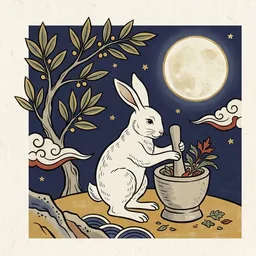
Gye-myo (癸卯) Day Pillar: Personality, Love and Career
Gye-myo (癸卯) is rain on new shoots: a soft, kind, creative water that feeds what it loves, gives a lot and has to learn to keep a bit for its own roots.
- Gentle
- Creative
- Nurturing
- Soft-spoken
- Generous
- Easily drained
At a glance
- Day stem (the "self")
- Gye (癸) · yin Water
- Day branch
- Myo (卯) · Rabbit · yin Wood
- Growth stage of the day stem
- Birth (長生)
- Nayin ("sound") element
- Gold Leaf (金箔金) · Metal
- Void branches (kongwang)
- Jin (辰) · Sa (巳)
- Stem that combines with yours
- Mu (戊) → Fire
- Six-harmony partner
- Sul (戌)
- Clashing branch
- Yu (酉)
- Triad branches
- Mi (未) · Hae (亥)
Hidden stems
- Gap (甲)Hurting Officer (傷官)
- Eul (乙)Eating God (食神) · main qi
Stems stored inside the branch, each shown with its ten god relative to your day stem. The last one is the main qi.
Stem and branch. The stem feeds the branch. Energy flows outward into the world, which makes for expressiveness and generosity, and a risk of being drained.
Growth stage of the day stem. A newborn's stage: hopeful, quick to learn and well supported by others, with a fresh start in the air.
Nature and personality
The Gye-myo (癸卯) day pillar is spring rain falling on a young meadow: a soft-spoken, creative and caring personality whose instinct is to help other things grow. People born on a Gye-myo day tend to be gentle in manner, quick with ideas and generous with attention, and they often pour more of themselves into other people's plans than into their own. In saju, the Korean four pillars system, a birth chart has four pillars (year, month, day and hour), each made of a heavenly stem above and an earthly branch below, one of the twelve animals. The day pillar, called ilju in Korean, is the one that describes you personally: its stem is the day master, the core self, and its branch is your private side and the circle you keep closest. Here the day master is 癸, yin water, the gentlest water in the system: dew, mist, fine rain and the spring that seeps up from underground, not a river with a name. It does not force its way anywhere; it soaks in. The branch is 卯, the rabbit, which is young wood: the second month of the year, the east, the green hour when seedlings are just up and tender. Water feeds wood, so the stem feeds the branch, and the energy of this pillar flows outward into the world. In ordinary life that is the friend who stays on the phone until your cover letter reads right, the person who cooks too much because someone might turn up hungry, the one who is always sketching, arranging or tweaking something for somebody else. The same direction of flow is the risk, because a cloud that keeps raining empties itself. Inside the rabbit sit two hidden stems, small energies tucked within the branch, and each is named by a ten gods role, one of ten labels for how another stem relates to the day master. For a water day master, wood is what you produce. The main one is 乙, yin wood, the Eating God (食神): easy, pleasant self-expression, taste, craft and the urge to feed and comfort people. Beneath it is 甲, yang wood, the Hurting Officer (傷官): a sharper kind of output, with wit, original ideas and a quick allergy to rules that make no sense. So the inner circle of this pillar is almost all making and giving, which is why Gye-myo people so often have a hobby that is practically a second profession. The day stem sits at the growth stage called Birth (長生), the newborn stage of the twelve, which fits the fresh eyes and the habit of staying a beginner at things well into adulthood. Its nayin, the classical image attached to each pillar, is Gold Leaf (金箔金): metal beaten so thin it is almost light, beautiful and valuable but marked by rough handling. It is a fair picture of the sensitivity under the soft manner.
Strengths
- Tender attention that makes people feel noticed
- Fresh ideas and a gift for making things look or taste right
- Gentle persuasion that rarely needs a raised voice
- A beginner's curiosity that lasts well into adult life
- Generosity that is real and not for show
Challenges
- Giving until nothing is left for yourself
- Sensitivity to tone, so one sharp word can linger for days
- Finding it hard to say no without feeling unkind
- Going quiet and withdrawing instead of saying what hurt
Love and relationships
Gye-myo shows love by making a partner's days a little softer: the playlist built for your commute, the tea that appears on your desk, a note in a coat pocket that says only that the sky reminded them of you. It is attentive, inventive affection, and it is usually more tender in private than in public. The day branch is traditionally called the spouse palace, the seat of the closest partner, and here it holds a rabbit with two output gods inside, so expect someone who expresses love creatively, teases lightly and goes quiet and elsewhere when hurt, rather than arguing. What they need back is a partner who notices the giving before it has to be pointed out, offers something in return besides thanks, and reads silence as a signal and not as peace. Someone who treats generosity as a bottomless supply is a poor fit; someone who asks what do you need this week is a very good one. Gye-myo does best when they name the need first, even in one plain sentence, instead of hoping to be asked.
Work and career
Work suits this pillar when it lets care and craft show in the result: the designer whose layouts feel kind, the editor who makes someone else's writing sound more like itself, the teacher who remembers what each child was afraid of. Fields that fit the rain-on-seedlings image include design and illustration, writing and editing, floristry and gardening, food, tea and baking, teaching and tutoring, beauty and styling, content creation and hospitality. Because both hidden gods are output, the work product matters: a portfolio, a menu, a lesson plan, a shelf of finished pieces. The Hurting Officer makes rigid hierarchies and endless approval rounds tiring, so a clear brief with freedom in the how is the best setup. The usual weak points are quoting a price that undervalues the work and staying in a supporting role because it is comfortable. Put your name on the thing, and fix a rate before someone asks you to.
Money
Income tends to follow the gift: it comes from craft, recommendations and repeat customers more than from bargaining or hard selling. Tradition calls output the root of earning, since what you make is what you are paid for, so this pillar often earns best by turning pro at the thing it already does for free. The leak runs the same way as the pillar's energy: the round of drinks, the present chosen too carefully, the favour never billed, a loan to a friend that is in practice a gift. Three plain habits help. Keep a written rate for your work and use it, friends included. Treat savings as a bill you pay yourself on the first of the month. And lend only a sum you would be fine never seeing again.
Energy and wellbeing
Water feeding wood is an outflow, so the usual theme here is depletion: the pillar gives energy out faster than it takes it in, and the signs are familiar ones, such as a flat afternoon after a day of other people's problems or sleep cut short for someone else's crisis. Tradition suggests refilling the source: regular sleep and meals, warm drinks, quiet hours with nobody's needs in them, and time among green things, since wood likes to stretch toward light. Treat tiredness as information to plan around, not a debt to push through. This is a lifestyle reading in the language of the five elements, not medical advice.
Who you get on with
Traditionally the rabbit has a six harmony bond with the dog (戌), a quiet pairing of the soft rabbit with a loyal, protective animal; a person with a dog branch in their chart often feels steadied around a Gye-myo friend, and the other way round. In the wood triad the rabbit travels with the goat (未) and the pig (亥), three branches that grow in the same direction and bring a sense of easy company. The one clash is the rooster (酉): metal cutting wood, the tender against the exacting, where the rooster's plain criticism lands harder than it was meant. That is a mismatch of temperament, not a curse, and it eases when both say what tone they intend. Separately, the day stem 癸 is said to combine with 戊 (yang earth, the mountain) toward fire: water meeting a steady bank, so a 戊 day master often brings the structure a giving person lacks. By element, metal refills your water, wood is the work you give to, fire is warmth and material results, and earth gives shape and limits. The void branches (空亡) here are the dragon (辰) and the snake (巳); tradition reads the areas where they fall as lighter or less anchored, a nuance that depends on the rest of the chart.
How life tends to unfold
Saju divides a life into ten-year stretches called daewoon, the great luck cycles. Each is a stem-and-branch pair that colours a decade as a season colours a year, and the age it starts and the direction it runs are worked out from the birth date. With the day stem at the Birth stage, this pillar often has a long, curious early stretch, with many interests tried and a talent that takes time to settle into a form. Later cycles tend to be about gathering that range into one recognisable thing. Broadly, metal cycles refill the water: study, mentors, support and a feeling of being looked after. Water cycles bring peers and company, and more of you to share. Wood cycles ask for output, busy and productive years that can be rich and tiring in equal measure. Fire cycles turn work into money and partnerships. Earth cycles bring responsibility and outside rules, which can feel heavy but give the flow a channel. What an actual decade holds depends on the rest of the chart, so read these as tendencies, not a timetable.
Advice
Decide what gets your freshest hours before anyone asks, and give people what is left of the day with a clear heart. Let 'I will check my week and tell you tomorrow' be a complete sentence. Keep one piece of work that is only for you, with no audience and no one to feed, so the well has a spring of its own. When something is wrong, say it while it is still small: a soft voice is easy to miss, so say it once, plainly, instead of hinting twice.
Frequently asked questions
What does the Gye-myo day pillar say about personality?
It pairs 癸, yin water such as dew and fine rain, with 卯, the rabbit, young spring wood. The result is a gentle, creative person who looks after others and puts effort into making things pleasant and well made. The stem feeds the branch, so energy flows outward, and the main lesson is keeping enough for yourself. How it plays out depends on the other three pillars.
Why do Gye-myo people feel drained after helping others?
In saju terms water feeds wood, and here the day stem feeds the day branch, so the pillar's energy naturally flows outward into the people and projects around it. Both hidden stems in the rabbit are output, the energy of giving and making. Tradition reads this as generous and expressive, with a built-in need to refill through sleep, solitude and a firm yes or no.
How do I know if my day pillar is Gye-myo?
The day pillar follows a fixed cycle of sixty days, so it comes straight from your birth date and does not depend on your birth year. Enter your date into a four pillars calculator; if you were born near midnight, add the time as well, because different methods treat the late-night hour differently. Gye-myo comes round once every sixty days.
Learn the terms on this page
Is this your day pillar?
Your day pillar comes from your exact birth date, not your birth year. Enter it in our Four Pillars calculator and it shows all four of your pillars.
New to saju? Saju (四柱, "four pillars") describes a person by the year, month, day and hour of birth. The day pillar is the centre of it: its stem is you, and its branch is your closest circle and your home life.