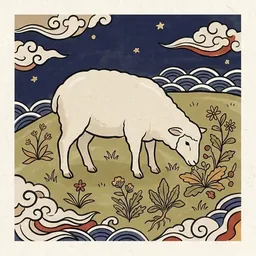
Sin-mi (辛未) Day Pillar: Personality, Love and Career
Sin-mi (辛未) is a fine jewel in warm, dry earth: neat, calm, observant and loyal, it is helped more than it says and holds a high bar for its own work.
- Refined
- Detail-minded
- Quietly supported
- Self-taught streak
- Mellow
- Loyal
At a glance
- Day stem (the "self")
- Sin (辛) · yin Metal
- Day branch
- Mi (未) · Goat · yin Earth
- Growth stage of the day stem
- Decline (衰)
- Nayin ("sound") element
- Earth by the Roadside (路傍土) · Earth
- Void branches (kongwang)
- Sul (戌) · Hae (亥)
- Stem that combines with yours
- Byeong (丙) → Water
- Six-harmony partner
- O (午)
- Clashing branch
- Chuk (丑)
- Triad branches
- Hae (亥) · Myo (卯)
Hidden stems
- Jeong (丁)Seven Killings (七殺)
- Eul (乙)Indirect Wealth (偏財)
- Gi (己)Indirect Resource (偏印) · main qi
Stems stored inside the branch, each shown with its ten god relative to your day stem. The last one is the main qi.
Stem and branch. The branch feeds the stem. The day master is supported from below, so help and nourishment tend to arrive without much asking.
Growth stage of the day stem. Just past the peak: calm, experienced and careful with energy. Wisdom counts for more than force.
Nature and personality
The Sin-mi (辛未) day pillar is a small, finely made piece of jewellery lying in warm, dry soil. People born on a Sin-mi day tend to be refined, observant and a little particular, with a quiet loyalty and a standard for craftsmanship that they apply to themselves first. In Korean saju, the Four Pillars system, every birth date carries a pair of characters called the day pillar. The upper one, the day stem or day master, stands for you; the lower one, the day branch, is one of the twelve animals and describes your private temperament and closest circle. Here the day master is 辛, yin metal. It is not an axe or a sword but the delicate sort of metal: a ring, a needle, a polished mirror. It is happiest when the work is exact and the result is clean. The branch is 未, the goat, which is earth, the dry, sun-warmed ground at the end of summer. Earth produces metal in the five-element cycle, so the branch feeds the stem. In daily life that looks like support that turns up without much asking: a senior who passes on a useful contact, a family member who quietly covers a cost, a friend who keeps your spare key. The goat also holds three hidden stems, smaller energies tucked inside the branch, and each is named by a ten gods role, a way of labelling how another stem relates to the day master. The main one is 己, Indirect Resource. Resource means learning and being looked after, and the indirect kind is the unconventional version: self-teaching, offbeat interests, a hunch that proves right. Next comes 乙, Indirect Wealth, a practical sense for what things are worth and where small openings lie. The faintest is 丁, Seven Killings, the most demanding of the ten gods: a small flame of inner pressure, a critic who sharpens the metal and sometimes stings it. The day master sits in the Decline (衰) stage of the twelve growth stages. That sounds gloomy but pictures a season after the peak: calm, composed, with little need to prove anything. The nayin, the poetic nickname of the pillar, is Earth by the Roadside (路傍土), ordinary ground that everyone walks over and everyone relies on, a fair image for a person whose usefulness is steady and rarely announced.
Strengths
- Precise eye for detail and finish
- Loyal and dependable in small matters
- Self-taught curiosity about unusual subjects
- Calm, unhurried manner under pressure
- Good judgement of what something is really worth
Challenges
- Keeps a high standard that others find hard to meet
- Withdraws instead of saying what is bothering them
- Accepts help awkwardly, or forgets to notice it
- Can turn a private habit into a rule for everyone
Love and relationships
Sin-mi shows love through upkeep. This is the partner who re-sews the loose button before you notice it, keeps your documents in one tidy folder and quietly replaces the lightbulb that has been out for a week. Words come later and fewer; a sentence of real warmth from a Sin-mi person has usually been thought over first. The day branch is called the spouse palace, the seat of the closest partner in a chart, and here it holds a goat: gentle, home-loving, fond of calm rooms and of being comfortable with one person. The hidden Indirect Resource makes them need time to themselves with their own interests, so a partner who treats that time as rejection will have a harder year than one who respects it. The Seven Killings tucked into the same branch brings a sharp eye for faults: Sin-mi tends to notice the small thing, say nothing, and go cool. The warmer path is to say it early and lightly. Traditionally 辛 is paired with 丙, the bright sun, so Sin-mi often feels drawn to open, sunny people who make conversation easy; it is a lean, not a rule.
Work and career
Sin-mi tends to work best at a desk, a bench or a counter where precision is valued, not on a stage. Typical fits are editing and proofreading, translation, archive and records work, accounting and administration, quality checking, laboratory or technical work, restoration, curation, jewellery and fine craft, and any role where one person quietly keeps the details straight for everyone else. The hidden Indirect Resource favours niche expertise: the colleague who knows the odd old file format, the obscure regulation or the one supplier who actually answers. The Seven Killings is a tolerance for demanding standards, so Sin-mi often does well with a strict manager or a clear specification. The weak point is visibility. Work done flawlessly goes unmentioned, so it helps to say aloud what you fixed and to accept the title that comes with it.
Money
Money habits tend to be tidy and a little cautious, in line with the goat's dry, storing earth. The hidden Indirect Wealth gives a good feel for value, so Sin-mi buys fewer things and buys them well: the repairable boots, the good knife, the notebook that lasts. The leak is quality for its own sake, or collecting, where a small interest slowly becomes a large cabinet. A simple structure works well: an automatic monthly transfer into savings on payday, and a separate small account for repairs and replacements so that nothing has to be paid for from a bad mood.
Energy and wellbeing
In the five-element picture Sin-mi is metal on dry earth, with only a trace of wood and fire, and tradition links metal with autumn, dryness and the breath. Habits that add a little moisture and movement suit this pillar: plenty of water, a humidifier in a heated room, an evening walk in fresh air and stretching the shoulders after long close work. The mind tends to keep fixing small things at night, so a short written list before bed lets it stop. This is lifestyle symbolism, not medical advice.
Who you get on with
Traditionally the goat has a six-harmony bond with the horse (午), a lively, outspoken branch that draws the goat into conversation; the pillar before this one in the cycle, Gyeong-o (庚午), is the horse-day version, with a harder metal stem. The goat also joins the rabbit (卯) and the pig (亥) in a wood triad, so those signs often bring practical exchange, such as introductions, favours and shared projects. The clash is the ox (丑), another slow, firm earth sign: two people who each prefer to be right quietly, which usually resolves once one of them says the thing aloud. By element, fire people warm and test the metal, water people loosen it, and earth people feed it. Tradition also marks 戌 and 亥 as the void branches (空亡) of this pillar, where links feel thinner or arrive later; since the pig is one of them, read that as a nuance, never as a flaw. How it all plays out depends on the rest of each chart.
How life tends to unfold
Daewoon are the ten-year luck cycles that run alongside a life, each coloured by its own stem and branch; where they start and which way they run is worked out from the birth date. With a day master at the Decline stage, many Sin-mi people seem to be settled and composed earlier than their age, and the long arc tends to be one of slow, accumulating usefulness, much like Earth by the Roadside. In general, earth cycles add support and routine; fire cycles raise standards and scrutiny, which can feel pressured and also clarifying; water cycles loosen the metal and invite more speaking, travelling and trying new things; wood cycles bring practical openings and more work to handle; and metal cycles bring peers, rivals or partners who share the load. Which decades feel like which depends on the whole chart, including the year, month and hour pillars, so read these as tendencies and not as a timetable.
Advice
Let one thing a week be good enough and leave it alone. When someone offers help, say yes before you work out how to repay it. Say the small annoyance on the day it happens, in one light sentence, instead of filing it. And give your odd interests a fixed evening of their own, since the quiet curiosity is what keeps the rest of the careful life interesting.
Frequently asked questions
Does the Decline stage make the Sin-mi day pillar weak?
No. Decline is the sixth of the twelve growth stages and pictures the calm after the peak, not a shortage of strength. For Sin-mi it reads as composure, a mellow temperament and less need to show off. The pillar is also fed by the goat's earth, so the day master is well supported rather than depleted.
What are the void branches of Sin-mi and should I worry about them?
Every day pillar has two void branches (空亡), the two animals missing from its ten-day group; for Sin-mi they are the dog (戌) and the pig (亥). Tradition says matters tied to them can feel less anchored or arrive late. It is a nuance in a chart and not a warning, and it depends on the rest of the chart.
Does being supported by the branch mean life is easy for Sin-mi?
Not exactly. The goat's earth feeding the metal means help tends to arrive, but it does not remove effort or the demanding inner critic that the Seven Killings stem brings. Support makes the work lighter to carry, not shorter. How easy a life feels depends on the whole chart and on how you use the help.
Learn the terms on this page
Is this your day pillar?
Your day pillar comes from your exact birth date, not your birth year. Enter it in our Four Pillars calculator and it shows all four of your pillars.
New to saju? Saju (四柱, "four pillars") describes a person by the year, month, day and hour of birth. The day pillar is the centre of it: its stem is you, and its branch is your closest circle and your home life.