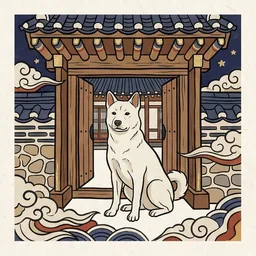
Gyeong-sul (庚戌) Day Pillar: Personality, Love and Career
Gyeong-sul (庚戌) is raw iron by a banked forge: firm, loyal and proud, held up from below, and at its best when it has a post and rules that are clear.
- Principled
- Commanding
- Loyal
- Proud
- Exacting
- Banked fire
At a glance
- Day stem (the "self")
- Gyeong (庚) · yang Metal
- Day branch
- Sul (戌) · Dog · yang Earth
- Growth stage of the day stem
- Decline (衰)
- Nayin ("sound") element
- Hairpin and Bracelet Metal (釵釧金) · Metal
- Void branches (kongwang)
- In (寅) · Myo (卯)
- Stem that combines with yours
- Eul (乙) → Metal
- Six-harmony partner
- Myo (卯)
- Clashing branch
- Jin (辰)
- Triad branches
- In (寅) · O (午)
- Traditional label
- Goegang (魁罡)
Hidden stems
- Sin (辛)Rob Wealth (劫財)
- Jeong (丁)Direct Officer (正官)
- Mu (戊)Indirect Resource (偏印) · main qi
Stems stored inside the branch, each shown with its ten god relative to your day stem. The last one is the main qi.
Stem and branch. The branch feeds the stem. The day master is supported from below, so help and nourishment tend to arrive without much asking.
Growth stage of the day stem. Just past the peak: calm, experienced and careful with energy. Wisdom counts for more than force.
Traditional label. One of four pillars the tradition calls Goegang, "the chief star": unusually forceful, decisive and proud, with a strong sense of authority and all-or-nothing swings.
Nature and personality
The Gyeong-sul (庚戌) day pillar is the Metal Dog: a lump of raw iron sitting beside a banked forge on a late-autumn hillside. People born on a Gyeong-sul day tend to be principled, forceful and fiercely loyal, with a firm sense of right and wrong, little patience for fuss, and an inner fire they keep low until a cause worth lighting it comes along. Korean saju, the Four Pillars system, describes a birth date as pairs of characters, and the pair for the day itself is the day pillar, called ilju. The upper character, the day stem, is read as the day master, the core self; the lower one is a branch, one of the twelve animals, and it stands for your private side and your closest circle. The day master here is 庚, yang metal, in its hardest form: ore, an axe head, a girder, not yet a jewel. The branch is 戌, the dog, which is dry earth, the ground of late autumn once the harvest is in, and in tradition a place where fire is stored. Earth gives rise to metal, so the branch feeds the stem and the day master is held up from below. In everyday life that looks like backing that arrives without much asking: a family that quietly stands behind you, a mentor or institution that gives a stable footing, a position you grew into with the ground already laid. It is help that Gyeong-sul rarely requests and rarely mentions. Three hidden stems sit inside the dog, each tagged with a ten god, a saju term for how another element relates to the day master. The main one is 戊, mountain earth, the Indirect Resource (偏印): learning and protection of an unconventional kind, a self-taught streak and a protective instinct. Next is 丁, a lamp or forge flame, the Direct Officer (正官): conscience, discipline and the wish to be judged fairly by a clear standard. The faintest is 辛, polished jewellery metal, the Rob Wealth (劫財): a peer who is also a rival, which gives pride and a habit of sharing with equals. The growth stage is Decline (衰), a name from the twelve stages that describes settling past the peak, not weakness: a deliberate, seasoned manner that often sounds older than the person's age. The nayin, the poetic nickname for the pillar, is Hairpin and Bracelet Metal (釵釧金): worked jewellery, an image of a hard exterior with a refined, orderly taste inside. Gyeong-Sul is also one of the four day pillars that carry the traditional label Goegang (魁罡), literally a 'chief star'. It speaks of strong will and commanding presence, not of fate.
Strengths
- Keeps promises, including the inconvenient ones
- Decisive when others are still hesitating
- A clear standard of fairness that people can rely on
- Quietly protective of whoever is in their care
- Stamina that holds steady under pressure
Challenges
- All-or-nothing verdicts on people and plans
- Stubbornness once a position has been taken
- Pride that finds it hard to ask for help or to apologise first
- Banked feelings that surface suddenly as a ruling
Love and relationships
A Gyeong-sul partner is rarely casual. Dating is not a way of trying things out: once the decision is made, the commitment is total and so is the expectation that it be mutual. In saju the day branch is called the spouse palace, the traditional seat of the partner in a chart, and here it holds a dog with a Direct Officer inside it. That points to a person with firm ideas of how a relationship should be run, who is faithful and protective, and who can turn a private standard into a checklist without noticing. Affection shows up as reliability: the one who remembers the hospital appointment, takes the late train to meet you, and never lets a friend of yours be mocked in their presence. Words of love may be few, and open vulnerability is slow to come. What helps most is a partner who is secure enough to hear bluntness, says what they need as a request and not a hint, and forgives first once in a while. Gyeong-sul in turn does best when it asks, 'Is this a principle or just a preference?', before drawing a line.
Work and career
This is the person to whom a tangled project is handed because they will actually decide something. Gyeong-sul does well in roles with clear authority and clear rules: management, project leadership, engineering and manufacturing, public service, the armed forces or security, auditing and compliance, law and arbitration, quality assurance, metalwork, restoration and jewellery. Work that is fine, exacting craftsmanship suits the Hairpin and Bracelet nayin well. The Direct Officer inside the branch makes them care about institutions, rank done fairly and a good name. A lax or arbitrary boss is far harder on this pillar than long hours. The weak points are delegating and being flexible with people who work differently; sharing the standard in writing, and noticing what colleagues do well beside what they do wrong, makes authority easier to follow.
Money
With earth feeding the metal from below, money tends to arrive in a steady, supported way: a reliable salary, a position that comes with benefits, a family that taught careful habits. Gyeong-sul values the lasting purchase over the trendy one, such as the good tool, the sturdy shoes, the repaired appliance. The Rob Wealth hidden in the branch is the traditional image of sharing with peers, so there is a tendency to pay the whole bill, cover a friend and not ask for it back. Pride makes it hard to say that money is tight. Keeping a separate account for other people's emergencies, with a set monthly amount, protects both the loyalty and your own reserve.
Energy and wellbeing
Hard metal on dry autumn earth, with a little fire stored inside: tradition reads this as a pillar that runs dry and tense under load, that tends to hold tension in the shoulders and jaw. The remedy borrows water's softness. Plenty to drink, swimming or a long bath, a walk by a river, and exercise that lets the pent-up heat out are all good matches. Regular rest matters because this pillar will carry on past sensible limits out of duty. Read it as tradition and everyday habit, not as medical advice.
Who you get on with
The dog's traditional six harmony partner is the rabbit (卯). Rabbit days such as Eul-myo (乙卯) are the classic place to look, and that one pairs two traditional bonds at once, because the stem 乙 is also said to combine with your own 庚. The dog also sits in a fire triad with the tiger (寅) and the horse (午), three branches that run in one direction; the horse in particular brings the forge heat that shapes raw metal. Note that the rabbit and the tiger are both this pillar's void branches (寅卯), which tradition reads as links that feel lighter or arrive later, so these pairings are nuance, not rules. The dragon (辰) is the dog's traditional clash: earth against earth, two firm wills, more often friction than disaster, and usually easing once each says plainly what is not negotiable. By element, earth people support you, fire people shape and test you, water people cool and loosen you, and fellow metal people can be good mirrors or rivals. What the whole chart says counts for more than any single branch.
How life tends to unfold
The ten-year luck cycles of saju, called daewoon, move through the sixty pillars in order, each colouring a decade with its own element and animal. With a day master at the Decline stage, Gyeong-sul often takes on responsibility early and wears it with a seasoned air, so the first decades can feel more like duty than play, and the middle years tend to bring the sense of having built something solid. In general earth cycles add support and also weight of obligation, fire cycles act as the forge, with tests of rank and reputation that can be demanding and also shaping, metal cycles bring peers, allies and competition, water cycles let feeling and talent flow out and soften the surface, and wood cycles turn attention to practical affairs and money. The jewellery nayin suggests a character that is finished with time and care. Which decades feel like which depends on the rest of the chart, so these are tendencies, not a timetable.
Advice
Give the banked fire a vent before it needs one: say 'this is bothering me' on the first day instead of delivering a ruling on the fifth. Ask for help while the load is still a task and not a test of endurance. Keep one friend who is allowed to tell you that you are being too hard, and listen when they say it. Before drawing a line, decide whether it is a principle or a preference, and let preferences bend.
Frequently asked questions
What does the Goegang label mean for Gyeong-sul?
Goegang is a traditional label for four day pillars, Gyeong-sul among them. It is said to indicate a commanding, decisive and proud temperament that tends toward all-or-nothing. Older writing was wary of it, but modern readers mostly take it as determination and leadership. It is one label among many in a chart and does not settle anyone's love, money or work.
Is Gyeong-sul a hard day pillar for marriage?
No. Old texts attached warnings to Goegang pillars, but they describe a strong, loyal and demanding temperament, which is not a verdict on marriage. Gyeong-sul tends to take commitment very seriously. How a partnership goes depends on honest communication and on the rest of the chart, not on this pair alone.
Is Gyeong-sul the same as being born in a Metal Dog year?
The characters are the same, but they are used differently. The sixty pairs repeat as years and as days, and 1970 was a Metal Dog year. Your day pillar comes from your birth date and describes you personally, while the year pillar is one other layer of the chart, so a person of any birth year can have a Gyeong-sul day.
Learn the terms on this page
Is this your day pillar?
Your day pillar comes from your exact birth date, not your birth year. Enter it in our Four Pillars calculator and it shows all four of your pillars.
New to saju? Saju (四柱, "four pillars") describes a person by the year, month, day and hour of birth. The day pillar is the centre of it: its stem is you, and its branch is your closest circle and your home life.