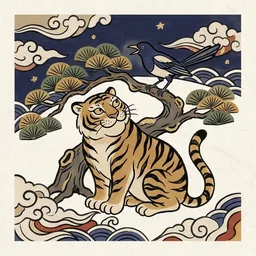
Im-in (壬寅) Day Pillar: Personality, Love and Career
Im-in (壬寅) is a wide river that feeds a spring forest: it is kind, curious and full of ideas, gives a lot, and needs rest so it does not run dry.
- Generous
- Curious
- Free-flowing
- Perceptive
- Idea-rich
- Easily drained
At a glance
- Day stem (the "self")
- Im (壬) · yang Water
- Day branch
- In (寅) · Tiger · yang Wood
- Growth stage of the day stem
- Illness (病)
- Nayin ("sound") element
- Gold Leaf (金箔金) · Metal
- Void branches (kongwang)
- Jin (辰) · Sa (巳)
- Stem that combines with yours
- Jeong (丁) → Wood
- Six-harmony partner
- Hae (亥)
- Clashing branch
- Sin (申)
- Triad branches
- O (午) · Sul (戌)
Hidden stems
- Mu (戊)Seven Killings (七殺)
- Byeong (丙)Indirect Wealth (偏財)
- Gap (甲)Eating God (食神) · main qi
Stems stored inside the branch, each shown with its ten god relative to your day stem. The last one is the main qi.
Stem and branch. The stem feeds the branch. Energy flows outward into the world, which makes for expressiveness and generosity, and a risk of being drained.
Growth stage of the day stem. Sensitive and thoughtful with a strong inner life. The body may tire easily; imagination and care run deep.
Nature and personality
The Im-in (壬寅) day pillar is the Water Tiger: a wide river pouring into a spring forest. People born on an Im-in day tend to be generous, curious and quick to share what they know, with plenty of ideas and a habit of feeding other people's growth before their own. In Korean saju, the Four Pillars system, every birth date has a two-character name taken from a sixty-day cycle, called its day pillar. The upper character, the day master, stands for you; the lower one, the branch, is your private circle and temperament. Here the day master is 壬, yang water. It is not a pond but a moving river: big, free and hard to fence in. The branch is 寅, the tiger, a wood sign and the first branch of spring. Water nourishes wood, so in saju terms the stem feeds the branch, and the river waters the forest. In ordinary life that is the person who spends an evening helping a friend rewrite a CV, who answers every question in the group chat, and who gives away the idea they were saving for themselves. The flow goes outward, which makes this pillar expressive and warm, and also leaves it prone to being drained. Every branch holds hidden stems, smaller energies tucked inside, and each is named by its ten gods role, one of ten labels for how another stem relates to the day master. The tiger's main one is 甲 (Eating God), the tall tree. Eating God is the star of output: talk, cooking, craft, teaching, the pleasure of making something and handing it over. Beneath it sits 丙 (Indirect Wealth), the sun, which stands for earnings that arrive from varied, unplanned directions and for an eye for openings. Wood feeds fire, so tradition reads this pair as talent turning into value. The faintest is 戊 (Seven Killings), mountain earth, the star of pressure and challenge. It can show up as a sharp inner critic, or as the ability to stay level when the stakes are high. The day master stands at the Illness (病) stage of the twelve growth stages. The name sounds worse than it is: it is not a forecast about health but a picture of someone sensitive, perceptive and a little delicate, who picks up moods easily. The nayin, the poetic image attached to each pillar, is Gold Leaf (金箔金): metal beaten very thin, bright and precious, which suits a gift that shines most when it is not spread over too much surface.
Strengths
- Generous with time, ideas and attention
- Quick, flexible mind that links unrelated things
- Explains well and puts people at ease
- Sensitive to mood, so others feel understood
- Starts things with a sense of adventure
Challenges
- Gives more than is left, then runs on empty
- Scatters interest across many beginnings
- Absorbs other people's moods as if they were their own
- Inner critic that wakes up when pressure rises
Love and relationships
Someone with an Im-in day is often the one who proposes the unplanned weekend: a train to a coastal town, a night market, a mountain path nobody has reviewed. Love comes out as shared adventure, long talk and giving. The Eating God in the tiger makes them playful, a good cook or a good listener, and quick to turn a small moment into a story. The day branch is traditionally called the spouse palace, the seat of the partner in a chart, and a tiger there suggests a person who needs air and movement in a relationship and tires of a routine that never changes. The Illness stage adds a tender side. Im-in takes in a partner's mood quickly, sometimes before the partner knows it, and can end up carrying a feeling that was never theirs. Because the stem feeds the branch, the pattern in love is giving first; the risk is running quietly low and then pulling away. They do best with someone curious and a little independent, who asks what they need and does not treat generosity as a bottomless supply. Saying the tired sentence early, such as 'I need a quiet evening', is a kindness to both people.
Work and career
Work suits Im-in when ideas can be turned into something other people use. The colleague who runs the workshop, writes the newsletter, plans the itinerary or finds the angle nobody else saw is often this pillar. The Eating God points toward teaching and training, writing and content, design, food and hospitality, travel and tourism, education, product ideas and marketing; water's traditional link with movement also suits work that crosses borders, languages or fields. What tires this pillar is repetition without meaning, and long administrative stretches with no new input. Seven Killings in the background means Im-in can perform well under a deadline but takes harsh criticism more to heart than it shows. Two habits help: a fixed block of finishing time each week, and a detail-minded partner who likes the part of the work that Im-in finds dull.
Money
Money tends to follow talent. The tiger's Eating God feeds its Indirect Wealth, the traditional picture of skill turning into varied income: extra classes, freelance jobs, small commissions, a side project that grows, rather than one fixed stream. Money leaves the same way it arrives, through generosity and curiosity: dinners for friends, trips, courses, equipment for a new interest. Gold Leaf is a fair image, plenty of surface and very thin. A standing order into a separate savings account on the first of the month, a small fund for fun, and a rule of waiting two days before buying anything for a brand-new passion keep the generosity without leaving the account bare.
Energy and wellbeing
In the five-element picture Im-in is water feeding wood, with a spark of fire and a trace of earth inside: lots of flow and not much holding. Tradition reads that as a pillar that gives out energy and has to refill on purpose. The usual signs are scattered thoughts, fatigue after a heavy social week, and a mood that follows whoever you were with last. Regular sleep hours, warm meals, plenty of water, time near trees or a river, and quiet gaps between social plans do the most. This is lifestyle symbolism, not medical advice.
Who you get on with
Traditionally the tiger's six-harmony partner is the pig (亥), another water-rich sign, and the pair is said to combine toward wood: an easy, supportive match, a good travel companion. A Jeong-hae (丁亥) day meets Im-in on two levels at once, since 壬 also combines with 丁. The tiger sits in a fire triad with the horse (午) and the dog (戌), three branches that run in the same direction and tend to feel enthusiastic and loyal. The monkey (申) is the tiger's clash: two quick, bold signs pulling against each other, often a lively friendship that needs clear agreements. The tiger's void branches (空亡) are 辰 and 巳, the dragon and the snake, which tradition reads as links that feel thinner or arrive later. By element, metal people feed water, as with the Sin-chuk (辛丑) pillar before this one; fire people warm the river and help turn ideas into results; earth people give shape and boundaries, which can feel like pressure at first. The Gye-myo (癸卯) pillar after is a gentler version of the same river-and-forest picture. How any of this plays out depends on the rest of each chart.
How life tends to unfold
Daewoon, the ten-year luck cycles of saju, run through the sixty pillars in order and colour each decade with a stem and a branch; where yours begin and which come next depend on the whole chart. With an Illness-stage day master, Im-in often has an early stretch of feeling things strongly and trying many paths, then a settling as experience gives the sensitivity somewhere to stand. In general, wood cycles give the river more forest to water: busy, expressive years of teaching, making and travelling, with giving too much as the thing to watch. Fire cycles tend to turn talent into visible results and income. Earth cycles bring structure, responsibility and the occasional hard critic, which can put an edge on the Gold Leaf. Metal and water cycles refill the river through study, mentors, rest and good friends. As for the void branches 辰 and 巳, tradition says matters tied to them feel less anchored when they appear in a cycle; take it as a cue to check details twice, not as a warning.
Advice
Decide in the morning what you are willing to give today, and let that be enough. Finish one thing before opening the next. Keep one fixed hour of quiet in the week, and when a friend's mood lands on you, ask whose it is before you carry it home. When an idea arrives, write the first draft before you share it, so that people receive something made rather than a spark.
Frequently asked questions
What does the Water Tiger day pillar Im-in mean in saju?
It is the pairing of 壬, yang water like a wide river, with 寅, the tiger, a wood sign, in the day position of a Korean four pillars chart. People with it are usually generous, curious and expressive, with a tendency to give more than they keep. Your own day pillar comes from your birth date, and a Four Pillars calculator will find it.
Does the Illness growth stage mean Im-in people are unhealthy?
No. Illness is simply the name of one of the twelve growth stages, a stage that pictures sensitivity and delicacy rather than disease. For Im-in it describes a perceptive person who feels moods strongly and needs regular rest. It says nothing about your actual health, and saju is a lens for temperament, not a medical tool.
Is an Im-in day pillar the same as the Water Tiger year?
It is the same pair of characters, used in a different place. The sixty pairs repeat as years every sixty years, and 2022 was a Water Tiger year, while an Im-in day pillar belongs to your own birth date and describes you personally. The year pillar is just one other layer of a full chart, so someone born in 2022 does not automatically have Im-in as a day pillar.
Learn the terms on this page
Is this your day pillar?
Your day pillar comes from your exact birth date, not your birth year. Enter it in our Four Pillars calculator and it shows all four of your pillars.
New to saju? Saju (四柱, "four pillars") describes a person by the year, month, day and hour of birth. The day pillar is the centre of it: its stem is you, and its branch is your closest circle and your home life.