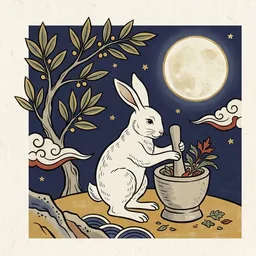
Jeong-myo (丁卯) Day Pillar: Personality, Love and Career
Jeong-myo (丁卯) is a lamp fed by young wood: shy, keen-eyed and neat, it learns fast, feels a lot and glows best when it is cared for and free to act.
- Refined
- Perceptive
- Soft-spoken
- Studious
- Easily moved
- Well nourished
At a glance
- Day stem (the "self")
- Jeong (丁) · yin Fire
- Day branch
- Myo (卯) · Rabbit · yin Wood
- Growth stage of the day stem
- Illness (病)
- Nayin ("sound") element
- Fire in the Furnace (爐中火) · Fire
- Void branches (kongwang)
- Sul (戌) · Hae (亥)
- Stem that combines with yours
- Im (壬) → Wood
- Six-harmony partner
- Sul (戌)
- Clashing branch
- Yu (酉)
- Triad branches
- Mi (未) · Hae (亥)
Hidden stems
- Gap (甲)Direct Resource (正印)
- Eul (乙)Indirect Resource (偏印) · main qi
Stems stored inside the branch, each shown with its ten god relative to your day stem. The last one is the main qi.
Stem and branch. The branch feeds the stem. The day master is supported from below, so help and nourishment tend to arrive without much asking.
Growth stage of the day stem. Sensitive and thoughtful with a strong inner life. The body may tire easily; imagination and care run deep.
Nature and personality
The Jeong-myo (丁卯) day pillar is a lamp stocked with fresh young wood: a quiet, perceptive, finely tuned personality that notices a change of tone, a crooked line or an unspoken mood before anyone else in the room does. People born on a Jeong-myo day tend to be gentle in manner, particular about their surroundings and quick to learn, and their flame stays steady as long as someone, or something, keeps feeding it. Korean saju, also called the Four Pillars system, describes a person through four pairs of characters. The day pillar, called ilju in Korean, is the pair for your birth date, and it speaks about you personally. Its upper character is the day master, the core self; its lower character is the branch, the animal, which stands for your private side and your closest circle. Here the day master is 丁, yin fire: not a bonfire or the sun but a candle, a paper lantern, the ember in a hearth, a light small enough to read by and warm enough to gather around. The branch is 卯, the rabbit, a wood sign that tradition ties to spring and to first light. Wood is what fire burns, so the branch feeds the stem. The lamp is placed on a shelf that is already stocked. In daily life that looks like help arriving without much asking: the senior colleague who tells you what the meeting was really about, the aunt who keeps paying for one more course, the friend who sends the exact article you needed. Every branch also holds hidden stems, smaller energies kept inside it, and each is tagged with a ten gods role, one of ten ways another stem relates to the day master. The rabbit holds only two, and both are wood and both are Resource. 甲, big-tree wood, is Direct Resource and is the residual one; 乙, the vine and the flower, is Indirect Resource and is the main one. Resource means learning, shelter and being looked after. Direct Resource is the formal kind: school, a mentor, proper channels. Indirect Resource is the sideways kind: self-teaching, unusual interests, intuition. With nothing else inside, this inner circle is made of study and protection alone, which is why Jeong-myo people often look calm and careful outside while taking in a great deal within. The day master sits at the Illness (病) stage of the twelve growth stages. The name is poetic and says nothing about health: it pictures strength easing off and sensitivity sharpening, like a person who feels every draught in the house. It adds tenderness, a fine ear and a talent for feeling rather than forcing. The nayin, the traditional poetic name for the pillar, is Fire in the Furnace (爐中火): fire not blazing in the open but held inside a kiln, contained, steady and put to use, which suits a warmth that is deliberate rather than showy.
Strengths
- Notices detail, tone and mood faster than most
- Learns quickly from teachers, books and watching
- Refined taste and a tidy, thoughtful way of working
- A gentle presence that people open up to
- Receives help and guidance with grace
Challenges
- Waits to be handed information or reassurance instead of going to get it
- Absorbs other people's moods and is tired by it afterwards
- Prepares carefully, then hesitates over the first real step
- Hurt feelings go quiet instead of being said
Love and relationships
A Jeong-myo person tends to fall in love by being listened to. Attention is the language here: the playlist built for one specific train ride, the gift chosen three months ago because you mentioned it once, the note left under a cup. Because the branch is traditionally called the spouse palace, the seat of the partner in a chart, and holds a rabbit, the picture is of someone who wants a partner who is kind, tasteful and calm to be near, and who wants a home that feels safe to be soft in. What this pillar needs is patience and tenderness. Raised voices, public teasing and being rushed into decisions make the flame shrink. The honest weak spot is waiting: with so much nourishment already inside, Jeong-myo may expect the other person to read the signals and move first, and then feel overlooked when they do not. One plain sentence beats a month of hints. Tradition adds that 丁 combines with 壬, yang water, a wide, calm, flowing presence, and since that combination turns toward wood, which is the rabbit's own element, it is read as an easy and natural pairing. It is a lean, not a promise.
Work and career
This pillar does its best work where care, precision and taste count, and where there is a person senior enough to learn from. The colleague who proofreads the contract and finds the clause with the wrong date, or who rearranges a messy shared drive so that everyone can suddenly find things, is often a Jeong-myo. Fields that fit the two Resource stars include editing and publishing, research, translation, teaching and tutoring, libraries and archives, counselling, curating, design, and anything that needs a dependable eye. The furnace nayin also points to crafts that use heat and patience, such as ceramics, baking and fine metalwork, and wood links to paper, textiles and plants. The flame struggles in noisy, constantly shifting teams where nobody explains the standard, and in jobs that reward quick, bold moves before understanding. A good first mentor shapes this career more than any title. Choose a role where your thoroughness is the point, then practise putting a first draft in front of people earlier than feels comfortable.
Money
None of the rabbit's hidden stems is a wealth star, so money tends to come through skill, qualifications and the people who vouch for you, rather than through chasing deals. Spending leans toward quality and atmosphere: good paper, a well-made lamp, tea, books, a course that looks interesting. The leak is usually mood-related, a small purchase to soften a heavy week, or enrolling in a new class before the last one is finished. A fixed transfer to a savings account on payday, plus a clearly named monthly treat budget, lets the pleasure stay without becoming guilt.
Energy and wellbeing
In the five-element view this pillar is a small fire sitting on a large pile of wood. Tradition warns that too much fuel can smother a small flame, and in daily terms that reads as too much input and not enough action: a head full of reading and plans, with the body staying still. Walking in daylight, working with the hands, regular warm meals and a fixed bedtime help the fire draw air. Because the Illness stage is the sensitive one, quiet time after crowded days is a need, not a luxury. Saju is a lens on habits and temperament, so if low mood or tiredness lasts, a doctor is the right person to ask.
Who you get on with
Traditionally the rabbit has a six-harmony bond with the dog (戌), a loyal, quiet pairing, though the dog is one of this pillar's void branches (戌亥), which tradition reads as a link that feels thinner or arrives later. The rabbit also forms a wood triad with the goat (未) and the pig (亥): three branches that lean the same way, so people of those signs often feel familiar quickly, with similar rhythms and a shared softness. The pig is void here too, which only means the tie may be quieter than it looks. The rooster (酉) is the rabbit's clash: metal cutting wood, a precise, critical energy against a gentle one. It is a pairing of different tempos, not a curse, and it often works once both say plainly what they need. By element, water and wood people feed the lamp, other fire people keep it company, and earth people give it something to illuminate. The pillar just before it in the cycle, Byeong-in (丙寅), a sun above a tiger, tends to feel like a bright, bold elder sibling, and the one after, Mu-jin (戊辰), is a solid earth dragon. Beyond the day pillar, everything depends on the rest of each chart.
How life tends to unfold
Saju reads a life in daewoon, ten-year luck cycles that each carry a stem and a branch of their own. With a day master in the Illness stage and an inner circle made of Resource, Jeong-myo tends to have an early life of being guided and sheltered, with a lot of study and a sensitivity that gets stronger before it gets steadier. Cycles with wood or water add more nourishment and can feel comfortable, perhaps too comfortable, so they are good seasons to act on what has been learned. Fire cycles bring confidence and visibility. Earth cycles give the lamp something to say and to make, which is often when a voice appears. Metal cycles bring money, results and some sharp feedback. Traditionally the branches 戌 and 亥 are void for this pillar, so when they appear in a cycle or a year, the matters tied to them can feel less solidly anchored; treat that as a reason to double-check plans, not as a warning. Which decade does what depends on the whole chart, the other three pillars included.
Advice
Send the draft at eighty percent. Ask the question in the meeting rather than composing it afterwards in a message you do not send. Give your preferences a sentence each week, however small, such as the film you want to see, so the people who love you stop guessing. Keep your rooms tidy and your evenings quiet, since that is how this flame stays steady. And let a little of what you have learned be used before it is perfect: a lamp is meant to be lit.
Frequently asked questions
What is the Jeong-myo day pillar like?
Jeong-myo is yin fire over the rabbit, a candle flame sitting on wood. People with this day pillar are usually gentle, observant, refined and quick learners, who take in other people's moods and give back care in small, careful ways. Their main lesson is turning all that preparation and sensitivity into confident action.
Does the Illness stage mean Jeong-myo has poor health?
No. Illness is the name of a growth stage, a poetic picture of strength easing off while sensitivity sharpens, and it is not a medical prediction. For Jeong-myo it suggests a fine, easily moved temperament that needs good routines and quiet time. Questions about real health belong with a doctor, not a chart.
Is a Jeong-myo day the same as a Fire Rabbit year?
It is the same pair of characters, but they sit in different places. The sixty stem-and-branch pairs repeat as days every sixty days and as years every sixty years, and 1987 was a Fire Rabbit year. Your day pillar comes from your birth date and describes you personally, while the year pillar is a separate layer of the chart.
Learn the terms on this page
Is this your day pillar?
Your day pillar comes from your exact birth date, not your birth year. Enter it in our Four Pillars calculator and it shows all four of your pillars.
New to saju? Saju (四柱, "four pillars") describes a person by the year, month, day and hour of birth. The day pillar is the centre of it: its stem is you, and its branch is your closest circle and your home life.