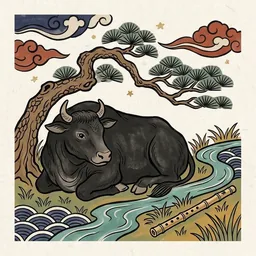
Jeong-chuk (丁丑) Day Pillar: Personality, Love and Career
Jeong-chuk (丁丑) is a small stove in a cold barn: calm, loyal and kind, it shows love by what it makes and gives, and it is slow to open up but sure.
- Steady
- Generous
- Hands-on
- Loyal
- Private
- Slow-burning
At a glance
- Day stem (the "self")
- Jeong (丁) · yin Fire
- Day branch
- Chuk (丑) · Ox · yin Earth
- Growth stage of the day stem
- Storehouse (墓)
- Nayin ("sound") element
- Water of the Mountain Stream (澗下水) · Water
- Void branches (kongwang)
- Sin (申) · Yu (酉)
- Stem that combines with yours
- Im (壬) → Wood
- Six-harmony partner
- Ja (子)
- Clashing branch
- Mi (未)
- Triad branches
- Sa (巳) · Yu (酉)
- Traditional label
- Baekho (白虎)
Hidden stems
- Gye (癸)Seven Killings (七殺)
- Sin (辛)Indirect Wealth (偏財)
- Gi (己)Eating God (食神) · main qi
Stems stored inside the branch, each shown with its ten god relative to your day stem. The last one is the main qi.
Stem and branch. The stem feeds the branch. Energy flows outward into the world, which makes for expressiveness and generosity, and a risk of being drained.
Growth stage of the day stem. The storehouse: thrifty, patient and good at keeping things inside, like treasure locked in a vault.
Traditional label. One of seven pillars the Korean tradition marks as Baekho, "white tiger": intense, sudden and dramatic in how events arrive, said to ask for care with health and haste.
Nature and personality
The Jeong-chuk (丁丑) day pillar is a small stove burning in a winter barn: a patient, hard-working and generous personality whose warmth is deep but is shown through making things, feeding people and keeping promises, not through announcements. People born on a Jeong-chuk day tend to be loyal, a little guarded and slow to start, with far more going on inside than a calm face lets on. In Korean saju, the Four Pillars system, a person is described by four pairs of characters, and the day pillar (ilju) is the pair for your birth date. The upper character is the day master, the self; the lower is the branch, an animal, which stands for your home life and closest circle. Here the day master is 丁, yin fire: the candle, the ember in a clay stove, a heat that is small but close. The branch is 丑, the ox, an earth sign tied to the coldest, wettest stretch of winter, the field resting under frost and the barn where animals are kept warm. A little fire inside a cold, heavy place: that is the picture, and it is why people with this pillar so often become the warmth that other people gather around. Fire makes earth, as ash becomes soil, so the stem feeds the branch. Energy flows outward into the world, which gives expressiveness and generosity and carries a risk of being drained. In daily life that is the person who brings the dish to the party, stays late to finish the shared project, and gives away the better seat without mentioning it. Three hidden stems sit inside the ox, smaller energies tucked into the branch, each tagged with a ten gods role, one of ten ways another stem relates to the day master. The residual one is 癸, rain and dew, Seven Killings: pressure that pushes back, a high inner standard, a demanding boss or deadline. In the middle is 辛, the polished jewel, Indirect Wealth: an eye for value and for earning from the side. The main one is 己, garden soil, Eating God: the gift of making, cooking, crafting and savouring, with a dry humour. Tradition likes this stacking, skill at the front and wealth behind it, and reads it as a pillar that earns through what its hands can do. The day master is at the Storehouse (墓) stage of the twelve growth stages, the place where the harvest is put away. It points to saving, memory and an inward turn: people with it keep things, keep secrets and keep going, and show their depth late. The nayin, the traditional poetic name for the pillar, is Water of the Mountain Stream (澗下水): a clear, cool brook running quietly between rocks, the other half of the picture, a calm reserve beside the fire. One more traditional note: this is one of the few day pillars that folk tradition marks with the label Baekho (白虎), the White Tiger. Older texts tie it to intensity and strong will, while most modern readers take it as courage and staying power. It decides nothing by itself.
Strengths
- Patient, dependable effort that keeps going
- Skilful hands: cooking, making, fixing, growing
- Generous with time, food and practical help
- Loyal and discreet; a safe keeper of confidences
- A good eye for real value and quality
Challenges
- Gives more than is counted, then runs low without saying so
- Slow to speak up about needs and prices
- A harsh inner standard that is hard on mistakes
- Holds on to things, grudges and routines a little too long
Love and relationships
Jeong-chuk loves slowly and keeps loving. It can take months to say the words and years to stop meaning them. The affection shows up as deeds: learning to cook your family's dish, fixing the loose shelf, remembering the date of your exam and having soup ready after it. The day branch is called the spouse palace, the seat of the partner in a chart, and here it holds the ox, so the traditional picture is of someone who wants steadiness, honesty and a home that feels like a base. Because the stem feeds the branch, the pillar's love-life weak spot is giving without saying so. Jeong-chuk will carry the household load quietly, grow tired, and only then, in one heavy sentence, let the partner know. A partner who notices, gives back in kind and asks what is needed will see this person soften visibly. Seven Killings in the hidden stems also makes the person strict with themselves and sometimes with the relationship, so a gentle sense of humour helps. Tradition says 丁 combines with 壬, a wide and flowing water stem, which can read as a natural pull; take it as a lean only.
Work and career
Work suits Jeong-chuk when the result can be held, tasted or used. The Eating God as main stem and Indirect Wealth beneath it point toward trades and crafts: cooking and baking, ceramics, carpentry, gardening and farming, food production, product making, interior work, and teaching practical skills. The Storehouse stage also fits roles where things are kept in order, such as inventory, archives, purchasing and bookkeeping, or the quiet job of keeping a shop running day after day. The hidden Seven Killings gives a high tolerance for demanding standards and deadlines, so quality control and exacting kitchens are not frightening to it. What it dislikes is self-promotion: someone else gets the credit because Jeong-chuk never put a name on the work. Sign the work, state the price and keep a list of what you delivered.
Money
The ox holds Indirect Wealth, an eye for what things are really worth, and Eating God above it, so money tends to come from skill and from steady repeated work rather than a single stroke of luck. The Storehouse stage adds the saving instinct: many Jeong-chuk people keep a quiet reserve and like to know where it sits. The leak is generosity and unpaid effort: picking up the bill, doing extra hours as a favour, selling a handmade thing for less than the materials and the evening it took. Pricing your time out loud and setting a fixed monthly transfer to savings before the gifts are bought keeps the kindness without draining the store.
Energy and wellbeing
In the five-element picture this is a small fire giving heat to cold, wet earth, with a trickle of water in the background, so the usual theme is spending warmth faster than it is replaced. Giver's fatigue tends to show first as short temper over small things at the end of the week. Regular warm meals, a fixed sleep time, daylight in the winter months and movement that warms the body, such as a brisk walk or kneading dough, keep the stove stocked. Make one evening a week where nobody needs anything from you. Saju is a lens on habits and temperament and not a diagnosis; if tiredness lingers, see a doctor.
Who you get on with
Traditionally the ox has a six-harmony partner in the rat (子), a quiet, practical pairing where each tends the other: the neighbouring pillar Byeong-ja (丙子), the sun over the rat, is the classic image. The ox also forms a metal triad with the snake (巳) and the rooster (酉). The snake is the steadier partner here, and the rooster is one of this pillar's void branches (申酉), which tradition reads as a link that feels thinner or arrives later. The goat (未) is the ox's clash, earth against earth, two firm wills who each know the right way to do things. It is more a matter of stubborn practical disagreement than hostility, and it usually eases once both say what they actually want. By element, wood people add fuel and encouragement, fire people share the load and the laughter, and earth people give the stove a place to rest. Metal and water people can sharpen or cool; whether that helps depends on the rest of each chart.
How life tends to unfold
Alongside a life run the daewoon, ten-year luck cycles that are each coloured by one stem and one branch. With the Storehouse stage, Jeong-chuk often has a reserved, slow-starting early life in which duties, family and study get done without much applause, and a middle life in which the store opens: craft, reputation and the people it fed become visible. Wood cycles add fuel and encouragement. Fire cycles bring warmth, company and a wider audience. Earth cycles increase the making and the workload at once, which can feel heavy but productive. Metal cycles tend to bring income and recognition, along with exacting standards. Water cycles can feel like pressure or discipline, since the hidden Seven Killings is water, and often end up tempering the work. Traditionally the branches 申 and 酉 are void for this pillar, so when they appear in a cycle or a year, the matters tied to them can feel less solidly anchored. Read that as a reason to confirm details, not as a warning. How each decade really goes is a question for the whole chart, not for this pillar alone.
Advice
Once a month, count what you have given, the way you would count stock, and let the number decide where to say no. Name your price before the third favour, not after. Let somebody else cook one meal a week. Put your name on what you make. And remember that a stove is allowed to be stoked: asking for fuel, in the form of help, thanks or a day off, is part of keeping the whole barn warm.
Frequently asked questions
Is Jeong-chuk a Baekho (White Tiger) day pillar, and is that bad?
Yes, Jeong-chuk is on the traditional list of Baekho pillars, but it is not bad. Baekho is a folk label attached to a few day pillars, said to indicate strong will and intensity. Modern readers mostly see courage and stamina. It is one label among many and does not decide anyone's luck.
What does the Storehouse stage mean for Jeong-chuk?
Storehouse (墓) is the stage where the harvest is stored away, and it is sometimes called the tomb, though its tone is quiet rather than grim. For Jeong-chuk it suggests an inward, saving, memory-keeping nature that reveals its depth slowly. It is a picture of keeping and gathering, not an omen, and it fits a person whose best qualities show with time.
What jobs suit the Jeong-chuk day pillar?
Tradition points to work where the hands make something real: cooking and baking, ceramics, gardening, carpentry, product making, teaching a practical skill, or keeping stock and records in order. The pillar's hidden stems combine skill, a sense of value and tolerance for pressure. Choose a role where your work is credited and your price is stated clearly.
Learn the terms on this page
Is this your day pillar?
Your day pillar comes from your exact birth date, not your birth year. Enter it in our Four Pillars calculator and it shows all four of your pillars.
New to saju? Saju (四柱, "four pillars") describes a person by the year, month, day and hour of birth. The day pillar is the centre of it: its stem is you, and its branch is your closest circle and your home life.