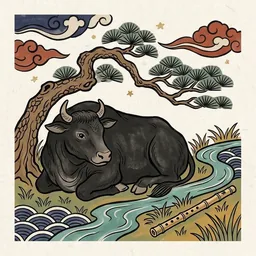
Sin-chuk (辛丑) Day Pillar: Personality, Love and Career
Sin-chuk (辛丑) is a gem in cool, damp earth: quiet, exact and loyal, well cared for by those near, slow to show its shine, and so very much worth the wait.
- Reserved
- Exacting
- Deeply loyal
- Self-taught
- Slow to bloom
- Well sheltered
At a glance
- Day stem (the "self")
- Sin (辛) · yin Metal
- Day branch
- Chuk (丑) · Ox · yin Earth
- Growth stage of the day stem
- Nurture (養)
- Nayin ("sound") element
- Earth on the Wall (壁上土) · Earth
- Void branches (kongwang)
- Jin (辰) · Sa (巳)
- Stem that combines with yours
- Byeong (丙) → Water
- Six-harmony partner
- Ja (子)
- Clashing branch
- Mi (未)
- Triad branches
- Sa (巳) · Yu (酉)
Hidden stems
- Gye (癸)Eating God (食神)
- Sin (辛)Companion (比肩)
- Gi (己)Indirect Resource (偏印) · main qi
Stems stored inside the branch, each shown with its ten god relative to your day stem. The last one is the main qi.
Stem and branch. The branch feeds the stem. The day master is supported from below, so help and nourishment tend to arrive without much asking.
Growth stage of the day stem. Being raised: gentle and receptive, supported by family and mentors, growing slowly but surely.
Nature and personality
The Sin-chuk (辛丑) day pillar is a polished jewel lying in cool, damp earth under the care of an ox: a reserved, exacting and very loyal temperament that gives little away at first and turns out to hold a great deal. People born on a Sin-chuk day tend to be careful observers who want to understand a subject or a person thoroughly before they commit, and who are looked after more often than they realise. Saju, the Korean four pillars system, writes a birth as pairs of characters, and the pair for the day you were born is called the day pillar (ilju). Its upper character, the day master, stands for you; its lower character, the day branch, is one of twelve animals and describes your private temperament and closest circle. Here the day master is 辛, yin metal. Yang metal is the axe or the sword; 辛 is the finished piece, a ring, a fine needle, a watch part. It is delicate, sensitive to pressure and happiest when it is clean and in good light. The branch is 丑, the ox, an earth sign that tradition ties to the last month of winter, when the ground is cold, damp and quiet and the next season is already being prepared underneath. Earth produces metal, so the branch feeds the stem and the jewel is held and nourished from below. In daily life, help arrives in low-key ways: a senior who speaks up for you in a meeting you did not know was about you, a relative who quietly covers a bill, a friend who always saves you a seat. The other side of being sheltered is staying out of sight. A jewel in the ground is safe, and also unseen. Three hidden stems sit inside the ox, each tagged with one of the ten gods, saju's ten labels for how another energy relates to the day master. The main one is 己, Indirect Resource. Resource means learning and being cared for, and the indirect kind is the self-taught, off-syllabus sort: the person who masters a niche subject alone at night. Next is 辛 itself, Companion, a self-reliant inner core. The faintest is 癸, Eating God, a quiet gift for cooking, craft and putting feeling into made things. The growth stage of the day master is Nurture (養), the picture of something raised carefully before it meets the world, much like a kimchi jar buried in the garden for winter: sealed, slow and better for the time. The nayin, a poetic nickname attached to every pair, is Earth on the Wall (壁上土), the smooth plaster that makes a house warm and quiet.
Strengths
- Loyalty that holds for years, not weeks
- A trained eye for flaws, fit and fine detail
- Self-taught depth in the subjects that grip you
- Quiet, reliable follow-through
- Good taste in things made to last
Challenges
- Keeps feelings sealed until they are heavy
- Stays in comfortable shelter instead of stepping forward
- Replays a remark long after others forgot it
- Resists changes to routines, even sensible ones
Love and relationships
Slow to start and slow to leave is the usual shape of love here. A Sin-chuk person watches for a long time, tests the water with small questions, and only then lets someone into the real conversations. Affection is shown through memory and upkeep: the favourite tea kept in the cupboard, the birthday that is never missed, the repair done before it was asked for. The day branch is traditionally called the spouse palace, the seat of the closest partner, and here it holds the ox with an Indirect Resource inside. That points to someone who wants a relationship to feel like home, with warmth, routine and being looked after in return. When upset, the tendency is to go quiet and expect to be read. A partner who does not take silence for coldness and who asks small, gentle questions gets the most out of this pillar. What helps in return is saying one honest sentence on the same day something stings, before it turns into a stone.
Work and career
Work suits Sin-chuk when depth is valued over speed. Picture the colleague who is the only one who knows where the old contract is filed and why one clause was changed; nobody notices until the week it is needed, and then they are indispensable. Fields that fit the jewel-in-the-earth image include research, archives and libraries, editing and translation, restoration and conservation, laboratory work, jewellery, ceramics and other fine crafts, and anything involving fermenting, tea or careful cooking. The quiet style has a cost. Good work can sit unseen because the person never announced it. Asking for visibility, putting a name on a finished piece and agreeing a regular time to show progress are practical habits worth more than an extra year of polishing.
Money
The ox is the farm animal that carries and stores, and earth is the element that holds metal, so the traditional picture is of a vault: money tends to be accumulated patiently and spent with thought. The Indirect Resource in the branch means the places where this pillar spends freely are learning, books, good tools and a single well-made object in place of three cheap ones. The habits to watch are putting off a purchase that would actually help and undercharging for skilled work because asking feels awkward. A yearly list of three things worth paying full price for, and a rule to review what you charge once a year, keeps the care from becoming reluctance.
Energy and wellbeing
A cool, damp earth branch and a delicate metal stem make the theme stagnation more than burnout: staying indoors, staying with a worry, staying in one chair. Anything that adds warmth and movement balances the picture, such as daylight walks, a warm meal at fixed times, stretching, and talking a problem through with a person instead of mulling it alone at night. Because the pillar holds so much quietly, regular sleep matters. Treat this as a lifestyle reading of cool earth and thin metal, not medical advice.
Who you get on with
Tradition gives the ox a six harmony partner in the rat (子), two earth-and-water neighbours on the zodiac circle that hold each other warmly. Rat days, and the neighbouring Gyeong-ja just before it in the cycle is one, are the first place to look for easy company. The ox also sits in a metal triad with the snake (巳) and the rooster (酉), three branches that run the same way. The snake, however, is one of this pillar's void branches (辰巳), which tradition reads as a link that feels thin or arrives late, so the rooster is the more present friend of the two. The opposite sign is the goat (未), the ox's one traditional clash: slow and settled meeting soft and feeling-led, which shows up as different ideas of what a calm weekend is. Separately, 辛 is said to combine with 丙, the sun, toward water, a picture of light finally reaching the jewel; a 丙 day master often brings out the more radiant side of you. Among the five elements, earth supports you, water gives you an outlet, and fire gives shape and pressure.
How life tends to unfold
For a Sin-chuk chart, saju reads life as a run of ten-year stretches called daewoon, the great luck cycles. Each is a stem-and-branch pair that colours a decade the way a season colours a year, and the start age and direction are worked out from your birth date. With a Nurture day master, the early decades often feel like preparation: you are held close, you study, and skills compound out of sight before anyone sees them. In general, earth cycles add more shelter and can make the comfort too deep; water cycles loosen the seal and bring expression, travel and a wider circle; fire cycles bring structure, roles and responsibility, the heat that warms the cold ground; wood cycles bring practical matters such as income and projects to manage; and metal cycles bring peers and some competition. What a real decade brings depends on the rest of the chart, so read these as tendencies, not a timetable.
Advice
Let one person a week see something unfinished, because waiting for perfect keeps the best work in the ground. Name what you want in one plain sentence before expecting anyone to guess it, and say thanks to the people who quietly help. Keep one routine that gets you outside in daylight, and change one other habit on purpose each season so that settled does not become stuck.
Frequently asked questions
Why do Sin-chuk people seem so reserved?
The pillar pairs a delicate metal jewel with the earth of the ox, which is the cold, quiet end of winter, and both are protective by nature. People with it usually observe first and speak once they are sure. It is not coldness, and once trust is built they tend to be the most loyal and attentive friend in the group.
What does Earth on the Wall mean for the Sin-chuk pillar?
Earth on the Wall (壁上土) is the nayin, a poetic nickname each of the sixty pillars carries. It pictures plaster spread over a wall: a smooth, finished surface that keeps the room warm and quiet. For Sin-chuk it echoes a steady, protective character that works at the surface of things with care. It is a symbol, not a verdict.
Which day pillars suit Sin-chuk best?
Tradition points to the rat as six harmony, and to the snake and the rooster as the metal triad, though the snake is a void branch for this pillar and tends to feel thinner. The goat is the traditional clash and often feels like a different pace of life. These are leanings only; honest communication matters far more than any chart pairing.
Learn the terms on this page
Is this your day pillar?
Your day pillar comes from your exact birth date, not your birth year. Enter it in our Four Pillars calculator and it shows all four of your pillars.
New to saju? Saju (四柱, "four pillars") describes a person by the year, month, day and hour of birth. The day pillar is the centre of it: its stem is you, and its branch is your closest circle and your home life.