Dragon
The Dragon is the fifth of the twelve zodiac animals and the only one that never walked the earth. Dragon-year people are usually ambitious, warm-hearted and proud, with big plans held steady by the earth of their branch, 辰.
- Element
- Earth
- Birth Years
- 1940 · 1952 · 1964 · 1976 · 1988 · 2000 · 2012 · 2024
Character
If you were born in a Dragon year, you tend to be ambitious, confident and generous, a visionary with a proud streak whose energy lifts the people around you. Your best partners are traditionally the Monkey and the Rat, who share your triad, and the Rooster, your six-harmony match. In Korea your birth-year animal is called your ddi, and saying you are a Dragon ddi still draws an admiring smile, because the dragon is the only creature among the twelve that exists purely in imagination. That reputation can be a lot to live up to. Many Dragons think in long horizons: you picture the finished building while others are still arguing about the plot of land. You often step forward when a room needs someone to decide, and you are open-handed with praise, time and favours. The other side is pride. You may find it hard to say "I don't know" or to accept a smaller role for a while, and a bruised ego can make you go quiet rather than ask for what you need. People who know you well usually see the softness underneath: a Dragon who feels trusted is loyal, funny and surprisingly sentimental. As for the old talk of dragon years being lucky, it describes how much the sign is admired, not a promise; your character is shaped by far more than the year you arrived.
The Earthly Branch
- Branch
- 辰
- Yin or yang
- Yang
- Element
- Earth
- Solar month
- around April
- Hours
- 07:00–09:00
- Direction
- Southeast
The branch behind the Dragon is 辰 (jin in Korean, tatsu in Japanese), the fifth of the twelve earthly branches. It is a yang branch, and its fixed element is earth, but a particular kind: the damp, warm soil of late spring, soaked by the season's rains, that stores water beneath the surface. In the solar-term calendar 辰 governs the month around April (roughly early April to early May, so treat it as approximate), the hours from 07:00 to 09:00, when the morning's work gets going, and the southeast, a direction Japan still calls tatsumi (辰巳, also written 巽), the dragon-and-snake corner. Being the one imaginary animal on the wheel gives 辰 its reputation for grand designs and long reach. The earth underneath is what makes those designs workable: it lends patience, a feel for storing things up, and the sense to hold resources until the right season. A Dragon at their best combines both, a large vision with the stamina to till the ground for it.
The Five Element Types
Wood · 1964, 2024 (甲辰)
Wood controls earth, so here the stem pushes against its own branch, like roots breaking open spring soil. Wood Dragons tend to be inventive, restless and keen on reform, with a strong sense of fairness. The tension can show as impatience with slow systems; the gift is fresh growth where others saw only bare ground.
Fire · 1976 (丙辰)
丙 is the fire of the sun, and fire feeds earth, so the stem warms and strengthens the branch. Fire Dragons are often the most outwardly charismatic of the five, natural speakers who rally people quickly. They run hot, and learning to rest before they burn out matters more for them than for most.
Earth · 1988 (戊辰)
戊 is mountain earth resting on the damp earth of 辰, so earth doubles earth. This tends to be the steadiest, most practical Dragon, someone who builds slowly and keeps promises. Ambition is still there, but it moves like a mountain range rising rather than a lightning strike, and stubbornness is the trait to watch.
Metal · 1940, 2000 (庚辰)
Earth feeds metal, so the branch nourishes a stem of raw, hard metal. Metal Dragons are usually decisive, principled and hard to sway once they have chosen a path. Their honesty is refreshing, though it can land as bluntness, and a little tact turns that strength into leadership people follow willingly.
Water · 1952, 2012 (壬辰)
壬 is the water of great rivers and seas, and 辰 is moist earth that holds water, so this pairing sits comfortably; in folklore the dragon is a creature of water anyway. Water Dragons tend to be perceptive, diplomatic and adaptable, reading a room before they move. Their risk is drifting between options when a firm choice is needed.
Strengths
You see the best possible version of a situation and can describe it so vividly that others want to build it with you. You are brave about beginnings, generous with credit, and steady under pressure once you have committed. In a crisis you tend to become calmer rather than louder, and people remember that. Your enthusiasm is practical fuel too: a team with a Dragon in it often moves faster simply because someone believes the goal is reachable.
What to Watch
The same pride that drives you can make feedback feel like an attack, so you may defend a plan long after its weak points are visible. You can promise on a grand scale and then find the details tedious. Some Dragons also expect loyalty without saying what they need, and feel hurt when others fail to guess. Watch for the moment you start performing confidence instead of feeling it; that is usually when asking for help would serve you best.
Love and Partnership
In love you tend to be warm, expressive and a little theatrical. You like planning memorable dates, you remember the big occasions, and you show affection through action: a surprise weekend away, a carefully chosen gift, standing up for your partner in public. You are drawn to people with their own spark, because a partner who only admires you soon feels less interesting than one who challenges you. What helps most is the quieter side of intimacy. Dragons can find it harder to talk about doubts or small hurts, preferring to look strong, so a partner may feel shut out at exactly the moment you are struggling. Saying "that bothered me" early, in plain words, keeps resentment from building. When a Dragon feels secure, the relationship tends to grow into a real partnership, with shared projects and a shared appetite for adventure.
Compatibility
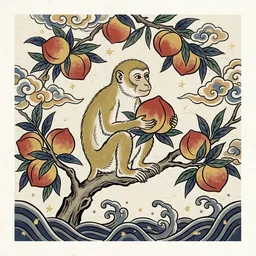
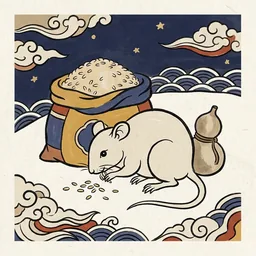
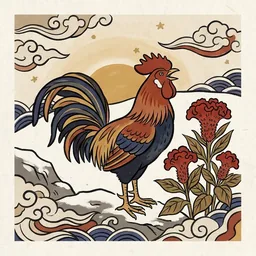
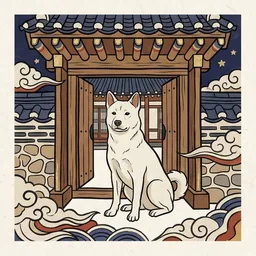
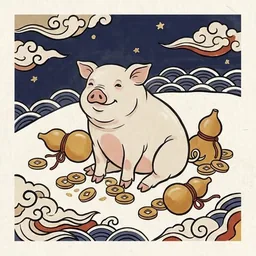
Traditional zodiac compatibility looks at how the branches relate, not only at the animals' personalities. Your strongest grouping is the triad (三合, samhap in Korean, three in harmony): 申子辰, the Monkey, the Rat and the Dragon, which together form a water frame. The Monkey brings quick ideas, the Rat brings resourcefulness, and the Dragon, whose branch stores water, gives the trio a place to gather and settle, so these partnerships often feel like a team with a shared goal. Your six-harmony match (六合, yukhap in Korean) is the Rooster: 辰 and 酉 combine into metal, and the Rooster's precision gives shape to your big plans while you give the Rooster the nerve to aim higher. Your clash (冲, chung in Korean) is the Dog, the branch directly opposite you on the wheel. Both 辰 and 戌 are earth, but one is wet spring soil and the other dry autumn soil, so the two of you may disagree about pace and priorities: the Dog wants proof and loyalty, while you want momentum. Plenty of Dragon and Dog pairs work well once they name that difference out loud. Finally, wonjin (怨嗔) is a Korean folk pairing of quiet resentment, and yours is the Pig; an old rhyme says the dragon dislikes the pig's dark face. It describes small irritations that build up when things go unsaid, and regular, honest conversation is the usual remedy. None of these pairings decides a relationship on its own; the full birth chart and two people's choices count for far more.
Work and Money
At work you tend to gravitate toward leadership, big projects and public-facing roles: launching something new, pitching an idea, representing a team in front of others. You do well when you are given a goal and room to decide how to reach it, and less well when every step must be signed off by someone else. Paired with a detail-minded colleague, your plans turn into schedules. With money, Dragons are usually generous: you pick up the bill, give presents with flair and love celebrating other people's wins. That warmth can tip into big-gesture spending, especially when you want to impress. Dragons tend to be happiest with money when generosity and their own security are both looked after, so that giving never costs them their footing.
In Korean Culture
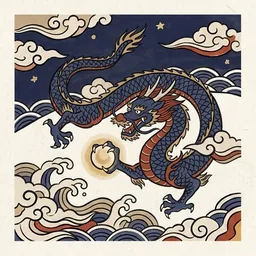
In Korea the dragon, yong, is the most hopeful animal you can dream about. A dragon dream is the classic taemong, the conception dream that is said to announce a child, and it is traditionally read as a sign that the child will go far. The proverb "a dragon rises from a small stream" praises someone who succeeds from humble beginnings. Folklore also tells of the imugi, a great serpent said to become a true dragon after a thousand years, in many versions only once it obtains the yeouiju, the wish-granting pearl that dragons are painted holding. That pearl appears in the card art on this page, where a blue dragon coils through clouds above the waves, clutching a glowing pearl: the pearl stands for aspiration, and the clouds and water recall the dragon's old role as the bringer of rain that farming villages prayed for. The Joseon court claimed the dragon too; the king's face was politely called yongan, the dragon face, and his robes carried dragon roundels. More recently, the 甲辰 year of 2024 was widely called the year of the blue dragon, a name taken from the blue-green colour tied to the stem 甲.
In Japanese Culture
In Japanese eto, the twelve-animal cycle, 辰 (tatsu) is the one imaginary creature in the line-up. In Dragon years, New Year cards (nengajō) are full of nobori-ryū (昇り龍), the dragon climbing toward the sky as a picture of rising fortune. The word tōryūmon (登竜門), the dragon's gate, means a gateway to success; it comes from the Chinese legend of a carp that leaps the falls at Dragon Gate and turns into a dragon. Shrines across Japan honour ryūjin (龍神), dragon deities of water and rain. The guardian Buddha (mamori honzon) for people born in Dragon and Snake years is Fugen Bosatsu (普賢菩薩), known in Sanskrit as Samantabhadra.
Advice
Keep the big picture, but cut it into a first step small enough to finish this week; Dragons gain more from momentum than from announcements. Before you defend an idea, ask one person you trust to name its weakest point, and thank them for it. When you feel the urge to impress, check whether the gesture is for the other person or for your pride. Let yourself be helped now and then; it makes your strength easier for others to trust. For how the Year of the Goat looks from a Dragon's side, the 2027 forecast for your sign covers it.
Frequently Asked Questions
Is the Dragon the luckiest sign of the Chinese zodiac?
Not in any measurable way. Every sign has its own strengths, and fortune-telling traditions read a person through the whole birth chart rather than the year animal alone. The Dragon is simply the most admired symbol in East Asian culture, linked with emperors, rain and good dreams, so Dragon years carry a festive reputation that the sign itself cannot guarantee.
Who is the best match for a Dragon?
Traditionally the Monkey and the Rat, which share the Dragon's water triad, and the Rooster, its six-harmony partner. These pairings tend to feel easy because each side supplies something the other lacks, whether ideas, resourcefulness or precision. Real compatibility still depends on two people's habits, values and willingness to talk things through.
Is a Dragon and Dog relationship a bad match?
No, it is a demanding match rather than a bad one. The Dog sits directly opposite the Dragon on the zodiac wheel, so the pair is called a clash, which usually shows up as different speeds and priorities. Couples who agree early on how they will make decisions together often find that the contrast keeps them balanced instead of stuck.
I was born in January or early February of a Dragon year. Am I a Dragon?
Probably not. The zodiac year does not begin on 1 January. Saju, the Korean four-pillars birth reading, changes animals at ipchun (立春), the start of spring around 4 February, while everyday Korean usage often follows the Lunar New Year instead. If your birthday falls before the change, you belong to the Rabbit. In Japan people casually count eto by calendar year, for New Year cards or for becoming a toshi-otoko or toshi-onna (someone whose own animal year has come round), but fortune-telling there also uses 立春.
What does it mean to dream of a dragon in Korea?
It is one of the best dreams you can have in Korean folk belief. Besides being the most famous conception dream, a dragon dream is read as a sign of recognition, promotion or a long-held wish coming within reach. A dragon rising into the sky is taken most favourably, and one holding the pearl points to a hope you are close to grasping.