Ox
Patient, dependable and quietly determined, the Korean Ox (丑) finishes what it starts and keeps its word; what looks like slowness is usually staying power. It gets on best with the Snake, Rooster and Rat.
- Element
- Earth
- Birth Years
- 1937 · 1949 · 1961 · 1973 · 1985 · 1997 · 2009 · 2021
Character
If you were born in an Ox year, you tend to be diligent, patient and deeply trustworthy: the person who says yes slowly, then keeps that promise long after others have forgotten making theirs. The famous Ox 'stubbornness' and 'slowness' are the other face of that steadiness, the same refusal to cut corners that makes you so easy to rely on.
In Korea your birth animal is your ddi, the zodiac animal of the year you were born, and most Koreans can name theirs without a pause; Ox people are so-tti. You are probably the one who reads the instructions before opening the flat-pack box, who still wears boots bought a decade ago because you have had them resoled twice, and who answers an exciting offer with 'let me think about it', then turns up at seven the next morning ready to work once you have agreed. Friends may tease you for being the last to try a new app, yet they also know you will be the one who learns it properly. Trust, for you, is earned over years rather than evenings. Few people get in quickly, but those who do find you remarkably loyal.
The friction comes when the ground shifts. A sudden change of plan can feel like an affront, and once you have decided something you may defend it longer than the facts support. Most Oxen are not rigid out of pride; they thought hard before committing, and reopening the question feels like wasted effort. Under pressure you tend to go quiet and keep working rather than complain, which looks like calm from outside but can hide real tiredness.
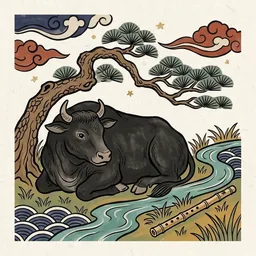
The ox on this page, a black ox resting under a pine beside a stream with a bamboo flute lying in the grass, painted in the manner of Korean folk painting (minhwa), quietly corrects the workhorse image: rest and unhurried ease are part of the ox's strength, not a break from it.
The Earthly Branch
- Branch
- 丑
- Yin or yang
- Yin
- Element
- Earth
- Solar month
- around January
- Hours
- 01:00–03:00
- Direction
- Northeast
The Ox stands on the earthly branch 丑 (chuk in Korean, ushi in Japanese), the second of the twelve branches that East Asian calendars use to count years, months, days and hours. It is yin, and its fixed element is earth, but this is the earth of deep winter: wet soil frozen hard, holding seeds that will not stir until spring. Its month runs roughly through January, from the solar term Minor Cold (小寒) in early January to the Start of Spring in early February. Its double hour is 01:00 to 03:00, the stillest part of the night; Japanese folklore calls the heart of that span ushimitsu-doki, 'the third quarter of the ox hour', the hour in which ghost stories like to set their scenes. Its direction is the northeast, which Japanese calls ushitora, the ox-and-tiger corner, traditionally the kimon or 'demon gate' that old cities and houses were laid out to guard.
What 丑 adds to the character is the patience of ground that waits. Nothing seems to happen on a frozen field in January, yet everything spring needs is already in place beneath the surface. Tradition also treats 丑 as a storehouse: it closes the metal triad of Snake, Rooster and Ox, and it carries the hidden stems 己 (earth), 癸 (water) and 辛 (metal), keeping each safe until it is needed. Ox people often work the same way, quietly gathering skill, know-how and goodwill whose value only becomes obvious later.
The Five Element Types
Wood · 1985 (乙丑)
Picture a slender shoot forcing its way through frozen soil. 乙 is yin wood, and wood controls earth, so the stem works its roots patiently into the hard ground of 丑. Wood Oxen tend to be gentler and more flexible than the sign's reputation suggests, yet they rarely abandon a goal; they simply find a softer way through. They grow best when free to change methods without being asked to change their values.
Fire · 1937, 1997 (丁丑)
Think of a lantern set down on a snowy field. 丁 is yin fire, a small and steady flame, and fire feeds earth, so the stem warms the cold branch from above. Fire Oxen are often the warmest and most openly encouraging members of the sign: patient teachers, loyal friends, people whose care shows in practical kindnesses. When overworked, that warmth can sharpen into a short temper, so keeping a little fuel back for themselves matters.
Earth · 1949, 2009 (己丑)
When 己, the yin earth of a tended field, lies over the Ox's own earth, the element doubles and the sign appears in its most concentrated form. Earth Oxen are usually the most dependable people in any group, careful with promises and very hard to rattle. Doubled earth can also settle into routine, so a deliberately new experience now and then keeps the ground from packing too hard.
Metal · 1961, 2021 (辛丑)
Earth feeds metal, and 丑 is the storehouse of metal, so a 辛 stem, fine yin metal like a polished blade or jewel, finds itself unusually at home. Metal Oxen lean toward precision and firm principles; they will redo a joint or a sentence until it is exactly right. Their fairness is admired, though they can come across as severe, and a little humour in how they voice a high standard helps others rise to it.
Water · 1973 (癸丑)
Here the earth of 丑 controls the stem 癸, yin water such as rain or melting snow, and the result resembles a deep pond held within firm banks. Water Oxen are often the most thoughtful and perceptive members of the sign, slow to speak but quick to grasp what is happening beneath the surface. Their caution is usually wise, though they can deliberate so long that a good chance slips past; setting a date for the decision helps.
Strengths
Reliability is the Ox's signature. When you say a report will be ready on Thursday, it is ready on Thursday, and people learn to plan around your word. You have stamina for the unglamorous middle of a project, the stretch where enthusiasm fades and only persistence remains. You learn thoroughly rather than quickly, so your skills tend to be deep and hard to shake. You stay calm in practical emergencies, from a burst pipe to a missed train connection, and you remain loyal to friends through the years when they have little to offer in return.
What to Watch
The steadiness that makes you dependable can harden into resistance. You may dismiss a new idea before hearing it out simply because it disturbs a routine that works, or keep pushing a plan that stopped making sense months ago. Ox people often take on more than their share without saying so, then feel quietly resentful that nobody noticed. You can be slow to forgive a broken promise, since you keep yours so carefully. And because you rarely complain, others may not realise you are worn out until you are close to empty.
Love and Partnership
Ox people are rarely the smoothest talkers in a new romance. You may struggle for the right words on a third date, yet you are the one who fixes the wobbly table leg in your partner's flat without being asked, or quietly keeps their favourite tea in your cupboard. Love, for you, is something shown over years: turning up, keeping your word, staying through dull and difficult seasons alike, and partners tend to feel very safe with you. The trouble is that what goes unsaid can be misread as indifference, especially early on or by someone who needs to hear things. You can also be slow to adjust when a relationship has to change, whether that means a move to a new city, a new job's hours or a baby's arrival, and you may dig in just when your partner most needs flexibility. Saying 'I need a few days to get used to this' is far kinder than silent resistance. A partner who values loyalty over sparkle, and gives you time to warm up, usually finds that an Ox's love lasts.
Compatibility
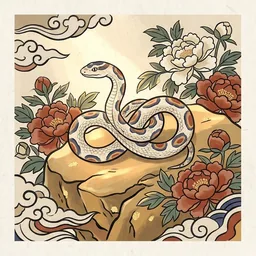
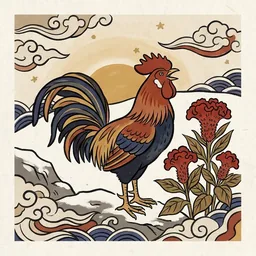
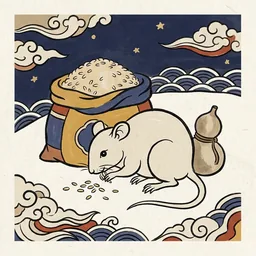
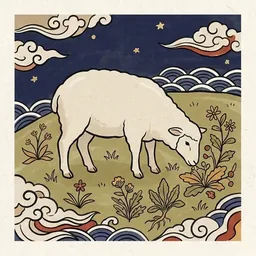
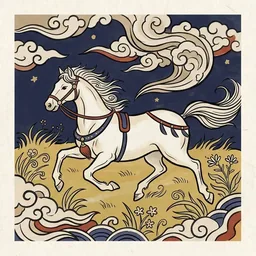
Korean compatibility reading starts from the earthly branches, and for the Ox it points to three easy partners and two that call for patience. Your strongest bond is the triad (三合, samhap in Korean, a group of three branches that combine well) with the Snake (巳) and the Rooster (酉). Together 巳, 酉 and 丑 form the 'metal frame': the Snake is where metal is born, the Rooster where it is strongest and the Ox where it is stored, so the trio often works like a well-run workshop, with the Snake planning, the Rooster refining and the Ox seeing the job through. Your six-harmony partner (六合, yukhap, a one-to-one pairing of branches) is the Rat (子). The branches 子 and 丑 sit side by side in midwinter and combine into earth; the Rat's quick wit spots the opening, and the Ox's endurance turns it into something that lasts.
Your clash (冲, chung, the branch directly opposite yours) is the Goat (未). Both are earth signs, yet 丑 is the frozen ground of January and 未 the baked soil of July, so the two of you can want the same security while disagreeing about timing, pace and comfort. The Horse (午) is your wonjin (怨嗔), a Korean folk pairing of two signs that easily rub each other the wrong way; classical texts also count the same branches among the six harms (六害). One version of the old wonjin verse reads 牛嗔馬不耕, 'the ox resents the horse for not ploughing', which neatly captures the friction between a steady worker and a free spirit. These pairings describe rhythms to understand, not people to avoid, and a whole birth chart says far more than the year animal alone.
Work and Money
Ox people tend to be valued at work for qualities that never go out of fashion: they arrive prepared, finish what they are given, and their results still hold up when someone checks them a year later. You usually prefer a clear brief and the freedom to work through it at your own pace, and you often do well where the payoff is long, in engineering and construction, farming and food, skilled trades, logistics, archives, public service or any role that keeps a system running. You may be slow to put yourself forward for promotion, assuming good work speaks for itself. Often it does, but not always loudly enough, so letting people know what you have finished is part of the job.
With money, Oxen tend to be steady rather than adventurous. Most prefer a reliable income to a thrilling gamble, distrust anything that promises quick results, and take quiet satisfaction in security built slowly. The blind spot is being so careful that you rarely spend on rest or pleasure for yourself, or staying with an arrangement out of habit after it has stopped serving you.
In Korean Culture
For most of Korean history the ox was less a symbol than a working partner. In farming villages it pulled the plough and hauled the cart, and it was often the most valuable thing a family owned, which is why so many everyday sayings involve it. 'So ilko oeyanggan gochinda', mending the barn after the ox is lost, is the Korean version of locking the stable door after the horse has bolted. 'So gwie gyeong ilgi', reading sutras into an ox's ear, describes advice that goes unheard. Buddhism gave the animal a quieter role. On the outer walls of many Korean temple halls you can find the simu-do (尋牛圖), the ox-searching pictures, a sequence usually in ten panels in which a herdsman looks for a lost ox, tames it and rides it home, an image of the search for one's own true mind. The series is also called sipu-do (十牛圖), the Ten Ox-Herding Pictures, a Zen theme well known in Japan too. In one of the best-known panels the herdsman plays a flute on the ox's back, an echo of the flute lying in the grass on this page. And the county of Cheongdo, in North Gyeongsang Province, is known for its traditional bullfighting festival, where two bulls lock horns and push until one turns away, a contest of stamina rather than bloodshed.
In Japanese Culture
In Japan's eto, the twelve-animal cycle that households still mark each New Year, the sign is ushi, and oxen are closely tied to Sugawara no Michizane, the Heian-period scholar honoured as a god of learning. Tenmangu shrines across the country, Dazaifu and Kitano among them, keep reclining oxen of stone or bronze called nade-ushi, 'stroking oxen', and students rub their heads in hope of help with exams. High summer brings doyo no ushi no hi, the day of the ox in the hot doyo period, when many people eat grilled eel for stamina. From Aizu in Fukushima comes the akabeko, a red papier-mache ox whose head nods at a touch, long kept as a lucky charm for children. The language uses the animal too: gyuho, 'ox steps', describes a slow, plodding pace, the way an ox moves or a project creeps forward. And when your ox year comes round again, you become a toshi-otoko or toshi-onna, a man or woman of the year.
Advice
Keep your pace, and check your direction from time to time. Before pressing on with a long plan, ask once a season whether it still leads where you want to go; persistence is a gift only when it is pointed the right way. Let people see a little of the effort you carry, and accept help before you are exhausted rather than after. When change arrives, give yourself a short, honest adjustment period instead of a flat no. And take the black ox's lesson seriously: an afternoon under the pine with nothing to finish is not lost time, it is how a strong animal stays strong.
Frequently Asked Questions
Who is the best match for an Ox?
Traditionally the Snake and the Rooster, your triad partners, and the Rat, your six-harmony partner. The Snake shares your depth and patience, the Rooster your love of order and high standards, and the Rat brings quick ideas that your steadiness can carry through. These are tendencies, not guarantees; two people's full birth charts, and the way they treat each other, matter far more.
Are the Ox and the Goat, or the Ox and the Horse, a bad match?
No, they are pairings that ask for more understanding rather than ones to avoid. The Goat is your clash, the sign opposite yours, so you may differ in pace and in how you look for comfort. The Horse is your wonjin, a Korean folk 'resentment' pair, which mostly shows up as irritation when a steady planner meets someone who wants the freedom to change course. Couples and colleagues who name those different rhythms early often work very well together.
I was born in January or early February. Am I an Ox?
Possibly, and the answer runs in two directions, because the sign changes in early spring rather than on 1 January. Born in January or early February of the year after an Ox year, before your cut-off date, you are still an Ox, even though the calendar already shows a Tiger year. Born in the same weeks of an Ox year itself, before the cut-off, you count as a Rat, the sign that comes just before the Ox. Saju, the Korean four-pillar reading of birth year, month, day and hour, puts that cut-off at Ipchun, the Start of Spring solar term around 4 February. Many Korean families use Lunar New Year instead, which falls between late January and mid-February. In Japan, everyday custom switches the eto on 1 January, so a January birthday simply takes that year's sign, while traditional fortune-telling waits for Risshun, the day after Setsubun.
Is it the Year of the Ox, the Cow or the Bull?
All three point to the same sign, and Ox is simply the usual English convention. The calendar character 丑 is paired with the animal 牛, which means cattle in general. Korean calls it so, a word that covers cows, bulls and oxen alike, and the Japanese ushi is just as broad. Whether you picture a cow, a bull or a working ox, the meaning of the sign stays the same.