Pig
Generous, honest and hard-working, the Pig (亥) stands for plenty and shared good luck in Korea, not a joke. Pigs tend to get on best with the Rabbit, the Goat and the Tiger.
- Element
- Water
- Birth Years
- 1947 · 1959 · 1971 · 1983 · 1995 · 2007 · 2019 · 2031
Character
Pig-year people are usually described as generous, honest and hard-working: the friend who shares whatever good fortune comes their way and expects the same openness in return. If the English word 'pig' makes you wince, Korea reads the animal very differently, as a picture of plenty, good luck and money coming home, so being a Pig is closer to a compliment than an insult.
In Korea your birth animal is your ddi (the animal of the year you were born), and people treat it as a sketch of temperament rather than a sentence passed on your life. The Pig's sketch is warm and uncomplicated. You say what you mean and assume others do too. You would rather pay a little extra for the group dinner than see someone come up short, and you are often the person still stacking chairs after the party, or the one who quietly covers a colleague's shift without mentioning it. You enjoy good food, an easy evening and a crowded table, and you see no reason to apologise for liking comfort.
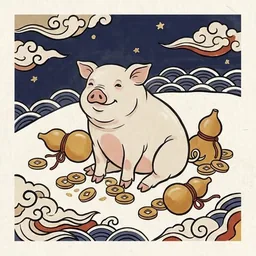
The painting on this page shows a round, cheerful pig among gold coins and gourds. That is the Korean bok-dwaeji, the 'luck pig' (bok means blessing or good fortune), drawn here in the style of minhwa, Korean folk painting. The gourds can recall the old Korean tale of Heungbu, the kind younger brother whose gourds split open to pour out treasure. Both images say that abundance is meant to be shared, and that suits the temperament: Pigs rarely hoard their luck, they pass it round. The other face of this openness is that you tend to trust before you check, and saying no can feel so unkind that you avoid it longer than you should.
The Earthly Branch
- Branch
- 亥
- Yin or yang
- Yin
- Element
- Water
- Solar month
- around November
- Hours
- 21:00–23:00
- Direction
- Northwest
The Pig belongs to the earthly branch 亥 (hae in Korean, i in Japanese), the twelfth and last of the branches used to count years, months, days and hours in East Asian calendars. 亥 is yin and its element is water: the cold, still water of early winter, when the harvest is in and the fields lie bare. Its month runs roughly from early November to early December, opening at Ipdong, the Start of Winter solar term. Its hours are 21:00 to 23:00, the last stretch of evening before midnight, and its direction is northwest.
Coming last does not make 亥 only an ending. Among the stems hidden inside it are 壬 (yang water) and 甲 (yang wood), so this winter water already carries the first tree of next spring. That is why 亥 opens the wood triad 亥卯未 (a triad, 三合 or samhap in Korean, is a set of three branches that combine well), and why its six-harmony bond with the Tiger (寅亥) also produces wood (six harmony, 六合 or yukhap, pairs two branches one to one). Both of the Pig's closest relationships lead toward new growth. 亥 is also one of the four branches 寅申巳亥 that begin a season, in its case winter. For the character, this suggests someone who closes out what is finished without drama and then quietly gets ready for what comes next, and who can afford to be generous because they trust that more will grow.
The Five Element Types
Wood · 1995 (乙亥)
乙 is yin wood, a reed or the grass along a riverbank, and water feeds wood, so the Pig's own water nourishes the stem above it. Wood Pigs tend to be the most tender-hearted of the sign: easy to talk to, quick to forgive and drawn to people who are still finding their feet. They flourish where their kindness is noticed and can drift where it is taken for granted, so the company they keep matters more for them than for most.
Fire · 1947, 2007 (丁亥)
丁 is yin fire, a lantern flame, and in the usual cycle the Pig's water would put it out. Yet 丁 pairs with 壬, the water hidden inside 亥, in one of the classic stem combinations, so the meeting of fire and water turns into attraction rather than a quarrel. Fire Pigs tend to be affectionate, expressive and openly warm, the friend who throws the party and makes every guest feel expected. Their moods can swing quickly, and a pause before replying in anger keeps that warmth kind.
Earth · 1959, 2019 (己亥)
己 is yin earth, the soft soil of a worked field, and earth holds water back, so here the stem gives the Pig's water banks to run between. Think of irrigation: water steered into a field instead of spilling everywhere. Earth Pigs tend to be the most practical and down-to-earth of the sign, generous with a plan behind it and good at turning goodwill into something that lasts. Once a routine suits them, they can be slow to let it go.
Metal · 1971 (辛亥)
辛 is yin metal, a cut jewel or a fine blade, and metal gives rise to water, so the stem keeps the Pig's spring clear and full. Metal Pigs tend to be the most refined and discerning of the sign, with clean taste, careful words and a strong sense of what is fair. They feel slights more sharply than they show and do best with friends who are honest with them gently rather than bluntly.
Water · 1983 (癸亥)
癸 is yin water, drizzle or mist, falling into the Pig's own winter water, so the element is doubled. 癸亥 is also the sixtieth and final pair of the sexagenary cycle, the sixty-year round of stems and branches, closing the whole circle before 甲子 begins it again. Water Pigs tend to be intuitive, imaginative and quick to absorb other people's moods. They need quiet time to let go of what they have soaked up, or their generosity slowly turns into exhaustion.
Strengths
People relax around you, and that is a real skill. You are generous in practical ways: the spare umbrella you hand over, the lift home, the dish you bring that feeds twice as many as asked. Your honesty is restful because nobody has to decode you. You work steadily without needing an audience, so the people who depend on you learn they can. You forgive easily and seldom keep score, which lets friendships survive rough patches. And your optimism is sturdy rather than naive: after a setback you tend to eat a good meal, sleep on it and start again.
What to Watch
Trust given too quickly is the Pig's best-known blind spot. You may lend a book, a favour or your weekend to someone who has not yet shown they will return it, and then feel foolish rather than angry. Because refusing feels rude, you can say yes to more than one person can carry, and tiredness arrives before you admit it. Comfort is another soft spot: the pleasant routine can push the dull but necessary task to next week, and next week again. None of this makes you careless; it only means your kindness needs a little structure.
Love and Partnership
Pigs love generously and without games. You tend to show it through care you can see and taste: a favourite snack waiting after a long day, an evening cleared because your partner sounded low, a gift that proves you were listening months ago. You want a home that feels full and easy, with good meals and no hidden scorekeeping, and you assume your partner wants the same. That candour is lovely, though it can make you slow to notice when someone is taking more than they give.
The pattern to watch is giving until you are empty. Because you dislike refusing, you may agree to plans, favours or compromises you do not really want, then feel worn out without quite knowing why. Pig people tend to stay devoted once committed, so the partner who suits you best is one who notices your effort, thanks you for it and gives back without being asked. If you are dating a Pig, plain appreciation and a fair share of the dishes mean more than any grand gesture.
Compatibility
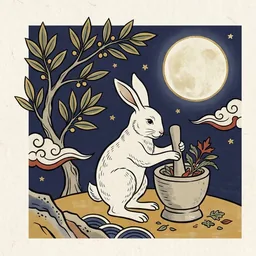
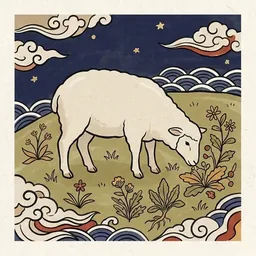
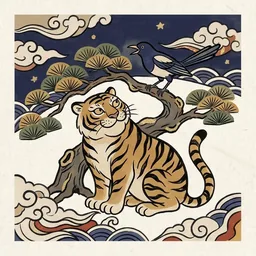
Your warmest bond is the triad. For you that is 亥卯未, the Pig, the Rabbit (卯) and the Goat (未), which together form a wood frame. The Pig sits at its opening, the winter water where young wood takes root, while the Rabbit carries that growth into spring and the Goat gathers it in late summer. With a Rabbit you share gentleness and a dislike of quarrels; with a Goat, a love of good food, easy company and a comfortable home. Your six-harmony partner is the Tiger (寅). 寅 and 亥 also combine into wood: your patience steadies the Tiger's rush, and the Tiger's courage stands up for you when your good nature is being used.
Your clash (冲, chung in Korean) is the Snake (巳), the branch directly opposite yours, summer fire facing winter water. The difference shows up as pace and caution. You open up and trust early; the Snake watches, weighs and decides later. Each can read the other wrongly, you as cold, they as careless, yet it is often a pull of real attraction, and naming the difference turns it into balance. Finally, the Dragon (辰) is your wonjin (怨嗔), a Korean folk pairing of two signs that rub each other up the wrong way. A line of the traditional wonjin verse, 龍嫌猪面黑, has the dragon objecting to the pig's black face, a jab at appearances rather than character. Day to day, the Dragon's large ambitions can make your contentment look like idling, while their grandness can tire you. None of these pairings rules a relationship in or out; a full birth chart, and two people's choices, count for far more than the year.
Work and Money
At work you are the person others trust to do the job properly and turn up again tomorrow. Pigs tend to bring diligence without ego, plain dealing and an easy warmth that gathers people, so teams form around you even when you never asked to lead one. You often thrive where service and goodwill matter: hospitality, care work or teaching, or any workplace where keeping people happy is part of getting things done. Your optimism helps a team through a bad quarter, though it can also make you underestimate how long a task will take or how much someone else will really contribute. You are rarely a cut-throat negotiator, and in competitive settings a colleague may quietly take credit for your work.
With money, Pigs tend to be open-handed. You enjoy treating people, sharing a good meal and giving gifts, and money tends to move through your hands toward others rather than stay still. That generosity is part of why people trust you. The tendency to watch is lending or giving out of politeness rather than real choice; Pigs usually feel most at ease when their generosity comes from a full cup, not from feeling unable to say no.
In Korean Culture
In Korea the pig is one of the luckiest animals you can name. A dwaeji kkum, a dream about a pig, is a classic good-fortune dream associated with wealth, and some people buy a lottery ticket the next morning half as a joke and half in hope, a custom told more as a story than a strategy. At a gosa, a small rite asking for good luck before a new shop opens or a film starts shooting, a boiled pig's head often sits on the table, and the people present tuck banknotes into its mouth or ears before they bow. Children save coins in a dwaeji jeogeumtong, the pig-shaped piggy bank, and a popular explanation for the money link points out that the Sino-Korean reading of 豚 (pig), don, sounds the same as the everyday Korean word for money. The association runs deep enough that advertisers in recent pig years promoted a so-called 'golden pig year'.
In Japanese Culture
In Japan the twelfth eto (干支, the Japanese name for the zodiac cycle) is not a farmyard pig but the wild boar, inoshishi, and the kanji 猪 itself means boar in Japanese while it means pig in Chinese. So the bold, charging image belongs to Japan: the idiom chototsu mōshin (猪突猛進) describes rushing headlong at a goal like a boar. In parts of western Japan, Inoko (亥の子) falls on the first boar day of the tenth lunar month, when children go round pounding the ground with a stone or straw bundle and families eat inoko-mochi, rice cakes wished on for health and many children, since boars have large litters. Tea practitioners traditionally held robiraki, opening the sunken winter hearth, on a boar day too, because the boar belongs to water and was thought to guard against fire. At Goō Shrine (護王神社) in Kyoto, boar statues stand where guardian lion-dogs usually do, honouring the legend that boars protected the courtier Wake no Kiyomaro, and the warrior deity Marishiten is often shown riding a boar. In a boar year, those born under the sign become toshi-otoko or toshi-onna, the year's own men and women.
Advice
Keep your generosity, and let it be a choice rather than a reflex. Before agreeing to the next favour, pause long enough to ask whether you actually want to; a kind 'not this time' protects the warmth you are known for. Give trust in steps: share a little, see what comes back, then share more. When a dull task has slipped twice, do it first thing, before the pleasant parts of the day pull you away. And let other people feed you sometimes. The luck pig in the painting sits among plenty because good things flow both ways.
Frequently Asked Questions
Is it bad to be born in the Year of the Pig?
No, quite the opposite in Korea. The word 'pig' can sound like an insult in English, but Korean culture links the animal with wealth, good luck and a full household. A pig dream is a famous lucky dream, a pig's head appears at good-luck rites for new businesses, and children drop their coins into pig-shaped piggy banks. The sign describes a generous, honest temperament, not a flaw.
Is the twelfth sign a pig or a boar?
Both, depending on the country. Korea and the Chinese-speaking world use the domestic pig, dwaeji in Korean, and the luck pig among coins in this page's illustration is a Korean minhwa image. Japan reads the same branch 亥 as the wild boar, inoshishi, which is where the image of headlong, fearless charging comes from. The branch, element and compatibility are identical whichever animal you picture.
Who is the best match for a Pig?
Traditionally the Rabbit and the Goat, who share your wood triad, and the Tiger, your six-harmony partner. Rabbits bring gentleness and tact, Goats share your love of comfort and good company, and Tigers add courage and drive. These are tendencies, not rules: a Pig can be very happy with any sign once both people understand each other's habits.
Should a Pig avoid dating a Snake?
No. The Snake is your clash sign, the branch directly opposite yours, and the label simply marks two very different speeds: you trust quickly and act openly, while the Snake observes, keeps counsel and commits slowly. That contrast can feel uncomfortable at first, but it is also why these two often fascinate each other. Talking frankly about pace and privacy usually turns the clash into balance.
My birthday is in January or early February. Which sign am I?
It depends on where you draw the new year. Saju, the Korean four-pillar reading of birth year, month, day and hour, starts the year at Ipchun, the Start of Spring solar term around 4 February, and many Korean families count from Lunar New Year instead. Everyday Japanese use switches the eto on 1 January, while traditional fortune-telling there starts the year at Risshun, the day after Setsubun. So someone born on 10 January 2020 is a Pig by both Korean counts but a Rat on the everyday Japanese calendar (by traditional fortune-telling in Japan, a Pig as well).