Goat
In Korea and across East Asia, the Goat, also called the Sheep, is the eighth animal of the zodiac, whose earthly branch is 未 (yin earth). Goat-year people tend to be gentle, tasteful and steady, and get on best with the Pig, Rabbit and Horse.
- Element
- Earth
- Birth Years
- 1943 · 1955 · 1967 · 1979 · 1991 · 2003 · 2015 · 2027
Character
If you were born in a Goat year, you tend to be gentle, considerate and quietly steady: you notice how people feel, care about beauty and comfort, and stay calm when a room turns tense. Your easiest partners are traditionally the Pig and the Rabbit, who share your triad, and the Horse, your six-harmony match.
In Korea your birth animal is your ddi (the zodiac animal of the year you were born), and it is read less as a fixed fate than as a temperament people recognise. Goat people often lead through atmosphere rather than volume. You are the one who remembers that a colleague cannot eat spicy food, who clears a cluttered desk until it feels usable again, who picks the café with good light and quiet tables. That care is not fussiness; you think clearly, and treat others well, when your surroundings feel settled.
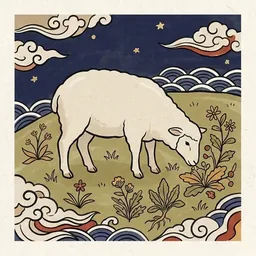
The sheep on this page, grazing among wild herbs on a green hillside, says much of the rest. It is in no hurry. It returns to good ground, eats slowly and stays near the flock. Goat people tend to work the same way: patient, loyal to the people and places that have treated them kindly, and slow to give up on anything they have tended. Under pressure you rarely explode; you go still and keep doing the next useful thing. The softer side of this is that you may avoid an open disagreement long after it would have helped, and you sometimes wait for others to decide when you already know what you want.
The Earthly Branch
- Branch
- 未
- Yin or yang
- Yin
- Element
- Earth
- Solar month
- around July
- Hours
- 13:00–15:00
- Direction
- Southwest
The Goat sits on the earthly branch 未 (mi in Korean, hitsuji in Japanese), the eighth of the twelve branches that mark years, months, days and hours in East Asian calendars. 未 is yin and its element is earth, but a particular kind of earth: the warm, dry soil of late summer, when the heat has done its work and crops are filling out. Its month runs roughly from early July to early August, beginning at the solar term Minor Heat, and its hours are 13:00 to 15:00, the slow, warm stretch after lunch. Its direction is southwest; Japanese has traditionally called that compass point hitsujisaru, 'sheep-monkey', because it lies between the branches of the Goat and the Monkey.
Being yin earth gives the sign its patience. Yang branches push outward; 未 holds, stores and ripens. Tradition also places hidden stems of earth, fire and wood (己, 丁, 乙) inside 未, which helps explain why Goat people can look mild yet carry real warmth and a quiet will to grow. The lesson of this earth is slow ripening: you tend to do best with results that build over seasons rather than wins that arrive overnight.
The Five Element Types
Wood · 1955, 2015 (乙未)
乙 is yin wood, the vine or meadow grass rather than the tall tree, and wood controls earth, so here a growing plant pushes its roots into dry summer soil. Wood Goats tend to look soft but keep going, bending around obstacles instead of stopping at them. They often hold firm views on how things should look and grow, and do best when they let that persistence show rather than hiding it behind politeness.
Fire · 1967 (丁未)
丁 is yin fire, a lamp or candle flame, and fire feeds earth, so the stem warms and strengthens the branch. Fire Goats are usually the most expressive members of the sign: warm hosts, eager makers, quick to feel things and to show them. The same heat on already dry ground can flare into irritation when they are tired, so rest and a cool head keep their warmth generous rather than scorching.
Earth · 1979 (己未)
己 is yin earth, the soft soil of a tended field, laid over the Goat's own earth, so the element is doubled. Earth Goats tend to be the steadiest and most practical of the sign, the friend who keeps the calendar, the savings jar and the promise. Doubled earth can also mean a slow start and a reluctance to change course, even once an old plan has clearly stopped working.
Metal · 1991 (辛未)
辛 is yin metal, the polished jewel or fine blade, and earth feeds metal, so the Goat's soil nourishes something bright and exact. Metal Goats often have the sharpest taste in the sign and high standards for craft, words and manners. Encouragement suits them better than criticism; they are usually harder on themselves than anyone else is, and benefit from hearing that good is often good enough.
Water · 1943, 2003 (癸未)
癸 is yin water, rain or morning dew, and earth contains water, so the stem soaks into the Goat's dry ground. Water Goats tend to be the most intuitive and adaptable of the sign, quick to sense a mood and gentle with anyone who is struggling. Because earth holds water in, they may keep their own feelings banked up; naming those feelings early keeps the ground from turning to mud.
Strengths
Your best qualities are the kind people feel before they can name them. You are considerate in specific ways, remembering birthdays, allergies and the name of someone's dog. Your taste is real: with very little you can make a rented room, a slide deck or a dinner table feel looked after. You are patient with slow processes, from learning an instrument to nursing a friendship through a hard year, and loyal once trust is earned. In a crisis you tend to stay level, which calms everyone nearby, and you are rarely the one who turns a disagreement personal.
What to Watch
The same gentleness can slide into avoidance. Goat people often say 'either is fine' when one option clearly is not, then feel quietly let down by the result. You may turn a decision over for days, waiting for a certainty that never arrives. Comfort matters to you, so you can stay too long in a job, a flat or a routine simply because leaving feels harsh. And because you dislike conflict, small hurts can pile up unspoken until they come out all at once, which surprises people who thought everything was fine.
Love and Partnership
You tend to show love through attention rather than speeches: the meal cooked when your partner is worn out, the playlist made for a long drive, the small thing they admired in a shop months ago that turns up as a gift. You want a relationship that feels like a safe, pleasant home, and you put real effort into making it one. What you need back is reassurance, said aloud more often than a bolder sign might think necessary. Goat people tend to fall slowly and then stay; early dating can feel uncomfortable because you dislike being judged, but once settled you are an unusually devoted partner. The trap is accommodation, agreeing to plans, holidays or habits you do not enjoy just to keep the peace. A partner who asks what you actually want, and waits for the answer, earns your trust quickly. If you are dating a Goat, steady kindness matters far more than grand gestures.
Compatibility
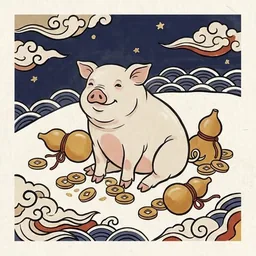
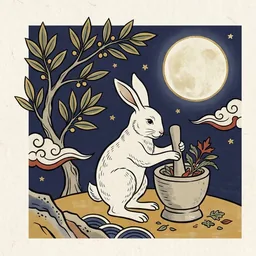
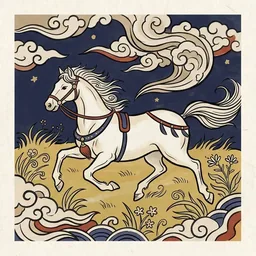
Your strongest bond is the triad, samhap in Korean (三合, a group of three signs that combine well): the Pig (亥), the Rabbit (卯) and the Goat (未) sit four places apart on the zodiac wheel and traditionally join into a 'wood frame', a trio that grows together. With a Pig you share easy generosity and a love of good food and company; with a Rabbit you share tact, taste and a preference for calm. Your six-harmony partner, yukhap in Korean (六合, a one-to-one pair of branches that bind), is the Horse (午). The two branches stand side by side in the summer months, and the Horse's drive pairs well with your steadiness, each supplying what the other lacks.
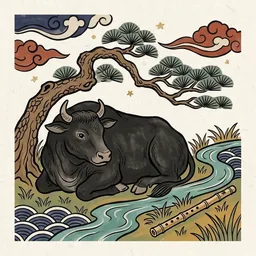
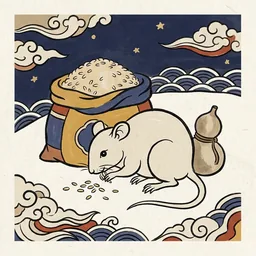
The clash, chung in Korean (冲, the branch directly opposite on the wheel), is with the Ox (丑). Both signs are earth, but the Ox is cold, wet winter soil and the Goat is warm, dry summer soil, so you often value the same things, security and loyalty above all, yet pursue them in opposite ways. Named openly, that difference can make a sturdy partnership. The Rat (子) is your wonjin (怨嗔), a folk 'resentment' pairing of two signs that tend to misread each other's small habits. An old verse sums it up in one image, 鼠忌羊頭角, 'the rat dislikes the goat's horns'. In practice it describes irritation, not doom. None of these pairings decides a relationship on its own; a full birth-chart reading looks at far more than the year.
Work and Money
At work you tend to be the steady hand who makes things run smoothly and look right. You do your best with a clear role, reasonable deadlines and colleagues you trust, and you often shine where care meets craft: design, editing, teaching, hospitality, nursing and care work, gardening, cooking, or any team role where someone has to notice what others miss. You are a natural collaborator rather than a lone competitor, and managers come to rely on your follow-through. Loud office politics drain you; in a workplace that rewards whoever speaks first, your contribution can go unseen, so keep a simple record of what you have delivered.
With money, Goat people often carry two habits at once: a careful saver who keeps a cushion, and someone who spends for comfort when tired or low, on a soft blanket, a good meal or something beautiful for the home. Neither is wrong. Goats tend to feel most at ease with money when comfort is a pleasure they choose rather than something they reach for in a low moment, and when the cushion keeps growing quietly in the background.
In Korean Culture
In Korea, asking which ddi someone is offers a gentle, indirect way to work out their age without asking it outright; because the animals repeat every twelve years, the answer plus a glance is usually enough. Two people born twelve years apart share an animal and are called ddi-donggap, 'same-ddi peers', a phrase people use with some amusement when, say, a manager and a new hire turn out to share a sign. Korean media also like to name each year by the colour of its heavenly stem: wood is blue, fire red, earth yellow, metal white and water black. So the 乙未 year of 2015 was widely called the year of the blue goat, and 2027, a 丁未 year and the Goat's own, is the year of the red goat, whose outlook is covered in the 2027 forecast. Everyday speech links the animal with mildness, too: to be as gentle as a sheep, yangcheoreom sunhada, is a compliment for a calm, easy-going person.
In Japanese Culture
In Japan the sign is simply hitsuji, the sheep, and in a sheep year the New Year postcards called nengajo fill with woolly sheep, sometimes drawn in pairs or small flocks; because sheep live together in herds, they are often said to stand for a peaceful, secure household. Each eto, the Japanese word for a zodiac sign, has a guardian Buddha (mamori-honzon), and for people born in the years of the sheep and the monkey it is Dainichi Nyorai, the cosmic Buddha of esoteric Buddhism. The branch even hides in daily speech: oyatsu, the word for an afternoon snack, comes from yatsu-doki, the old name for the time around two o'clock, which fell in the hour of the sheep. One traditional reading of the character 未, found in classical explanations of the twelve branches, links it to fruit that has not yet fully ripened. And when your own animal's year comes round, you become a toshi-otoko or toshi-onna, a man or woman whose year it is.
Advice
State your preference first, then be as accommodating as you like; your kindness is worth more when people know where you stand. Choose one decision you have been circling and give it a date instead of waiting to feel sure. Keep the calm surroundings that help you think, but check now and then whether comfort has quietly become a reason to stay put. And let people look after you in return: the sheep on the hillside belongs to the flock, it is not only the one keeping watch over it.
Frequently Asked Questions
Is it the Year of the Goat or the Year of the Sheep?
Both are correct. The sign is written with the hanja 羊, which in classical Chinese covers sheep and goats alike, so English sources say goat, sheep or sometimes ram. Japan settled on hitsuji, the sheep. In modern Korean the sign is yang-ddi, and yang on its own usually means a sheep (a goat is yeomso). The art on this page shows a sheep; the meaning is the same whichever animal you picture.
Who is the best match for a Goat?
Traditionally the Pig and the Rabbit, your triad partners, and the Horse, your six-harmony partner. Pigs bring warmth and ease, Rabbits share your tact and taste, and Horses add the momentum you sometimes lack. These are tendencies rather than rules: plenty of Goats are happy with an Ox or a Rat once both sides understand where their habits differ.
I was born in January or early February. Am I a Goat?
It depends on which new year you count from. Saju, the Korean four-pillar reading of birth year, month, day and hour, starts the year at Ipchun, the Start of Spring solar term around 4 February. Many Korean families go by Lunar New Year instead, which moves between late January and mid-February. In everyday Japanese use the eto changes on 1 January. If your birthday falls before the date you go by, you belong to the previous animal, the Horse.
Is a Goat and Rat pairing bad?
No, it is a pairing to understand rather than avoid. Korean folk tradition calls it wonjin, and Chinese sources list the same two branches as a 'harm' (害) pair, but both names describe small, repeated friction, such as one person's quick, restless rhythm grating on the other's need for calm. Talking about those habits openly usually takes the sting out, and plenty of Rat and Goat friends, colleagues and couples get along well.